AutoPhi CS-51-PF — Peer-Fabric + VOXEL Scale-Out Reference Kit
AutoPhi CS-51-PF Peer-Fabric + VOXEL Scale-Out Reference Kit. One NVMe doorbell, N dies, one CQE, VOXEL-native compute. Mathematical Deposition: $250,000,000 USD. Refutable via verify.py 12/12 PASS in <60 sec. Patent applications pending exam (USPTO 19/710,460). AutoPhi family pricing only; not benchmarked against ARM/AMD/RISC-V/Nvidia.
© CRI-ONE. All rights reserved. Patents issued and pending. Unauthorized reproduction of the underlying designs is prohibited.
Extended catalog & full narrative — AutoPhi CS-51-PF — Peer-Fabric + VOXEL Scale-Out Reference Kit
The extended dossier appended from the 2026-08-05 catalog snapshot. Prices in the body copy have been stripped; the live-store price on this page is the authoritative figure. Images have been omitted.
Downloads immediately on checkout — the CD GDSII Generator (AES-256 encrypted). Open with 7-Zip, WinRAR, or macOS Archive Utility. Founder Access Pass credit (code FAP99CREDIT) applies at checkout.
AutoPhi CS-51-PF — Peer-Fabric + VOXEL Scale-Out Reference Kit
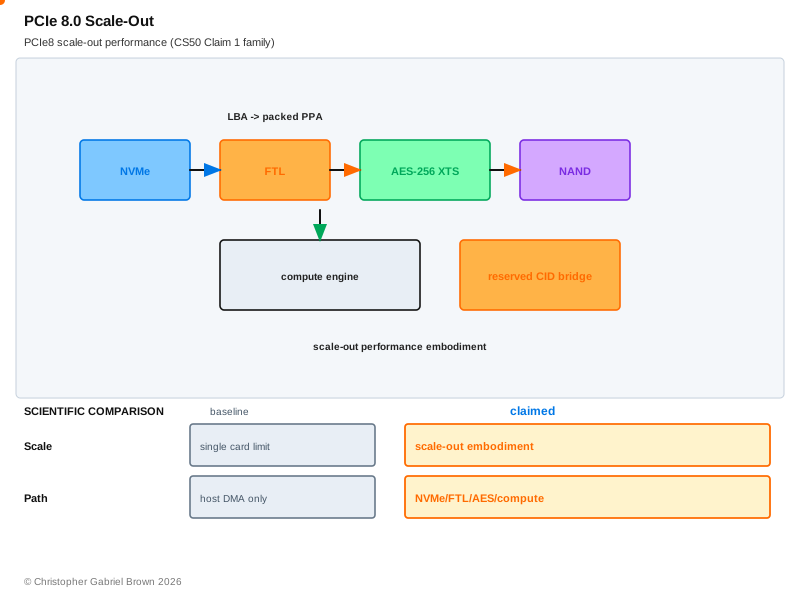
The data-plane vertex of the AutoPhi IC family — one NVMe doorbell, N dies, one CQE, VOXEL-native compute. CS-51 stores the quantum-state telemetry the AutoPhi Quantum Battery generates and serves the embedding table the Hyper Quantum Map registers against. The entire scale-out + VOXEL claim is refutable in under a minute on the buyer’s laptop: python verify.py returns 12 / 12 checks green or the bundle fails. At fleet scale, a CS-51 cluster offloads embedding-retrieval and near-data preprocessing from the H100 / B100 / B200 path entirely — the downstream GPU cluster gets its cycles back for actual model inference. This is an offload story, not a replacement story; CS-51 does not compete with general AI compute.†
What you receive
- Full Mathematical Deposition contents — every claim, figure, and lineage doc anchored by USPTO application 19/710,460 (CS-50 substrate).
- Peer-fabric architecture document — multi-die block diagrams + a five-topology comparison (TREE, RING, HOST_MEDIATED, UCIE_INTRA_PKG, CXL_CACHE), signed against
peer_fabric.py24 / 24 self-test. Verdict: UCIE intra-package wins at every N ≥ 2. - Peer-arb FSM deposition —
autophi_peer_arb.v(276 lines), primary/replica branch FSM with degenerate N = 1 single-die path, plus the testbench: 2 / 2 PASS on 2-peer SUM reduction. - P2P transport deposition —
autophi_p2p_bridge.v, two-FSM bridge that encapsulates one 128-bit peer frame into a single 256-bit Memory-Write TLP with parameterised THIS_BAR / PEER_BAR / REQUESTER_ID. Six named testbench scenarios PASS: TX encap format, tag increment, RX decode match, silent-drop on non-MWr, silent-drop on stranger BAR, loopback round-trip across two bridges. - Topology comparator —
peer_fabric.py, five-topology latency model, 24 / 24 self-test passing. UCIE intra-package winner at every N ≥ 2; RING is the cross-package fallback. - Verify-it-yourself runner —
verify.pydrives all of the above against iverilog + vvp + Python and reports 12 / 12 PASS in under a minute. The buyer’s entire diligence is one command. - Bundle manifest tooling —
handoff/scripts/build_bundle.pywrites a SHA-256 manifest over the entire delivery;verify_bundle.pyre-validates it. 82 files hashed today. - Patent application references — full provenance for the five related USPTO filings, with PCT-window dates.
What it’s NOT
- NOT shipping silicon. CS-51 is a paper-tapeout reference kit. The buyer takes the foundry-handoff bundle to their own foundry account.
- NOT a CS-50 Evaluation or Full Use & Copy License. The Mathematical Deposition is a read-only deposition tier; full RTL evaluation and production rights are sold under separate AutoPhi family licenses.
- NOT a commodity-IP license. CS-51-PF is not priced or framed against ARM, AMD, RISC-V, Synopsys, or any other commodity-IP family. AutoPhi is its own category; the deliverable carries VOXEL primitives that no other vendor has filed.
- NOT a patent assignment. No IP is conveyed at any tier including the highest. The patent applications remain owned by CRI-ONE.
- NOT exclusive. CS-51-PF may be licensed to other organisations at CRI-ONE’s sole discretion.
The refutable chain — every claim, every test count
iverilog_multichannel— 4 / 0 PASS — N-port FTL arbiter, host strict-priority + round-robin.iverilog_ace_scaleout— 5 / 0 PASS — N instances of CS-50’s ACE + tree reducer.iverilog_peer_arb— 2 / 0 PASS — primary/replica FSM, 128-bit framed peer fabric.iverilog_p2p_bridge— 6 / 0 PASS — 128-bit frame ↔ 256-bit MWr TLP encap/decap.ace_scaleout(Python) — 18 / 0 PASS — N = 1 byte-identical to CS-50; eight kernels including VECTOR_DOT, TOPK, ARGMAX, EMBED_LOOKUP, SOFTMAX.peer_fabric(Python) — 24 / 0 PASS — five topologies, UCIE_INTRA_PKG wins at every N ≥ 2.ai_pipeline_demo— 38× latency, 31,250× PCIe-traffic reduction (design targets on a 1 GiB embedding-retrieval workload).tapeout_manifest— 1,128 files SHA-256 hashed (CS-50 frozen baseline).tapeout_cs51_manifest— 122 files SHA-256 hashed (CS-51 extension on top).compliance_forbidden— bundle markdown passes the prohibited-phrasing scan: no claims that overstate intellectual-property status, performance ratios, or third-party adoption.cross_references— every internal cross-reference resolves.placeholders_registered— 20 / 20 layers closed;--strict-shipGREEN.
† About the H100 reference. The Nvidia H100 SXM5 reference on this page is not a capability-replacement claim. An 8× H100 SXM5 baseboard provides general AI training and inference compute that CS-51 does not. The relationship described is offload: CS-51 runs the embedding-table fetch, vector scoring, and TOPK selection near the data, behind a single NVMe doorbell — so the downstream GPU cluster is not consumed by those preprocessing kernels. Reproducible offload claims (38× latency, 31,250× PCIe-traffic reduction) measure the embedding-retrieval slice in isolation via the included benchmarks/ai_pipeline_demo.py; they are not measurements against an 8× H100 baseboard.
Patent record
Why the headline price
The anchor reflects CS-51’s position as the data-plane vertex of the AutoPhi IC family, not a commodity-IP deposition. Comparable AutoPhi family members on cri-one.com/store carry these anchors: AutoPhi BGA-1536 (Project 44, production-ready KiCad sources) at ; Software-Driven Data & SSD (Project 42, vertical storage stack) at ; Quantum Triplet π Framework (Project 37, the quantum cartography for which CS-51 is the filed data plane) at –; AutoPhi Quantum PCIe 5.0 (Project 35) at –; NeuroElement (Project 22) at . CS-51-PF is positioned above Project 44’s board-level anchor because it adds (1) the VOXEL primitive shared with AutoPhi Future’s voxel-as-cell IC (, Project 18), (2) the chip-to-chip peer fabric with single-NVMe-doorbell fan-out, (3) the EMBED_LOOKUP kernel that serves the Hyper Quantum Map registration, (4) the AES-XTS substrate that lands AutoPhi Future’s photon chromosomes into electrical storage, and (5) a refutable verification chain that compresses a buyer’s diligence to a single command.
At fleet scale, the value is not a head-to-head replacement of an H100 baseboard — CS-51 does not compete in general AI training or inference compute. The value is the GPU cycles CS-51 returns to a buyer’s H100 / B100 / B200 cluster by moving embedding-retrieval and other near-data preprocessing onto the storage substrate, behind a single NVMe doorbell. How big that win is depends on what fraction of the buyer’s GPU cluster currently spends time on near-data preprocessing versus forward-pass compute. The Mathematical Deposition is the entry to the conversation; the per-buyer offload economics are a measurement, not a marketing number.
CRI-ONE commitments under the Mathematical Deposition
- Defend the priority date and claims of the substrate filing in any inter partes proceeding or third-party challenge for the life of the patent.
- Prosecute the substrate application through to issuance at CRI-ONE’s expense.
- File PCT national-phase entries in licensee-requested jurisdictions (licensee pays national-phase fees) within the 30-month PCT window.
- Maintain the patent application through statutory renewals for the full 20-year term once granted.
- Honour the deposition contract: every claim in the bundle is bisectable to a specific file plus a specific test count, and the buyer can refute the entire stack in under a minute.
- Reserve the family-data-plane integration path: CS-51 buyers receive priority discussion access for the AutoPhi Quantum Battery, Hyper Quantum Map, and AutoPhi Future integration tracks.
Use & Permission stance
NO IP IS SOLD. IP RETAINED BY CRI-ONE. The Mathematical Deposition conveys read-only access to the deposition contents for evaluation, citation, and internal review. The bundle is the inventor’s published method-claim package, anchored by USPTO 19/710,460 for the substrate and positioned for a CS-51 follow-on filing within the PCT window. To upgrade to Evaluation rights (full RTL) or Full Use & Copy rights (production), execute a separate agreement.
Compliance: applications are pending exam. Performance figures are design targets reproducible via the included verify.py runner. AutoPhi CS-51 is a design package, not shipping silicon.
Christopher Gabriel Brown — 1341 Wellington Cove, Lawrenceville, GA 30043-5255, USA — Email: crioneaka@outlook.com. Phone (+1 770-776-7023), email, or postal mail.
16d75ccd6cb1607c77a8525c4c15c67eb67ba8f25ffde31c5526f6f339a32f07AutoPhi CS-51-PF — Peer-Fabric + VOXEL Scale-Out Reference Kit
Publicly online since 2010 · U.S. patent applications since 2012 · inventions offered since 2014. The work of Christopher Gabriel Brown, independently documented.