
Licensed Research: Alzheimer's Discovery -- FDA Roadmap
Where the Alzheimer's mechanism discovery sits on the real FDA approval road. Companion to the Alzheimer's Mechanism Analysis license. Educational reference; not medical advice.
© CRI-ONE. All rights reserved. Patents issued and pending. Unauthorized reproduction of the underlying designs is prohibited.
Extended catalog & full narrative — Open Research: The Alzheimer's Discovery on the Real FDA Road
The extended dossier appended from the 2026-08-05 catalog snapshot. Prices in the body copy have been stripped; the live-store price on this page is the authoritative figure. Images have been omitted.
This item is delivered by Christopher Gabriel Brown by email within 24 hours of your order. You'll receive the deliverable at the email on your order. USA delivery only. Founder Access Pass credit (code FAP99CREDIT) applies at checkout automatically.
The Alzheimer’s Discovery on the Real FDA Road
This is NOT medical advice and NOT a cure claim. It maps the Alzheimer’s Mechanism Analysis license onto the real FDA approval road, explains what happens if it is never accepted as a drug, and shows the one lawful way it can still reach people — as a dietary supplement (which by law cannot claim to treat or prevent Alzheimer’s).
|
Product |
|
|
Subject |
the Alzheimer’s Mechanism Analysis research package |
|
Stage on FDA road |
Stage 0 — Discovery / pre-IND |
|
IP posture |
Patent application #19/441,975 (per the package) |
|
Inventor |
Christopher Gabriel Brown, Lawrenceville, GA, USA |
|
Price |
— Licensed Research |
01 How to read this
Start with the master guide, then this page, then the giveaway itself:
- The True-to-Life Method of Filing an FDA-Approved Medicine — the full approval road, start to finish.
- This page — the Alzheimer’s discovery placed on that road.
- Sister companions: The Diabetes Discovery and The Parkinson’s Discovery on the Real FDA Road.
- The licensed package itself: Licensed Research: Alzheimer’s Mechanism Analysis.
All are in the Licensed Research category: cri-one.com/store/licensed-research.html.
02 What the Alzheimer’s discovery actually is
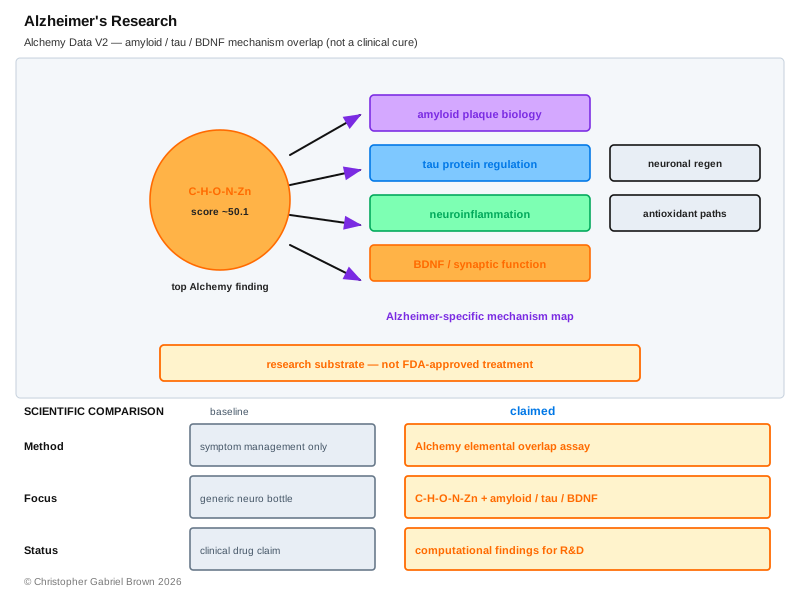
A computational discovery (Alchemy Data V2) cross-checked against three decades of AD research. Its honesty is the point — it identifies the right elements, then defends only the non-metal directions:
|
Direction |
Grade |
Role & evidence |
|
C-H-O-N-S (NAC / glutathione) |
B+ |
GSH depleted in AD brain (may precede onset); NAC crosses the blood-brain barrier. |
|
C-H-O-N-Mg (magnesium L-threonate) |
B+ |
Natural NMDA antagonist — same mechanism as approved memantine; L-threonate raises brain Mg. |
|
C-H-O-N-P (citicoline / choline) |
B |
Cholinergic support — the basis of every approved AD drug. |
|
Cu / Fe / Zn |
A (ID) / harmful |
Central to AD but they accumulate in plaques — deliberately excluded. |
The discipline that makes it credible: the formula excludes copper, iron, zinc, and aluminum, and is candid that metal-targeting drugs failed — PBT1 abandoned, PBT2 no benefit, deferiprone (2024, JAMA Neurology) lowered brain iron but worsened cognition.
Intellectual property: patent application #19/441,975 (per the package).
03 Where it sits on the FDA road
Stage 0 — Discovery & Preclinical · YOU ARE HERE (pre-IND)
Stage 1 — IND application (Form 1571) · not yet started
Stage 2 — Phase 1 / 2 / 3 trials · not yet started
Stage 3 — NDA filing (Form 356h) · not yet started
Stage 4 — FDA review + cGMP inspection · not yet started
Stage 5 — Approval decision · not yet reached
Stage 6 — Post-market · not yet reached
- Endpoints: ADAS-Cog (cognition), CDR-SB (Clinical Dementia Rating), ADCS-ADL (function); recent approvals also used amyloid-PET.
- Long, slow trials (18+ months, large enrollment) because dementia changes slowly.
- Honest catch: NAC, Mg L-threonate, and citicoline have mechanistic and small-study support, but no powered AD trial has tested this combination.
“Patent #19/441,975” is not “FDA-approved.” A patent protects the idea; FDA approval is the separate safety-and-efficacy road. AD is also the hardest field on it — most candidates fail.
04 What if there is no acceptance?
- Clinical hold — the FDA stops the IND in 30 days; trials never begin.
- Trial failure — no movement on ADAS-Cog/CDR-SB, or a safety signal. The norm in AD; only ~1 in 10 drugs entering trials is approved, and AD does worse.
- Refuse-to-File / Complete Response Letter — approval withheld pending fixes, sometimes permanently.
- No funding at all — the most likely case; 10–15 years and hundreds of millions of dollars without a pharma partner.
If any happen, three honest options remain: license/sell the patent, keep it open as licensed research, or make it as a dietary supplement — the one route that needs no FDA approval.
05 The one lawful way to make it: a dietary supplement
A dietary supplement is the only ingestible health product an independent maker can lawfully sell without FDA pre-approval (DSHEA, 1994). The trade: it may never claim to diagnose, treat, cure, or prevent a disease — “treats Alzheimer’s” or “restores memory loss” makes it an illegal unapproved drug.
- Use only legal dietary ingredients. Magnesium (incl. L-threonate) and citicoline are established. NAC is a special case — technically excluded (drug-first), but the FDA currently exercises enforcement discretion (2022 guidance), with a proposed rule (~2026) to formally permit it. Confirm current status first.
- File an NDI notification 75 days before sale for anything not sold before Oct 15, 1994.
- Manufacture under supplement cGMP (21 CFR Part 111).
- Label per 21 CFR 101 (Supplement Facts panel, ingredients, directions, warnings).
- Make only structure/function claims; include the FDA disclaimer; notify the FDA within 30 days; hold substantiation.
- Stay responsible for safety; report serious adverse events.
|
You MAY say (structure/function) |
You may NOT say (disease claims) |
|
“Supports memory and healthy cognitive function.” |
“Treats / prevents / reverses Alzheimer’s or dementia.” |
Required on every structure/function claim: “This statement has not been evaluated by the Food and Drug Administration. This product is not intended to diagnose, treat, cure, or prevent any disease.” Cognitive claims draw extra scrutiny — keep them general and honest.
Bottom line: reachable without FDA approval — but it means selling a brain-support product, not an Alzheimer’s treatment, and never naming the disease. That gap is the frustrating part.
Inquiries
Christopher Gabriel Brown — Inventor & Licensor
crioneaka@outlook.com ·
1341 Wellington Cove, Lawrenceville, GA 30043-5255, USA
Related work by the same author: Chemical Cooker Laboratory — cri-one.com/store/chemical-cooker-laboratory.html
Educational only. Not medical, legal, or regulatory advice; not a claim that any compound is a cure; not affiliated with or endorsed by the FDA or USPTO. The discovery is supplement-grade research, not an FDA-approved drug. Dietary-supplement rules (DSHEA, NDI, 21 CFR 101/111) and the NAC enforcement-discretion policy change over time — confirm current requirements with the FDA and qualified counsel before manufacturing or labeling anything. Do not self-treat; consult a licensed physician. USA buyers only; sales subject to Georgia (Gwinnett County) law.
© 2026 Christopher Gabriel Brown. All rights reserved. “Cri-One” and “Licensed Research” are product designations of the licensor. Patents retained; not sold.
5006de02d7842c78ded1f693bc1ef8314c46e0098038ad9bceaabc3b809d473e
Licensed Research: Alzheimer's Discovery -- FDA Roadmap
Publicly online since 2010 · U.S. patent applications since 2012 · inventions offered since 2014. The work of Christopher Gabriel Brown, independently documented.