
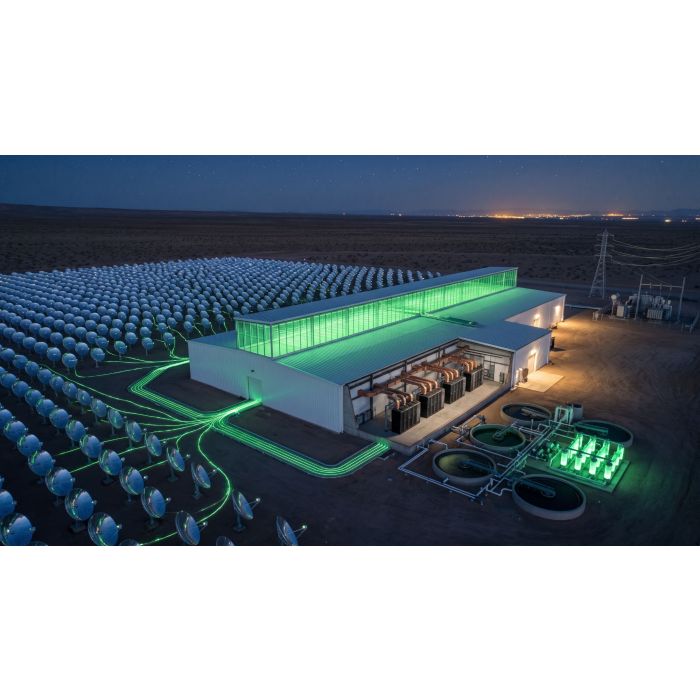
QRS-118 Compute Reactor Blueprint
Project 118. The reactor series with the processor put back in as the primary output. Same hardware as QRS-117, configured compute-first: twenty exa-operations per second to the scheduler, fifteen megawatts back to the grid, small-community AERS. U.S. patent-pending 19/865,419 + 19/865,443. Non-exclusive. One license covers all three configurations (real-solar, synthetic, hybrid) and both orientations (QRS-117 electricity-primary, QRS-118 compute-primary).
QRS-118 Compute Reactor Blueprint
Project 118. The reactor series with the processor put back in as the primary output. Same hardware as QRS-117, same patent coverage, same engine; configured so that twenty exa-operations per second of compute is what the facility is sized to, with electricity and environmental restoration as the byproducts a well-sited facility needs to be a good neighbor.
What the blueprint covers
- The reactor engine, unchanged. Solar-pumped laser array (parent claim 2), or synthetic-photonic primary catalyst of grid-electric laser-diode or LED modules at 100 kilowatts aggregate or more, 400 to 1,100 nanometer wavelengths, twenty-four-hour continuous operation (CIP claim 26(b)), or the hybrid scheduler that selects between them (CIP claim 27).
- The compute vault, built out to full density at commissioning. Ten thousand parent-claim-1 compute dies on a thermal-expansion-compensated baseplate not exceeding 0.1 parts per million per kelvin (CIP claim 26(e)). Three-wave Fabry-Perot cavity on CMOS per die. Hierarchical controller fabric with per-die loop-gain tensor and first-law alarm (CIP claim 26(d)).
- Microwave klystron bank. Industrial-scientific-medical frequency band, one megawatt or more of continuous-wave microwave power (CIP claim 26(c)).
- Dual-role output stage, sized compute-first. One hundred megawatts consumed on-site by the compute vault at full load; approximately fifteen megawatts exported to grid and nearby service; small-community AERS cluster for the facility and nearby residents (CIP claim 26(g), compute-primary configuration within the claim's scope).
- Chip-to-chip optical interconnect fabric sized for twenty-exaOPS continuous compute, using the three-wave die output at wavelengths from the dependent-claim group (405, 445, 488, 520, 638, 808, 980, or 1,064 nanometers).
- Multi-stage photovoltaic cascade for scattered-photon recovery, four or more junctions of successively decreasing bandgap (CIP claim 26(f)).
- Brownfield siting playbook for conventional industrial building shells (CIP claim 33), footprint under 0.5 hectares where the site plan requires (CIP claim 31).
Why Project 118 is its own listing
Project 117 (QRS-117 Quantum Electric Reactor Blueprint) is the same hardware configured for utility, municipality, and grid-operator buyers who are buying megawatts delivered to the grid. Project 118 is the same hardware configured for AI labs, hyperscalers, and defense compute facilities who are buying exaop-seconds of compute delivered to a scheduler. One listing per market orientation reads more clearly than one listing with every configuration listed four ways.
License posture
Non-exclusive, worldwide, U.S. patent-pending under 19/865,419 and 19/865,443 (filed 2026-11-06). One license covers all three configurations (real-solar primary, synthetic-primary all-electric, hybrid) and both orientations (electricity-primary a.k.a. QRS-117, compute-primary a.k.a. QRS-118). A buyer who takes Project 118 at this ask is licensed to build and operate either orientation, or a hybrid industrial site that serves both markets from one facility.
Reduction to practice
The parent application's 41,931 SKY130-cell synthesis of the compute die and the 2026-11-06 RTL build (31,601 cells / 0.30 square millimeters on SKY130) carry forward unchanged.
What ships with the blueprint
Specification, claim-mapped drawings (parent eight figures plus the CIP addenda), site plan for compute-primary configuration, chip-to-chip optical fabric sizing worksheet, scheduler priority ruleset, AERS cluster sizing for small-community footprint, brownfield-siting playbook, and the license. Delivered as an engineering blueprint and data set, not as a fabricated facility.