
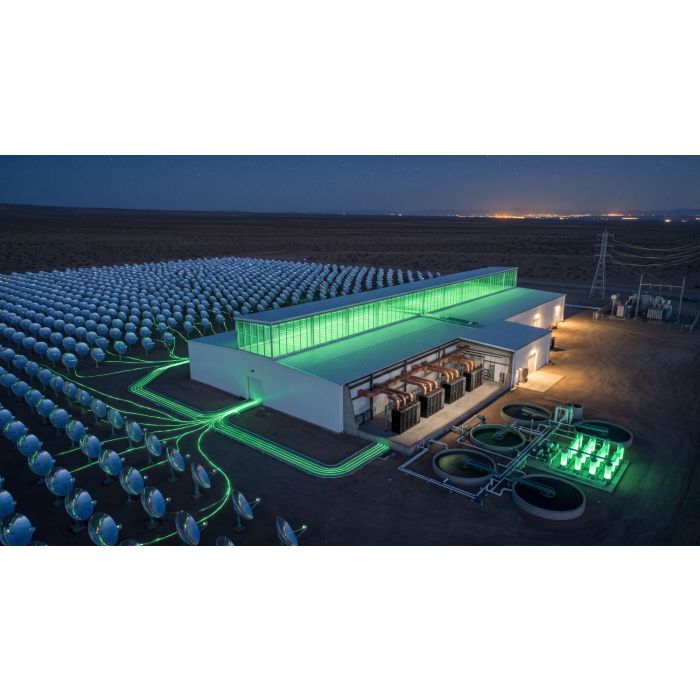
QRS-117 Quantum Electric Reactor Blueprint
Picture a stadium-sized facility that computes and cleans the environment at the same time. On one side of the building, ten thousand of the compute-core chips are stacked in a vault; between them, twenty exaflops of arithmetic — enough work per second to make every data center alive today look part-time — is happening in silence, at room temperature, with no cooling towers hissing outside. On another side, the same engine that drives the chips is scaled up to warehouse size: solar-pumped lasers in a mirror field pour green light into fiber trays, synthetic LEDs fill in whenever the sun doesn't, and microwave klystrons add the last stage of amplification. The waste products are water pulled clean of heavy metals, air pulled clean of pollutants, and coral reefs rebuilt from the carbon captured along the way — an Environmental Restoration System that serves fifty to two hundred thousand people on the land next to the compute. The blueprint comes in three configurations — real-solar primary, synthetic-primary all-electric, and hybrid — and one license covers all three. It is the facility-scale embodiment of the same engine that lives in QRS-116.
What this is. An engineering blueprint and reduction-to-practice data set for a reactor-scale compute facility, covered by U.S. patent-pending applications 19/865,419 (parent — reactor-scale compute facility, filed 2026-11-06) and 19/865,443 (continuation-in-part — synthetic-primary and hybrid variants, filed 2026-11-06). The facility is a datacenter, a power plant, and an air-and-water treatment plant sharing one physical substrate, with the inventor's compute core (QRS-116) replicated at approximately 10,000-die count inside the cavity hall.
Available in three configurations.
(1) Real-solar primary variant. On-site solar concentrator mirror field (1,000 to 10,000 parabolic mirrors, 1.5 meters each, on dual-axis trackers) feeding chromium-codoped or cerium-codoped Nd:YAG laser crystal rods at 4-10 percent sun-to-laser conversion efficiency. Zero electrical input at the pump stage. Preferred for desert-sited installations with annual mean solar insolation of 1,500 kilowatt-hours per square meter per year or higher. Footprint approximately 2 hectares.
(2) Synthetic-primary / all-electric variant. No solar concentrator field. Indoor high-power laser-diode bank or light-emitting-diode wall at 100 kilowatts to 5 megawatts aggregate optical output, grid-electric powered, operating twenty-four hours per day uniformly regardless of time of day, cloud cover, or season. Preferred for northern-latitude, urban-infill, indoor, or colocation installations where solar siting is impractical. Footprint approximately 0.5 hectares.
(3) Hybrid solar + synthetic variant. Both pump sources combined. The hierarchical controller fabric selects between solar-pumped laser and synthetic-photonic primary catalyst as a function of instantaneous solar insolation, time of day, cloud cover, seasonal projection, and compute demand. Preferred where land is available for a mirror field and 24/7 uniform output capability is also required.
All three configurations share the same compute core (per QRS-116), microwave klystron bank at 2.45 gigahertz unlicensed ISM band, optional electrochemical fourth catalyst, cavity hall with Zerodur baseplate, five-stage photovoltaic cascade, Peltier back-plane, hierarchical controller fabric with coupling-matrix g_ij measurement and first-law alarm, and dual-role output stage.
IC-level engineering (the chip inside the reactor). Each of the approximately 10,000 dies in the cavity hall is a three-wave Fabry-Perot cavity on complementary metal-oxide-semiconductor (CMOS), covered by parent claim 1. Reduction to practice is on record: the parent application's 41,931-cell synthesis on the SkyWater SKY130 open process design kit, and the 2026-11-06 register-transfer-level (RTL) build of the controller fabric on the OSS CAD Suite at 31,601 standard cells in 0.30 square millimeters on SKY130, with simulation verifying the per-die loop-gain tensor measurement and the first-law alarm assertion (what the simulation confirms is the controller behavior, not over-unity power generation). The RTL is portable to any SKY130-compatible foundry flow and ports forward to higher-density process design kits on a straightforward tech-node migration. The full die engineering package — three-wave Fabry-Perot cavity design, cell-level netlist, controller fabric RTL, coupling-matrix measurement block, first-law alarm block, and the safe nuclear option using Ni-63 / C-14 / Am-241 at smoke-detector-grade activity levels — is itself available as the standalone QRS-116 Compute Core Blueprint, shipped under the same patent-pending coverage.
Dual-role output (all configurations). Compute throughput of approximately 20 exa-operations per second — on the order of ten times Frontier (Oak Ridge, 1.7 exaFLOPS) at roughly one-quarter the per-watt energy. Electrical export of 10 megavolt-amperes at 34.5 kV. Air processing of 10,000,000 m³/day per module at 99.7 percent capture for 0.1 μm particulates. Water processing of 500,000 to 2,000,000 gallons/day per module to U.S. EPA Class A reclaimed-water standards. Service population of 50,000 to 200,000 people per installation.
Regulatory posture. Standard commercial power, FCC unlicensed spectrum, and municipal environmental permitting. No Nuclear Regulatory Commission involvement. No International Atomic Energy Agency involvement. No radioactive-material supply chain. The electric pivot was made on day one of the project (2026-11-05): zero conversion losses in the primary catalyst, full consumer-municipal market access.
Target buyers. Hyperscalers with nuclear-adjacent-datacenter demand (Microsoft, Amazon Web Services, Google Cloud, Meta, Oracle), national laboratories with exa-class compute mandates, sovereign governments executing industrial policy, electrical utilities, and municipal environmental agencies. The combination of exa-class compute and municipal environmental restoration on one substrate is the facility's public-service deliverable, and the compute customer's power-purchase agreement is the capital-cost mechanism. The three-configuration bundle removes the "will this site work for us?" friction — buyers in any geography, any insolation regime, any land-availability situation have a configuration that fits.
Priority. The inventor's 2017 dated disclosure of invention #123 ("imagine space travel that is so successful that over a long or short time we are able to store data in space itself"), nine years ahead of post-2017 reservoir-computing-at-scale citations. The synthetic-primary variant additionally anchors to the inventor's Project 115 Synthetic Electro-Photosynthesis architecture (publicly deployed on this catalog as the SYNTH-PHOTOSYNTHESIS product).
License posture. Non-exclusive. The license to this engineering blueprint covers all three configurations; the licensee selects which configuration to build. Facility CAPEX band \$60-160M (real-solar) or lower (synthetic-primary, smaller footprint) is in addition to the license fee (the buyer builds on top of the right-to-build). Contact christopher\@cri-one.com. U.S. patent-pending.