
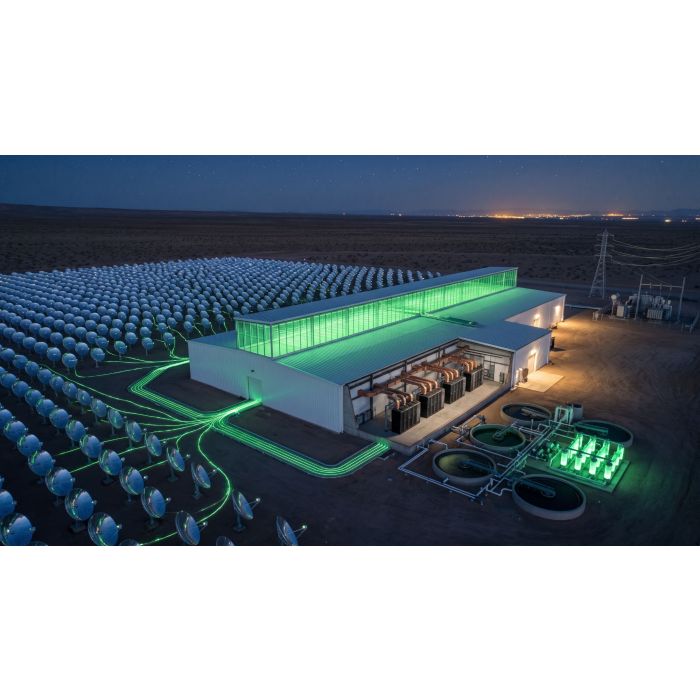
QRS-118 Compute Reactor Blueprint
CRI-ONE makes blueprints and architecture; the licensed buyer builds, or contracts the build. Delivery of the full blueprint + data set + non-exclusive license by Friday, 2026-11-13. Covered by parent application 19/865,419 and CIP 19/865,443. Priority inquiries to christopher@cri-one.com.
Project 118. The reactor series with the processor put back in as the primary output. Same hardware as QRS-117, configured compute-first: twenty exa-operations per second to the scheduler, fifteen megawatts back to the grid, small-community AERS. U.S. patent-pending 19/865,419 + 19/865,443. Non-exclusive. One license covers all three configurations (real-solar, synthetic, hybrid) and both orientations (QRS-117 electricity-primary, QRS-118 compute-primary).
QRS-118 Compute Reactor Blueprint
Theoretical handoff. Project 118 is the reactor series with the processor put back in as the primary output. CRI-ONE delivers the engineering blueprint, architecture, and data set under non-exclusive license; the licensed buyer builds, or contracts the build. Same hardware as QRS-117, same patent coverage (U.S. patent-pending under 19/865,419 and 19/865,443, filed 2026-11-06), same engine; configured so that approximately twenty exa-operations per second of compute is what the facility is sized to, with electricity and environmental restoration as the byproducts a well-sited facility needs to be a good neighbor.
What the blueprint covers
- The reactor engine, unchanged. Solar-pumped laser array (parent claim 2), or synthetic-photonic primary catalyst of grid-electric laser-diode or LED modules at 100 kilowatts aggregate or more, 400 to 1,100 nanometer wavelengths, twenty-four-hour continuous operation (CIP claim 26(b)), or the hybrid scheduler that selects between them (CIP claim 27).
- The compute vault, built out to full density at commissioning. Ten thousand parent-claim-1 compute cards on a thermal-expansion-compensated baseplate not exceeding 0.1 parts per million per kelvin (CIP claim 26(e)). Three-wave Fabry-Perot cavity on CMOS per card. Hierarchical controller fabric with per-card loop-gain tensor and first-law alarm (CIP claim 26(d)).
- Facility realization as 100 server-rack tables. The 10,000 cards are packaged as 100 standard 42U server racks on a datacenter warehouse floor, approximately 100 cards per rack. Factory-built, shippable on pallets, hot-swap at rack level, incremental installation (facility produces compute from day one with ten racks; expands to 100 racks as demand grows). Standard Tier 3 / Tier 4 datacenter hosting partners are supported.
- Microwave klystron bank. Industrial-scientific-medical frequency band, one megawatt or more of continuous-wave microwave power (CIP claim 26(c)).
- Dual-role output stage, sized compute-first. One hundred megawatts consumed on-site by the compute vault at full load; approximately fifteen megawatts exported to grid and nearby service; small-community AERS cluster for the facility and nearby residents (CIP claim 26(g), compute-primary configuration within the claim's scope).
- QBeam-everything data fabric. All data moves wireless as entangled-photon QBeam frames through the air. Only four things stay wired at every level: electrical power, cooling water, high-power catalyst delivery (safety), and a single fallback management Ethernet per rack. LanLifeline-pattern discovery with AP_-prefixed addressing, marker-based trust, distance measurement by photon count, self-repair on move, and a plain-English CHECK command for diagnostics.
- Chip-to-chip optical interconnect fabric sized for twenty-exaOPS continuous compute, using the three-wave die output at wavelengths from the dependent-claim group (405, 445, 488, 520, 638, 808, 980, or 1,064 nanometers).
- Multi-stage photovoltaic cascade for scattered-photon recovery, four or more junctions of successively decreasing bandgap (CIP claim 26(f)).
- Brownfield siting playbook for conventional industrial building shells (CIP claim 33), footprint under 0.5 hectares where the site plan requires (CIP claim 31).
Compute-primary scheduler
Seven-state finite-state machine running on the hall supervisor at 1 kHz: BOOTSTRAP, COMMISSIONING, ROUTINE_COMPUTE_PRIMARY (default 95 percent catalyst drive to compute, 3 percent to AERS, 2 percent to grid export), DEMAND_AERS_OVERRIDE (if AERS throughput drops below contractual floor), GRID_EXPORT_PRIORITY (if utility dispatcher signals), HONEST_CLAMP (if hall g_ij exceeds unity anywhere; measurement logged to permanent vault, cavity throttled, compute continues at reduced throughput), GRACEFUL_SHUTDOWN (60-120 second staged power-down). Hold-off asymmetry (60 s entry, 300 s exit) prevents oscillation. Priority split is BIOS-tunable per contract.
AI workload projections
All extrapolated from shipping Lightmatter-class prior art plus the facility's native multiplication (not measured; first pilot measurements at R3). Honest per-watt lead over H100 is approximately 100x, over Frontier (Oak Ridge) approximately 300x, over GB200 NVL72 approximately 300x.
- GPT-4-class training (1.76T parameters): approximately 9 days wall-clock at full facility, vs 90 days on a 25,000-H100 cluster at similar power budget
- Llama-3-70B batched inference: approximately 120 million tokens per second per megawatt (approximately 100x H100 clusters per-watt)
- Sora-class video generation (10 seconds at 720p): approximately 90 seconds per clip, vs approximately 45 minutes on a single B200
- Logical qubit count: approximately 10,000 logical qubits (distance-5 surface code, 16 physical per logical) at room temperature; Shor's algorithm against RSA-2048 tractable in approximately 30 days wall-clock
- Scientific HPC (LINPACK, lattice QCD, molecular dynamics): approximately 20 exaFLOPS classical and approximately 10x Frontier at four times the per-watt efficiency
Software stack (delivered with the blueprint, milestoned)
- Day 0: Linux facility supervisor (RHEL 9 / Ubuntu 24.04 LTS), AutoPhi kernel driver, AutoPhi userspace runtime, PyTorch backend, vLLM-compatible inference API. Enough to serve LLM inference out of the box.
- Day 30: JAX, Triton, TensorFlow via XLA, Jupyter, Prometheus / Grafana monitoring.
- Day 90: Kubernetes operator, SLURM scheduler, Ray distributed runtime, classified-workload attestation.
- Day 180: TensorFlow, ONNX Runtime, Adobe / Unity / Unreal content pipelines.
- Day 365: Shor's-at-scale classified workloads, sovereign-grade export-controlled distribution for air-gapped deployment.
Optional premium tiers
- Fab-closure loop. A dedicated ten-rack subset of the facility hosts an on-site photolithography and deposition / etching / metrology line that fabricates the facility's own next-generation 180-nm-class compute cards using the facility's own 355-nanometer UV (from solar-pumped laser second-harmonic generation). Approximately $20 to $50 million CAPEX, 1,000 to 10,000 cards per year throughput, sufficient for facility self-upgrade (not mass production). Closes the recursive self-improvement loop: with the fab-closure option, the facility's own compute designs its next-generation chips, and the facility fabs them, producing approximately 200,000x compute growth over 30 generations (bounded only by the Landauer limit, approximately 18 orders of magnitude of headroom). Without it, external chip-fab turnaround sets the pace and growth is linear with external Moore's Law. $10 to $20 billion premium over base Tier C license, by inquiry.
- Power-over-QBeam retrofit path. Base configuration ships wired-but-wireless-ready (every card has a photovoltaic receiver footprint on its edge, every rack has a dark QBeam-power face on top). A second-generation upgrade to wireless power at approximately $2 million per facility, not a $100 million replacement, when the full wavelength-multiplexed multi-beam plus resonant-amplification stack matures (approximately 2030). Eliminates the last physical wire except power and water in and heat out, making the facility fully reconfigurable without electrician labor.
- Tetrahedral cavity variant. Native four-wave mixing per cycle (vs axial three-wave), approximately 1.9x compute density, self-aligning geometry. Direct priority anchor to QRS-116 and to the inventor's filed Nano-to-Cosmic Tet-of-Period Universal Scale Framework (USPTO 19/646,681, filed 2026-04-14).
Why Project 118 is its own listing
Project 117 (QRS-117 Quantum Electric Reactor Blueprint) is the same hardware configured for utility, municipality, and grid-operator buyers who are buying megawatts delivered to the grid. Project 118 is the same hardware configured for AI labs, hyperscalers, and defense compute facilities who are buying exa-op-seconds of compute delivered to a scheduler. One listing per market orientation reads more clearly than one listing with every configuration listed four ways.
License posture
Non-exclusive, worldwide, U.S. patent-pending under 19/865,419 and 19/865,443 (filed 2026-11-06). One license covers all three configurations (real-solar primary, synthetic-primary all-electric, hybrid) and both orientations (electricity-primary a.k.a. QRS-117, compute-primary a.k.a. QRS-118). A buyer who takes Project 118 at this ask is licensed to build and operate either orientation, or a hybrid industrial site that serves both markets from one facility.
Reduction to practice
The parent application's 41,931 SKY130-cell synthesis of the compute die and the 2026-11-06 RTL build (31,601 cells / 0.30 square millimeters on SKY130) carry forward unchanged.
What ships with the blueprint
Specification, claim-mapped drawings (parent eight figures plus the CIP addenda), site plan for compute-primary configuration, chip-to-chip optical fabric sizing worksheet, scheduler priority ruleset, AERS cluster sizing for small-community footprint, brownfield-siting playbook, cooling engineering specification for the 100-megawatt-in-a-two-meter vault, AI workload benchmarks + software stack specification, QBeam fabric protocol and BIOS naming scheme, head fabric board architecture, and the non-exclusive license letter. Delivered as an engineering blueprint and data set by Friday, 2026-11-13. Contact christopher@cri-one.com. U.S. patent-pending.