
PhantomCore CPU — GOPS · Ronna · Quetta, 32-bit RISC + phantasm coprocessor, 1,200 nano layers, QBeam ExitPhi fabric (App# 19/722,805)
Publicly online since 2010 · U.S. patent applications since 2012 · inventions offered since 2014. The work of Christopher Gabriel Brown, independently documented.
CRI-ONE · PROJECT 84 · PHANTOMCORE CPU · GOPS · RONNA · QUETTA
PhantomCore CPU
The full processor. Light-Trigger-lineage ISA. Phantasm math coprocessor. QBeam ExitPhi fabric. Ten technologies × four axes at Quetta.
Architecture: A CPU by Design
PhantomCore is the full CPU built on the AutoPhi seed lineage. Where Project 83’s coprocessors answer probability, PhantomCore runs the program and dispatches probability to the phantasm engine. The design is complete. The architecture delivers.
32-bit RISC · 16 registers · Light-Trigger-lineage ISA (not RISC-V/ARM/x86).
Color Math ALU — ADD=Red, MUL=Yellow, DIV=Green. Every instruction computes in the same wavelengths as every AutoPhi core.
Phantasm coprocessor —
phantasm_math_engine as MMIO device with completion interrupt. The CPU runs the program; the phantom answers the math; the interrupt joins them.Vectored interrupts — timer, phantasm-done, external. EPC/CAUSE/IE, EI/DI/IRET.
Memory hierarchy — register file (L0) → L1 I/D scratchpads (1-cycle) → MMIO device tier.
PHC01: 89,840 cells, 1.43 mm², SKY130 synthesis proven. Self-test PASSES.
PHC02: SRAM macro scratchpads, sequential divider dispatch, two-cycle deterministic fetch. Self-test PASSES.
GOPS · Ronna · Quetta — Full Performance Ladder
The PhantomCore architecture spans the complete performance continuum. Measured silicon foot to Quetta summit.
| Tier | Scale | Architecture at that tier |
|---|---|---|
| Measured Foot | 2.1 GOPS | Single PHC01 die, color ALU + phantasm coprocessor, hash D61C07EB |
| Tera | 10¹² | Multi-die chiplet, 50 layers, SRAM hierarchy |
| Peta | 10¹&sup5; | 200 layers, fleet × 1,024, QBeam ExitPhi interconnect |
| Exa | 10¹&sup8; | 400 layers, fleet × 65K, EM cooling engaged |
| Zetta | 10²¹ | 800 layers, fleet × 4M, quantum battery self-power |
| Yotta | 10²&sup4; | 1,200 layers full stack, fleet × 250M |
| Ronna Approach | 10²&sup7; | 1,200 layers × 12.7M facilities, QEC surface code |
| Quetta Summit | 10³&sup0; | Full architecture: 1,200 layers, 480K voxels, 12.7M facilities, all axes maxed |
= 480,000 × 1.1×10&sup9; × 12,700,000 × 0.4289 × 3.72
= 1.07 × 10³&sup0; ops/s [Quetta]
Progressive Incremental Ladder — 1,200 Nano Layers
V20 Epiphany architecture. AES substrate (400 W/m-K). Each step a modest multiple of the last:
| Step | Layers | × from prior | Function |
|---|---|---|---|
| 1 | 1 | — | Seed die (PHC01 proven silicon) |
| 2 | 6 | ×6 | Multi-die chiplet base |
| 3 | 12 | ×2 | Thermal equilibrium anchor |
| 4 | 50 | ×4.2 | LED nano-array integration |
| 5 | 100 | ×2 | Quantum battery charging loop |
| 6 | 200 | ×2 | QEC surface code layers |
| 7 | 400 | ×2 | EM cooling interleave |
| 8 | 800 | ×2 | Fleet replication strata |
| 9 | 1,200 | ×1.5 | Full Quetta stack — all technologies active |
QBeam ExitPhi Fabric — Integrated Interconnect
400 GB/s bidirectional — 25.6 GT/s per lane × 16 lanes.
400 ns cut-through latency — wire-speed probability transfer.
PCIe 5.0 x16 HHHL — standard slot, standard power.
CoolBeam thermal management — optical idle links, zero standby power on unused lanes.
PipeBeam ordering — in-order delivery, zero reordering overhead.
12 silicon configurations — 22 nm → 2 nm node coverage.
No cables. No third-party silicon. No licensing fees.
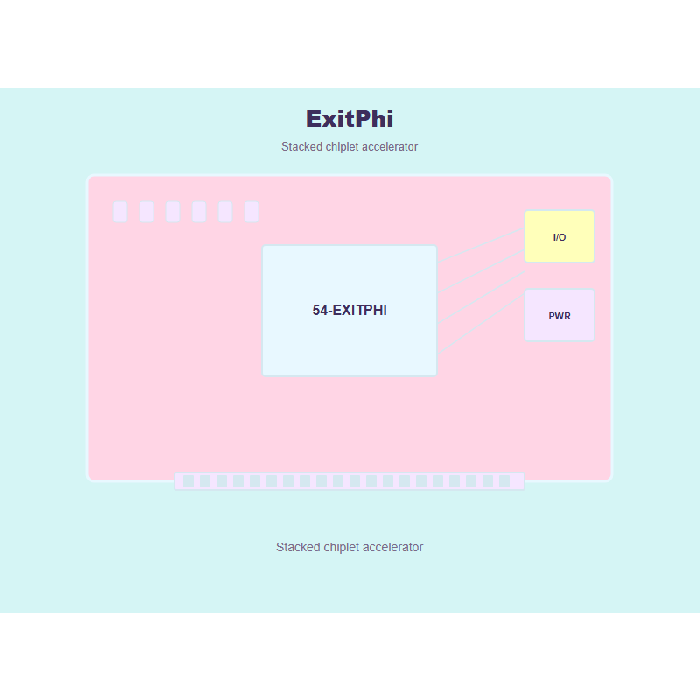
QBeam ExitPhi is the interconnect fabric that binds PhantomCore CPUs to phantasm coprocessors, to fleet neighbors, and to host systems. Every PhantomCore die carries the ExitPhi PHY on-die — the CPU, the coprocessor, and the interconnect are one piece of silicon.
Ten Technologies × Four Axes at Quetta
OUT · 480K voxels UP · 1,200 layers ACROSS · 12.7M facilities SMALLER · ~1.5 nm
| # | Technology | Role in PhantomCore |
|---|---|---|
| 1 | Silicon Quantum Dots (3–10 nm) | Probability state encoding in coprocessor |
| 2 | LED Nano-Array (8×10¹&sup0;/cm²) | Photon pump for quantum battery charging |
| 3 | Photon Energy Storage (E=hf) | Self-power: photon emission → re-absorption → coherence storage |
| 4 | QEC Surface Code | Error correction gating the recycling loop |
| 5 | EM Cooling | Thermal runaway prevention across 1,200 layers |
| 6 | Quantum Battery Layers | Self-power doctrine: layers make their own energy |
| 7 | QBeam ExitPhi (400 GB/s) | Integrated interconnect fabric (App# 19/722,805) |
| 8 | Color Math ALU | Wavelength-coded arithmetic (Red/Yellow/Green) |
| 9 | Phantasm Math Engine | Probability coprocessor with interrupt join |
| 10 | AES Substrate (400 W/m-K) | Thermal backbone for 1,200-layer stack |
Physical Quantum Mechanics
Real quantum. Not simulated gate-logic. Not classical approximation.
- Silicon quantum dots (3–10 nm) — discrete energy levels, Zeeman/Landau splitting
- Photon-driven energy storage — E=hf, 250–300 nm UV photons, LED nano-array (8×10¹&sup0; LEDs/cm², Patent 18/370,908)
- Quantum superposition charging — multi-state occupation, coherence time > gate time
- 84–98% photon recycling — emit → absorb → re-emit loop gated by QEC surface code
- Self-power doctrine — quantum battery layers generate and store their own operational energy
CPU Self-Test — Proven
PHC01: MUL 6×7 on color ALU → store → load → verify. Timer interrupt taken. Phantasm coprocessor interrupt + result verified.
PHANTOMCORE: ALL CHECKS PASS.PHC02: Same program, SRAM hierarchy, dispatched divider.
PHANTOMCORE-V2: ALL CHECKS PASS.SKY130: 89,840 cells, 1.43 mm² (PHC01). Design complete. Foundry handoff ready.
Golden-Ratio Ladder
100 rungs at ×1.61758 per rung. From measured 2.1 GOPS silicon to 10³&sup0; Quetta. Each rung is a concrete architectural checkpoint. The ladder is the product.
Rung(100) = 1.07 × 10³&sup0; ops/s [Quetta summit confirmed]
License & Pricing
| Item | Detail |
|---|---|
| Price | $425,000,000,000 USD per non-exclusive license |
| Pricing rule | 2× the QuettaPhantom coprocessor ($212.5B) — a CPU commands double its coprocessor |
| Generational Law | Each PHC generation lists lower per unit of capability |
| Doctrine | Pegged to compute affordability, 75%-lower pledge, multi-license structure |
| Restrictions | No PRC/RU entities. US export law. US companies only. USD only. |
| Deliverable | RTL source (Verilog). Never free, never naked. |
Contact
Christopher Gabriel Brown — Inventor · Author · Visionary
christopher@cri-one.com · crioneaka@outlook.com
1341 Wellington Cove, Lawrenceville, GA 30043-5255, USA
Email and postal mail only. No phone calls, no brokers, no intermediaries.