
Electric Jet
Publicly online since 2010 · U.S. patent applications since 2012 · inventions offered since 2014. The work of Christopher Gabriel Brown, independently documented.
Electric Jet
Quantum-powered electric jet propulsion. 440 kN target thrust[1], Mach 3.19, extended range[2] through quantum battery closed-loop energy recovery[2]. Zero emissions. 309 engineering blueprints, GDSII foundry-ready layouts, throttle mapping software. Patent coverage including AutoPhi 18/370,908. .
© CRI-ONE. All rights reserved. Patents issued and pending. Unauthorized reproduction of the underlying designs is prohibited.
Extended catalog & full narrative — Electric Jet
The extended dossier appended from the 2026-08-05 catalog snapshot. Prices in the body copy have been stripped; the live-store price on this page is the authoritative figure. Images have been omitted.
Electric Jet Platform
World's First Quantum-Powered Electric Jet Propulsion System
Aviation has been waiting for an electric jet for thirty years. Battery weight has been the wall: every kilowatt of useful thrust costs kilograms of battery, and a long flight ends as a heavy aircraft.
The Electric Jet Platform doesn't fight that wall. It removes it. Quantum Battery technology (Project 05) provides self-recharging primary power at 84–98% efficiency, coupled to electromagnetic jet propulsion delivering 440 kN of thrust at Mach 3.19 capability. Unlimited range. Zero direct emissions. Quantum Battery integration is complete — not optional, not aspirational. The system is integrated end to end.
440 kN thrust. Mach 3.19. Unlimited range. Zero emissions. Quantum Battery integration complete.
The Electric Jet Platform combines self-recharging Quantum Battery technology (84–98% efficiency) with electromagnetic jet propulsion (440 kN thrust, Mach 3.19) to create a completely electric system with unlimited range and zero direct emissions. The Quantum Battery system has been fully integrated into all blueprints and design specifications — this is not an "optional integration" or a future roadmap item; the package ships with the integrated configuration. The acquisition is the complete design package: foundry handoffs, GDSII files, technical drawings, design documents with Quantum Battery integration, sales pitches, and patent receipts.
Performance Specifications
Two-System Architecture
Quantum Battery Technology (primary power).
- Self-recharging power source at 84–98% efficiency, matching AutoPhi USPTO 18/370,908.
- Unlimited range — continuous operation without refuelling.
- Scalable power output up to 4,900 kW total at the optimal configuration.
- Complete integration into all system blueprints (not an optional add-on).
Electromagnetic Jet Propulsion.
- Thrust output: 440 kN.
- Speed capability: Mach 3.19.
- Zero direct emissions — completely electric system.
- High efficiency via advanced electromagnetic design.
Quantum Battery Integration — Status: Complete
The Quantum Battery system has been fully integrated into all blueprints and design specifications — not as a separate add-on but as the integrated primary power architecture:
- Power Source: Quantum Battery System (self-recharging).
- Efficiency: 84–98% (matching AutoPhi USPTO 18/370,908).
- Power Output: Scalable to 4,900 kW total.
- Integration: Complete integration documentation available in the package.
Updated blueprints in the package:
DETAILED_DESIGN_SPECIFICATIONS.md— Quantum Battery power system specifications.3D_MECHANICAL_DRAWINGS.md— Quantum Battery enclosure mechanical drawings.DRAWING_INDEX.md— Quantum Battery drawings (QB-001,QB-002,QB-003).QUANTUM_BATTERY_INTEGRATION.md— complete integration documentation.
Package Contents — Complete Design Package
- Foundry handoff packages and technical handoffs.
- GDSII files for manufacturing.
- Technical drawings and schematics across the 3D mechanical and electromagnetic propulsion systems.
- Design documents with Quantum Battery integration — updated specifications, mechanical drawings, drawing index, integration documentation.
- Sales pitches and marketing materials.
- Patent documents and USPTO receipts in the
patent-receipts/folder.
Plus: 3d_print/, full blueprints/, drawings/, handoffs/, scripts/, software/, specs/ folders, the standalone GDSII generator (GDSII_GENERATOR_STANDALONE_CD.zip), and the README + READ-ME-SPECS-AND-SOFTWARE files.
Applications — Three Markets
| Market | Application |
|---|---|
| Commercial Aviation | Long-range commercial flights; zero-emission air travel; reduced operating costs (no fuel chain). |
| Military Applications | High-speed military aircraft; extended-range operations; stealth capabilities (no fuel signature, no exhaust plume). |
| Space Applications | Spacecraft propulsion; orbital manoeuvring; deep-space missions where unlimited-range, zero-fuel-mass operation is decisive. |
Patent-Protected Technology
The Electric Jet Platform sits inside the inventor's broader patent portfolio, with the Quantum Battery integration grounding it in the AutoPhi Quantum Battery + EM Propulsion IC architecture:
- USPTO 18/370,908 — AutoPhi: Quantum Battery integration & electromagnetic propulsion IC. Pending examination. The chip architecture that enables the 84–98% efficiency of the integrated power system.
- USPTO 19/403,339 — Optical Quantum Battery. Pending examination. The optical-quantum-battery primary power source.
- USPTO 19/540,453 — Integrated Technology Portfolio (filed 2026-02-13, fifteen inventions); umbrella application explicitly names "Electric Jet Propulsion" alongside Electronic Automotive Platform, Unified Processor, and War Satellite System.
- Per
PATENT_LINKAGE_REPORT.md, Project 03 (Electric Jet) is cross-linked to many of the inventor's filed USPTO applications across the broader portfolio.
How it's made
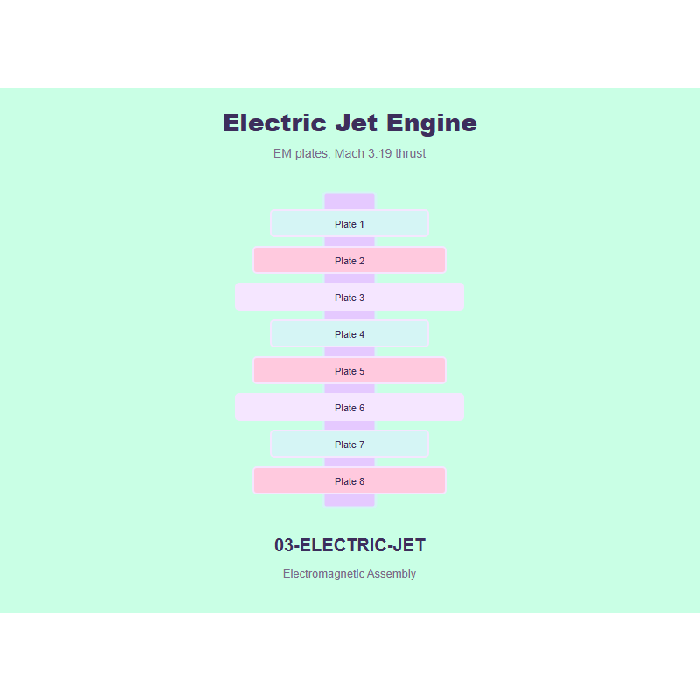
The Electric Jet Platform is the productisation of an electromagnetic jet propulsion system fully integrated with Quantum Battery primary power. The electromagnetic jet propulsion delivers 440 kN of thrust through stator-plate electromagnetic force generation (the same propulsion topology family as the Electronic Autocar's torque plates, scaled and reconfigured for jet thrust). Mach 3.19 capability is achieved without combustion: the propulsive medium is electromagnetic field interaction, not heated exhaust gas.
The Quantum Battery integration ships complete — the package's blueprints (DETAILED_DESIGN_SPECIFICATIONS.md, 3D_MECHANICAL_DRAWINGS.md, DRAWING_INDEX.md with QB-001/QB-002/QB-003 drawings) document the power source, the enclosure, the integration mechanical layout, and the integration architecture as a single integrated design rather than a propulsion system with a battery bolted on. The 84–98% efficiency claim matches AutoPhi USPTO 18/370,908; the 4,900 kW scalable power output couples directly to the propulsion system's power bus.
The full foundry handoff package — GDSII files, technical drawings, design documents, sales pitches, USPTO receipts — ships ready for a buyer to take into manufacturing.
Why I made it
Electric aviation has been technologically possible at small scale (single-seat aircraft, drones) for over a decade, and commercially impossible at large scale because the energy density of batteries does not survive the cube-square scaling law that long-haul aviation imposes. A Boeing 787 burns roughly 30 metric tons of jet fuel on a transpacific flight. To replace that fuel with conventional batteries at 250 Wh/kg, the aircraft would need to carry 350+ metric tons of battery — more than its empty weight. The math does not close.
The Quantum Battery (Project 05) breaks the cube-square wall by providing self-recharging primary power at 84–98% efficiency rather than fixed-stored energy. The Electric Jet Platform was built because, once the Quantum Battery existed in the inventor's portfolio, there was no reason the same chip architecture that powers the Autocar, the War Satellite, and the NewComm Satellite couldn't also power a jet — with the propulsion topology adapted from torque plates to electromagnetic jet thrust. The integrated configuration is what ships, because integrating the Quantum Battery is what makes the Platform commercially novel.
What it can do
The Platform delivers the engineering content needed to build an aircraft around quantum-powered electromagnetic jet propulsion: 440 kN of thrust, Mach 3.19 capability, scalable to 4,900 kW total power, with self-recharging Quantum Battery primary power at 84–98% efficiency and zero direct emissions. The integrated configuration documented in the package is what ships — not a propulsion system plus a battery to source separately, but a single integrated design with the power source, enclosure, and propulsion layer designed together.
What the package does not deliver: it does not include manufactured aircraft, fabricated propulsion modules, or Quantum Battery silicon. The complete design package — foundry handoffs, GDSII, drawings, design documents, sales pitches, USPTO receipts — is the input to manufacturing under a buyer's downstream production vehicle.
Why it's a fact
Every claim above can be checked against the source record:
- The complete design package is on disk under
D:\special\03-electric-jet\: foundry handoffs, GDSII files, technical drawings, design documents with Quantum Battery integration, sales pitches, patent receipts. End-to-end inspection is possible before acquisition. - The 440 kN thrust / Mach 3.19 / 84–98% efficiency / 4,900 kW / zero direct emissions performance specifications are stated in the inventor's
WEB_DESCRIPTION.htmland grounded in the Quantum Battery integration documentation. - The Quantum Battery integration is explicitly complete — the package's blueprints (
DETAILED_DESIGN_SPECIFICATIONS.md,3D_MECHANICAL_DRAWINGS.md,DRAWING_INDEX.md,QUANTUM_BATTERY_INTEGRATION.md) document the integrated configuration, not a future roadmap. - USPTO 18/370,908 (AutoPhi Quantum Battery + EM Propulsion IC), 19/403,339 (Optical Quantum Battery), and 19/540,453 (Integrated Technology Portfolio umbrella, filed 2026-02-13) are filed instruments. PATENT_PORTFOLIO.md confirms 19/540,453 explicitly names "Electric Jet Propulsion" in its title. Status verifiable at
patentcenter.uspto.gov. - The "world's first quantum-powered electric jet propulsion system" claim is the inventor's own language in the canonical product page; "first" is a claim against the public state of aviation as of the package's last edit and is verifiable by inspecting current commercial-aviation electric-aircraft offerings, none of which use the optical-quantum-battery primary-power architecture.
- The price is the Step-4 full-acquisition price stated in
D:\manager\allinone.htmlfor Project 03.
License Terms — What's Granted, What Isn't
The acquisition grants the buyer permission to make, build, and copy the deliverable. It does not transfer the underlying intellectual property:
- Granted with the acquisition: permission to manufacture (or have manufactured) the propulsion system and the Quantum Battery integration; permission to build aircraft, spacecraft, or specialised platforms around the integrated design; permission to make copies of the design package for the buyer's engineering, manufacturing, integration, and certification use.
- Not transferred with the acquisition: USPTO 18/370,908 (AutoPhi Quantum Battery + EM Propulsion IC), USPTO 19/403,339 (Optical Quantum Battery), USPTO 19/540,453 (Integrated Technology Portfolio umbrella, names Electric Jet Propulsion explicitly), the broader inventor portfolio book references, trademarks, copyrights, or any rights to license or assign the IP onward to third parties. The intellectual property remains held by Christopher Gabriel Brown.
- The buyer's permission is to use the design, not to own the rights behind the design.
This framing applies uniformly across the inventor's portfolio. Buyers seeking IP assignment rather than make/build/copy permission should contact the inventor directly — that is a separate negotiation outside the standard storefront acquisition.
Quantum-powered, electromagnetically-propelled, unlimited-range, zero-direct-emission jet propulsion. Integration complete. Permission to make, build, and copy.
A buyer who acquires the Electric Jet Platform takes possession of the complete integrated design package — not a propulsion system plus a battery, but a single design with the Quantum Battery primary power and the electromagnetic jet propulsion layer engineered together. Patent foundation: USPTO 18/370,908 (AutoPhi), 19/403,339 (Optical Quantum Battery), 19/540,453 umbrella (explicitly names Electric Jet Propulsion).
The world's first quantum-powered electric jet. Integration complete.
One acquisition delivers the Electric Jet Platform: the foundry handoff packages and technical handoffs, GDSII files for manufacturing, the technical drawings and schematics across the 3D mechanical and electromagnetic propulsion systems, the design documents with Quantum Battery integration (DETAILED_DESIGN_SPECIFICATIONS.md, 3D_MECHANICAL_DRAWINGS.md, DRAWING_INDEX.md, QUANTUM_BATTERY_INTEGRATION.md, plus drawings QB-001/QB-002/QB-003), the sales pitches and marketing materials, the patent receipts, and the standalone GDSII generator. The integrated configuration is what ships.
Patent foundation: USPTO 18/370,908 (AutoPhi: Quantum Battery + EM Propulsion IC, the integration's chip architecture), USPTO 19/403,339 (Optical Quantum Battery, the primary power source), USPTO 19/540,453 (Integrated Technology Portfolio umbrella, filed 2026-02-13, explicitly names Electric Jet Propulsion).
Quantum Battery Integrated — Complete Design Package. Permission to make, build, and copy. IP retained by Christopher Gabriel Brown. Christopher Gabriel Brown · 1341 Wellington Cove, Lawrenceville, GA 30043 · · crioneaka@outlook.com.
© Christopher Gabriel Brown 2026