
Electric Autocar
Publicly online since 2010 · U.S. patent applications since 2012 · inventions offered since 2014. The work of Christopher Gabriel Brown, independently documented.
Electronic Autocar Platform
Revolutionary Electromagnetic Automotive Propulsion System
Conventional electric vehicles use rotary motors. Magnetic fields turn a shaft, the shaft turns wheels, and the architecture is one century old.
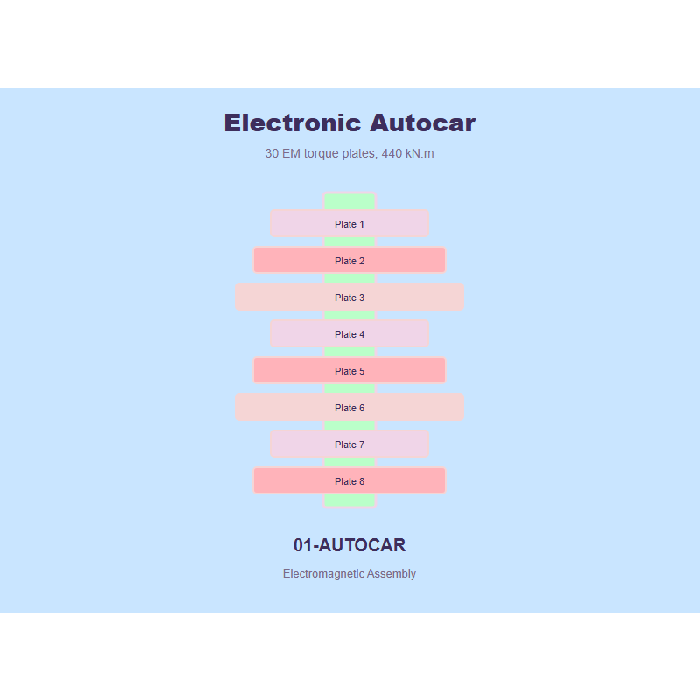
The Autocar Platform doesn't use rotary motors. It uses electromagnetic torque plates — a different propulsion topology entirely — and the result is 440 kN of torque, 300+ mph capability, and 86% efficiency at ultimate performance, in a system scalable from 1 to 50 plates and integrable with the Quantum Battery for unlimited range.
Electromagnetic torque plates instead of rotary motors. 440 kN, 300+ mph, 86% efficient. Quantum-battery-ready.
The Electronic Autocar Platform replaces conventional rotary electric motors with electromagnetic torque-plate propulsion. The plates generate exceptional power and torque density — 440 kN of torque, 300+ mph top speed, 86% efficiency at ultimate performance, 4,900 kW total power at the optimal 30-plate configuration — while the system remains fully scalable from 1 to 50 plates for any vehicle class. Quantum Battery integration is optional, providing self-recharging power for unlimited range. The acquisition is a complete engineering package with 202 documentation files plus a working software stack (Flask API, web dashboard, simulation tools).
Performance Specifications
Technology Stack
Electromagnetic Propulsion. Advanced torque-plate system providing exceptional power density and efficiency. The electromagnetic design eliminates traditional motor limitations — rotor inertia, brush wear, magnetic-field misalignment under load — enabling higher torque and power output in a compact form factor.
Quantum Battery Integration (optional). Self-recharging power source integration available. The system can be configured with the Quantum Battery (Project 05) for unlimited range and self-sustaining operation. The Quantum Battery's 84–98% efficiency (matching AutoPhi USPTO 18/370,908) couples directly to the torque-plate power bus.
Scalable Designs. Configurations from 1 to 50 plate systems, allowing precise power matching from compact city vehicles (1–5 plates) through commercial trucks (10–20 plates) to ultra-high-performance racing platforms (30+ plates) and heavy military applications (full 50-plate). Per-plate documentation in the engineering package.
Web-Based Management. Real-time monitoring and control through an integrated web dashboard. The platform includes Flask API backend and a comprehensive web interface for vehicle management and diagnostics — production-ready, not a simulation harness.
Production-Ready Code. Complete software package: Flask API, web dashboard, simulation tools, real-time monitoring system, control and diagnostics interface. All code documented and runnable from the package.
Package Contents
Complete Engineering Documentation (202 files):
- Core physics engine and motor variants.
- Complete blueprints and design specifications.
- Working sellable assembly with web dashboard.
- Complete step-by-step build instructions (
BUILD_GUIDE.md). - Comprehensive project documentation (
PROJECT_OVERVIEW.md). - Cost analysis and bill of materials (
COST_ANALYSIS.md). - Production checklist and verification procedures (
PRODUCTION_CHECKLIST.md). - Detailed design specifications (
DETAILED_DESIGN_SPECIFICATIONS.md). - Quantum Battery integration assembly guide (
QUANTUM_BATTERY_INTEGRATION_ASSEMBLY.md). - Working software product manifest (
PRODUCT_MANIFEST.md).
Software Package: Flask API backend; Web dashboard interface; Simulation tools; Real-time monitoring system; Control and diagnostics interface.
Plus: standalone GDSII generator (GDSII_GENERATOR_STANDALONE_CD.zip), 3D-print models (3d_print/), full blueprints/, drawings/, handoffs/, patent-receipts/, sales-pitches/, scripts/, software/, and specs/ folders.
Use Cases — Four Markets
| Market | Application |
|---|---|
| High-Performance EVs | 300+ mph capability for racing and performance applications; ultra-high torque for acceleration and towing; superior efficiency for extended range. |
| Commercial Automotive | Scalable configurations for various vehicle sizes; efficient power delivery for commercial fleets; cost-effective solutions for mass production. |
| Military Applications | High-power variants for military vehicles; rugged design for harsh environments; advanced control systems for tactical operations. |
| Fleet Management | Enterprise vehicle systems with centralised control; real-time monitoring and diagnostics; scalable platform for large fleets. |
Quick Start
For Software / Web Platform:
- Navigate to
blueprints/PRODUCT_PACKAGE/. - Install dependencies:
pip install -r requirements.txt. - Run:
python main.py. - Open browser:
http://localhost:8080.
For Physical Build:
- Read
blueprints/BUILD_GUIDE.md— complete build instructions. - Review
blueprints/COST_ANALYSIS.md— budget and BOM. - Follow
blueprints/PRODUCTION_CHECKLIST.md— step-by-step verification.
Patent-Protected Technology
The Autocar Platform sits inside the inventor's broader patent portfolio. Per PATENT_PORTFOLIO.md, the umbrella application explicitly names the Electronic Automotive Platform:
- USPTO 19/540,453 — Integrated Technology Portfolio (filed 2026-02-13, fifteen inventions); umbrella application explicitly names "Electronic Automotive Platform" alongside Unified Processor, Electric Jet Propulsion, and War Satellite System.
- USPTO 18/370,908 — AutoPhi: Quantum Battery Integration & Electromagnetic Propulsion IC (the cross-portfolio chip architecture that enables Quantum Battery integration into the Autocar's power bus).
- Cross-linked across the inventor's broader 1,752+-patent portfolio per PATENT_LINKAGE_REPORT.md.
How it's made
The Autocar Platform is the productisation of an electromagnetic torque-plate propulsion architecture, scaled from a 1-plate prototype through a 50-plate maximum, with the optimal 30-plate configuration delivering 440 kN of torque and 4,900 kW of total power at 86% efficiency at ultimate performance. The torque plates replace conventional rotary motors entirely; their design is documented at the physics level in the package's core physics engine, and at the engineering level in the per-plate specifications, blueprints, and BOMs.
The Quantum Battery integration (optional) is the path to unlimited range: the Quantum Battery (Project 05) provides self-recharging power at 84–98% efficiency, coupled to the torque-plate power bus through the integration assembly documented in QUANTUM_BATTERY_INTEGRATION_ASSEMBLY.md. The same chip architecture (AutoPhi USPTO 18/370,908) that powers the War Satellite, the Electric Jet, and the NewComm Satellite is the chip that powers this Autocar at the Quantum-Battery-integrated tier.
The software stack ships as production-ready code: a Flask API backend, a web dashboard, simulation tools, and a real-time monitoring and diagnostics interface. python main.py opens a working dashboard at http://localhost:8080.
Why I made it
The conventional EV motor — brushless or brushed, AC or DC, induction or permanent-magnet — is essentially a 19th-century invention plus 20th-century materials science. The torque is bounded by rotor radius and magnetic-field strength; the speed is bounded by mechanical inertia; the efficiency is bounded by losses that have been incrementally driven down for a hundred years but cannot be eliminated as long as the architecture is rotary.
The torque-plate architecture is a different propulsion topology entirely. It generates linear (or curved) electromagnetic force directly between stator plates, without the intermediate step of a spinning rotor. The result is higher torque density, higher top speed, and — coupled to the Quantum Battery — unlimited operating range. I built this Platform as the productised version of that architecture, with full engineering documentation and working software, because the conventional EV market needs an alternative architecture and the inventor's portfolio already contained the chip technology to power it.
What it can do
The Platform delivers the engineering content needed to build a vehicle around electromagnetic torque-plate propulsion at any scale from 1 to 50 plates. The 30-plate optimal configuration produces 440 kN of torque and 4,900 kW of power at 86% efficiency, with 300+ mph top-speed capability. The Quantum Battery integration (optional, documented in the package) couples the same self-recharging power architecture used by Project 05 / 04 / 03 / 19 directly to the Autocar's torque-plate power bus.
What the package does not deliver: it does not include manufactured vehicles, pre-built torque plates, or Quantum Battery silicon. The 202-file engineering documentation, the working Flask + web-dashboard software, the GDSII generator, and the integration assembly guide are the inputs to manufacturing — the buyer's downstream responsibility under whatever production vehicle they elect to use.
Why it's a fact
Every claim above can be checked against the source record:
- The 202-file
blueprints/tree, thedrawings/,handoffs/,patent-receipts/,sales-pitches/,scripts/,software/, andspecs/folders are inspectable on disk underD:\special\01-autocar-electronic-automotive-platform\. - The 440 kN / 300+ mph / 86% / 4,900 kW / 30-plate-optimal performance specifications are stated in the inventor's own
WEB_DESCRIPTION.htmland grounded in the per-plate engineering specifications in the blueprint folder. - The Quantum Battery integration documentation (
QUANTUM_BATTERY_INTEGRATION_ASSEMBLY.md, drawingsQB-001/QB-002/QB-003) is present in the package; the Quantum Battery itself is independently listed at the storefront under Project 05. - The Flask API and web dashboard are runnable:
python main.pyfromblueprints/PRODUCT_PACKAGE/opens the working dashboard. Buyers can verify before purchasing. - USPTO 19/540,453 umbrella application is on file (filed 2026-02-13, fifteen inventions; PATENT_PORTFOLIO.md confirms it explicitly names "Electronic Automotive Platform"). Status verifiable at
patentcenter.uspto.gov. - USPTO 18/370,908 (AutoPhi Quantum Battery + EM Propulsion IC) is on file and is the same patent referenced by the Quantum Battery, the Electric Jet, and the NewComm Satellite for their shared chip architecture.
- The $100B price is the Step-4 full-acquisition price stated in
D:\manager\allinone.htmlfor Project 01.
License Terms — What's Granted, What Isn't
The acquisition grants the buyer permission to make, build, and copy the deliverable. It does not transfer the underlying intellectual property:
- Granted with the acquisition: permission to manufacture (or have manufactured) torque plates, to build complete vehicles around the Platform at any plate-count configuration (1–50), to integrate the Quantum Battery into the power bus, to run the Flask + web-dashboard software, and to make copies of the design package for the buyer's engineering, manufacturing, fleet, and integration use.
- Not transferred with the acquisition: USPTO 19/540,453 (Integrated Technology Portfolio umbrella, explicitly names Electronic Automotive Platform), USPTO 18/370,908 (AutoPhi Quantum Battery + EM Propulsion IC, the chip architecture for Quantum Battery integration), the broader 1,752+-patent portfolio, trademarks, copyrights, or any rights to license or assign the IP onward to third parties. The intellectual property remains held by Christopher Gabriel Brown.
- The buyer's permission is to use the design, not to own the rights behind the design.
This framing applies uniformly across the inventor's portfolio. Buyers seeking IP assignment rather than make/build/copy permission should contact the inventor directly — that is a separate negotiation outside the standard storefront acquisition.
A different propulsion topology, productised with 202 documentation files and working software. Permission to make, build, and copy.
A buyer who acquires the Electronic Autocar Platform takes possession of the complete production-ready engineering package for an electromagnetic torque-plate propulsion architecture. Patent foundation: USPTO 19/540,453 umbrella (which explicitly names this product) plus USPTO 18/370,908 for Quantum Battery integration.
Electromagnetic torque plates. 440 kN. 300+ mph. 86% efficient. Production-ready engineering package.
One acquisition delivers the Electronic Autocar Platform: 202 files of engineering documentation (core physics engine, blueprints, design specifications, build guide, cost analysis, production checklist, detailed design specs, Quantum Battery integration assembly), the working software package (Flask API backend, web dashboard, simulation tools, real-time monitoring, control and diagnostics interface), the GDSII generator standalone, the 3D-print models, and the full drawings/, handoffs/, patent-receipts/, sales-pitches/, scripts/, and specs/ folders.
Patent foundation: USPTO 19/540,453 Integrated Technology Portfolio umbrella (filed 2026-02-13, explicitly names Electronic Automotive Platform), plus USPTO 18/370,908 for the Quantum Battery + EM Propulsion IC architecture used in the optional Quantum Battery integration.
$100,000,000,000 ($100B)
Production-ready engineering package. Permission to make, build, and copy. IP retained by Christopher Gabriel Brown. Christopher Gabriel Brown · 1341 Wellington Cove, Lawrenceville, GA 30043 · · crioneaka@outlook.com.
