
CRI-ONE HYDROPHI DATABASE
Publicly online since 2010 · U.S. patent applications since 2012 · inventions offered since 2014. The work of Christopher Gabriel Brown, independently documented.
The CRI-ONE HYDROPHI DATABASE is the complete, versioned, cross-joinable database of environmental interventions — and the entire working stack around it. One purchase delivers the 11-table intervention ledger, the four query applications that read it, the coupled-watershed simulator that verifies it, the federal live-data adapter that grounds it in today's numbers, the HydroPhi silicon blueprint engineered to host it, and the print-ready agency dossier that presents it. Every claim in the database traces to a named table row, every table row traces to a governing equation, and every equation runs in the shipped code. Commercial-grade, shipping today, first of its kind on the market.
What arrives in the download
A single archive containing five complete component packages, a top-level index, an umbrella license, and a manifest carrying a SHA-256 checksum for every file. Each component is itself complete: its own README, its own license, its own manifest, and every source file needed to run it offline. Nothing phones home. Nothing requires an account, a subscription, or an internet connection to operate.
Component 1 — The Corrective Controller Suite
Four browser applications over the full 11-table ledger, with a zero-dependency local launcher. Open the launcher, and the suite serves itself on your own machine — no install, no framework, no external calls.
- Which Phi? — the prescriber. State the symptom in plain English (“the river is dead”) and receive a one-line prescription: the actuator, the dose, the horizon.
- The corrective controller. Walks the ledger from symptom to element to reaction to hypothesis to actuator, showing its work at every step, in plain English.
- The fleet-scale calculator. Cross-joins the vocabulary, per-install, and hypothesis tables to answer: this many modules, this many years — what moves, and by how much.
- The ledger viewer. Nine-tab table browser with sort and filter across every CSV in the database.
Also inside: seven companion essays covering the unified lawn-to-ocean frame, deployment-fraction analysis, valuation and proof burden, the per-product deliverables, the per-install performance-sheet pattern, an element-by-element engineering critique, and the HydroPhi chip thesis.
Component 2 — The Multi-Actuator Cascade Simulator
A Python simulator that runs AquaPhi, AtmoPhi, OzonePhi, and HomePhi together on one shared watershed — not four isolated models, but one coupled system. Built on the reservoir-flux ordinary differential equation dR/dt = Fin(t) − R/τ: every reservoir gains mass through its sources and loses it through its sinks, and the balance sets the steady state.
- Fleet-scale runs at three shipped sizes — default, pilot, and state-scale — with captured sample output for each.
- A verification mode that checks the cross-actuator amplification claims in the cascade table against the actual fleet-ratio arithmetic. The headline cascade — one kilogram of NOx intercepted upstream unlocking 50–200 kilograms of water disinfected downstream — is not asserted; it is recomputed and passed on every run.
- JSON output for machine consumption, plain text for human reading.
- The full scenario engine: pool-to-ocean pH, nitrogen loading, PM2.5, stratospheric ozone, and residential CO2 — the five canonical scenarios, each with prescribed dosing.
Component 3 — The Live-Data Adapter
The simulator does not have to run on textbook averages. The adapter pulls today's numbers from three federal networks — anonymously, with no API keys required for the core feeds — and maps them directly onto the simulator's watershed parameters:
- USGS National Water Information System — instantaneous river discharge, temperature, dissolved oxygen, pH, and more, by gauge site, across eight parameter codes, with a documented site-pairing guide.
- EPA Envirofacts — UV index by ZIP code, anonymous; plus a documented one-step upgrade path to AirNow PM2.5, O3, and NO2 with a free key.
- NOAA Global Monitoring Laboratory — monthly-mean CO2, CH4, N2O, and SF6 trend series, plus a curated stratospheric-ozone column snapshot across five latitude bands.
Every feed degrades gracefully: offline, the adapter falls back to the bundled snapshot captured at build time, so the simulator always runs. The build-time capture is included — real river discharge, real UV, real CO2 at 428.73 ppm.
Component 4 — The HydroPhi Silicon Blueprint
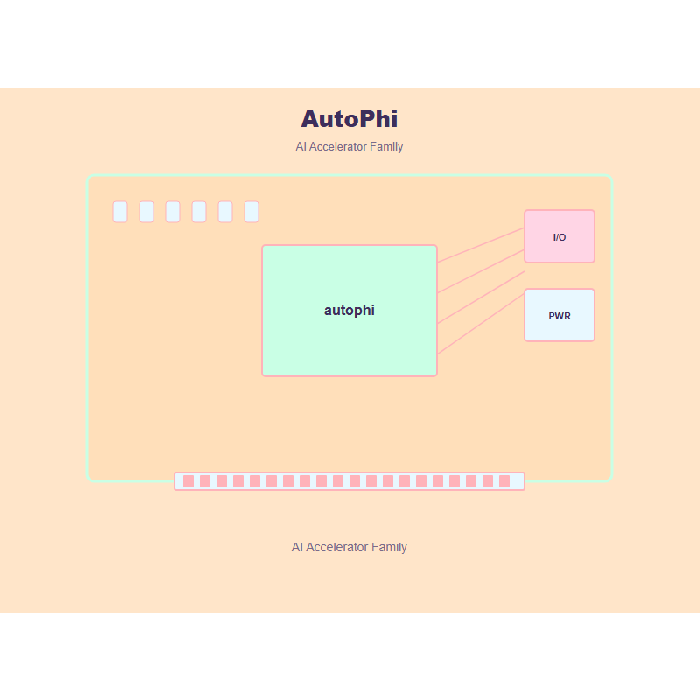
The chip the database was designed to run on. A V20-Epiphany-derivative die specification whose three hard-block primitives are the reservoir-flux math cast into silicon:
- the decay integrator — the R/τ sink term as a hardware primitive;
- the mass-balance closer — conservation enforced per cycle, not per software pass;
- the actuator-injection port — the Fin(t) source term as a first-class hardware input.
Specified at 12 GHz with 1,024 SIMD lanes: planetary-scale reservoir simulation at roughly four orders of magnitude over the software emulator. Delivered as a full block diagram covering the primitives, memory hierarchy, support logic, and host interface, in both working SVG and print-ready form, alongside the complete chip specification and driver API specification.
Component 5 — The Agency Pitch Dossier
The read-first surface, assembled for a federal contract officer or strategic-acquisition analyst. A single print-ready file: cover, contents, the five foundational essays, an executive summary of all eleven ledger tables with a spotlight on the per-install performance sheet, the three query applications' actual captured output rendered inline, and the procurement path. Open it in any browser; print to PDF in one step.
The ledger — all eleven tables
The heart of the database. Cross-joinable, versioned, auditable end-to-end: elements (what cycles), reactions (the governing chemistry, including the full stratospheric ozone cycle), hypotheses (each intervention claim with mechanism, confidence, and dependency), cascades (17 cross-actuator amplification chains), per_install (throughput, capital cost, operating cost, and element flux per deployed unit — the table a procurement officer reads first), vocabulary (plain-English symptom mapping), studies, accruments, probabilities, planet (the global reservoir baselines), and valuations. A machine-readable schema accompanies them.
The four actuators
AquaPhi treats water. AtmoPhi intercepts airborne loading. OzonePhi addresses the stratospheric column. HomePhi operates at the residence. The database prices, doses, verifies, and cross-links all four — and the cascade table is where they multiply each other.
The science frame
Built on the reservoir-flux frame Sydney Chapman derived for stratospheric ozone in 1930 — the archetype of every equation in the database — extended across every element that cycles between air, water, soil, and biomass, and attached to real, deployable, commercial-grade engineering with a per-install performance sheet.
Delivery, integrity, licensing
Delivered immediately after purchase as an AES-256 encrypted archive; the extraction password accompanies the download link. Every file is enumerated in a manifest with its SHA-256 checksum, byte size, and timestamp — the delivery is verifiable to the byte. The license is to the purchasing entity alone: no redistribution, no public posting, no IP transfer. Copyright © 2010–2026 Christopher Gabriel Brown, CRI-ONE. Patents issued and pending, with all prosecution and enforcement rights retained by the inventor. The work is for sale. The IP is not.
Available exclusively to companies incorporated, headquartered, and primarily operating in the United States of America. USD only. Communication by email and postal mail only — no phone calls, no brokers, no intermediaries.