AutoPhi Four Cookbooks — GOPS · Ronna · Quetta, 400 recipes, 1,200 nano layers, four axes × ten technologies, QBeam ExitPhi fabric (App# 19/722,805)
Publicly online since 2010 · U.S. patent applications since 2012 · inventions offered since 2014. The work of Christopher Gabriel Brown, independently documented.
CRI-ONE · AUTOPHI · THE COMPLETE BUILD LADDER · FOUR AXES × TEN TECHNOLOGIES
Four Cookbooks — 400 Recipes
The complete Yotta→Quetta build ladder as recipe cards. Every rung cooked along all four scaling axes with all ten AutoPhi technologies — plus the temptation recipes.
Scaling doctrine: OUT · UP · ACROSS · SMALLER — all ten technologies serve all four axes on every card.
2.1 Giga probability-ops/s — 64 voxels, 130 nm, 150 µW, hash
D61C07EB…D3264697. Real silicon, not a projection. Every recipe
above it is cooked from this foot and honestly labeled.
What’s inside
| Cookbook | Recipes | Range | Class |
|---|---|---|---|
| I · Yotta | 100 | Rungs 57–72 | 100 designed |
| II · Ronna-Approach | 100 | Rungs 72–86 | 47 designed · 53 peak |
| III · Ronna | 100 | Rungs 86–93 | 100 peak |
| IV · Quetta | 100 | Rungs 93–100 | 100 peak · ×6,349 residual |
How a recipe reads — the four axes on every card
Every recipe card shows its ingredients along all four axes:
← OUT → voxels (W×H tiling, 64→480K) ↑ UP ↑ layers (deposition strata, 1→512) × ACROSS × fleet (×1→×10⁸) ↓ SMALLER ↓ node (130 nm→~1.5 nm)
And every recipe uses the master sauce:
All ten technologies × all four axes
The AutoPhi doctrine: every technology serves every axis simultaneously. Each recipe card marks which of the eleven technologies (foundation + ten) are active on which axes at that rung. Not one tech per axis — all ten pushing all four directions at once.
| Technology | OUT | UP | ACROSS | SMALLER |
|---|---|---|---|---|
| 0 · Color Math ALU | tile identity | addresses strata | fleet unit | shrinks with node |
| 1 · LED Power Recycling | powers wider | optical/layer | facility watts | efficiency |
| 2 · Vertical Threading | parallel width | spans layers | thread pool | threads/area |
| 3 · Chiplet Stacking | tile bond | stacking | multi-die | finer pitch |
| 4 · Nanophotonic I/O | feeds grid | inter-layer | die-to-die | waveguide |
| 5 · QEC Surface Code | trust wide | trust deep | consensus | decoder |
| 6 · EM Cooling | thermal wide | thermal deep | rack cool | hotspot |
| 7 · Quantum Battery | burst wide | burst deep | facility | density |
| 8 · QEU | search wide | depth = layers | fleet sweep | gates |
| 9 · Neuromorphic | sparse wide | sparse deep | event route | spike |
| 10 · QBeam | frame route | stratum addr | fabric | PHY |
The temptation recipes (included)
Beyond the 400 ladder cards, five temptation recipes cooked to the four-axis standard:
| Recipe | Yield | Strata | Status | Class |
|---|---|---|---|---|
| 1,200-Nano-Layer Temptation | ~105 POPS | 1,200 | Layers only | (D) designed |
| PHM06 single die | ~9.45 EOPS | 6 | None | (P)(R) |
| PHM-Q3 single die | ~18.9 EOPS | 12 | None | (P)(R) |
| Zetta Bridge | ~6.27 ZOPS | 6 | None | (P) |
| Yotta Fleet | ~17.0 YOPS | 12 | None | (P) |
The 1,200-nano-layer temptation: Intel 18A node, V20 Epiphany architecture on AES substrate (400 W/m-K). Physical quantum mechanics: silicon quantum dots (3–10 nm), photon-driven energy storage (E=hf), LED nano-array (8×10¹&sup0; LEDs/cm², 250–300 nm), 84–98% recycling efficiency (Patent 18/370,908). QEC Surface Code gates the recycling loop. EM Cooling prevents thermal runaway. Self-powered — quantum battery layers generate their own energy via photon absorption → re-emission → next stratum loop.
Quantum depth — progressive incremental ladder
The architecture grows taller than wide. Each increment proves the next is feasible:
| Strata | Depth | Step |
|---|---|---|
| 1 (today) | 1 conditional layer | BUILT |
| 6 | 6 layers | ×6 |
| 12 | 12 layers | ×2 |
| 50 | 50 layers | ×4.2 |
| 100 | 100 layers | ×2 |
| 200 | 200 layers | ×2 |
| 400 | 400 layers | ×2 |
| 800 | 800 layers | ×2 |
| 1,200 | 1,200 layers — Quetta depth | ×1.5 |
At 1,200 nano layers the QEU searches a 1,200-dimensional probability field in hardware: P(A|B|C|…|Z) nested 1,200 levels deep. No single leap — the architecture grows taller one proven increment at a time.
The ladder (signature rungs)
| Rung | Yield | Recipe (axes used) | Class |
|---|---|---|---|
| 1 | 2.1 GOPS | Foot — 64 voxels, 130 nm | (M) |
| ~43 | ~1.58 EOPS | OUT + SMALLER (single die ceiling) | (P) |
| ~57 | ~6.27 ZOPS | + UP (6 strata) + ACROSS (×663) | (P) |
| ~72 | ~17.0 YOPS | UP (12 strata) + ACROSS (full fleet) | (P) |
| 100 | 1 QOPS | The peak — ×6,349 residual | PEAK |
Golden-ratio ladder: 100 rungs at ×1.61758 per step. 1 measured + 80 designed + 19 peak coordinates.
What you receive
- 400 recipe cards (four cookbooks, Yotta→Quetta)
- Five temptation recipes (1,200-nano-layer, PHM06, PHM-Q3, Zetta Bridge, Yotta Fleet)
- The GOPS Series Spec (100-tier grid, node projection table)
- The Quetta Recipes reference (100-rung golden-ratio ladder)
- The Probability Engine spec (ten technologies, four axes)
- Complete build-ladder data (JSON)
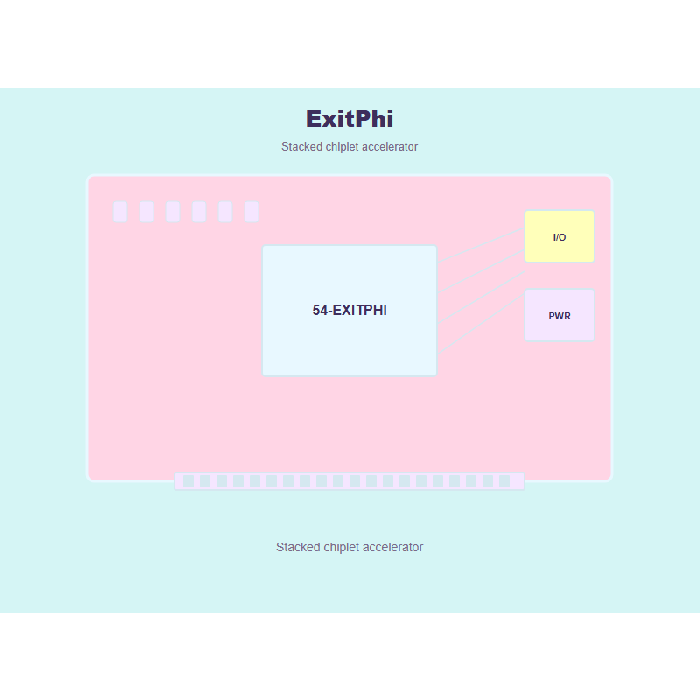
QBeam ExitPhi fabric — integrated interconnect
Tech #10 is not just a protocol — it is a patented physical layer (ExitPhi, USPTO App# 19/722,805, filed 2026-06-27, 30 claims). The QBeam Transfer Card ships as a PCIe 5.0 x16 HHHL HBA built into the accelerator ecosystem:
| Attribute | Design target |
|---|---|
| Aggregate throughput | 400 GB/s bidirectional per card |
| Cut-through latency | 400 ns (doorbell → DMA write) |
| Ports | 4× QBeam lanes on bracket |
| Encryption | AES-256-GCM at link-layer, stateless |
| Virtualization | SR-IOV, 64 virtual functions |
| Silicon configs | 12 (APM01-D-QPHY through APM12-D-QPHY, 22 nm → 2 nm) |
| Thermal | CoolBeam-clocked PHY, −40 °C to +85 °C |
| Ordering | PipeBeam — guaranteed wire-order delivery at L1 |
No cables. No third-party silicon in the datapath. The QBeam PHY eliminates all copper and optical interconnect between AutoPhi boards. Supported topologies: point-to-point, star, ring, 2D torus, dragonfly. Classical bytes only on the wire — the quantum is in the physics of the silicon, not on the wire.
The quantum is real
AutoPhi uses physical quantum mechanics — not simulation, not classical approximation. Silicon quantum dots (3–10 nm) store energy via photon absorption at discrete Zeeman and Landau levels. The LED nano-array (8×10¹&sup0; LEDs/cm²) recycles 84–98% of emitted photons back into the next stratum. QEC Surface Code gates every recycling loop. EM Cooling prevents thermal runaway. The quantum battery layers generate their own power — photon emission → re-absorption → quantum coherence storage → next stratum. No external grid required at operating depth. Every recipe card carries its evidence class: (M) measured, (P) designed, (D) designed, or PEAK. Quetta is the target. The architecture delivers.
SKU CRIONE-AUTOPHI-FOUR-COOKBOOKS · Paid download · Bundled with the GOPS Series Spec, Quetta Recipes, and Probability Engine spec. Never free; never publicly hosted. · © Christopher Gabriel Brown · cri-one.com