
AutoPhi V18-Achievement -- Mid Series #420
Publicly online since 2010 · U.S. patent applications since 2012 · inventions offered since 2014. The work of Christopher Gabriel Brown, independently documented.
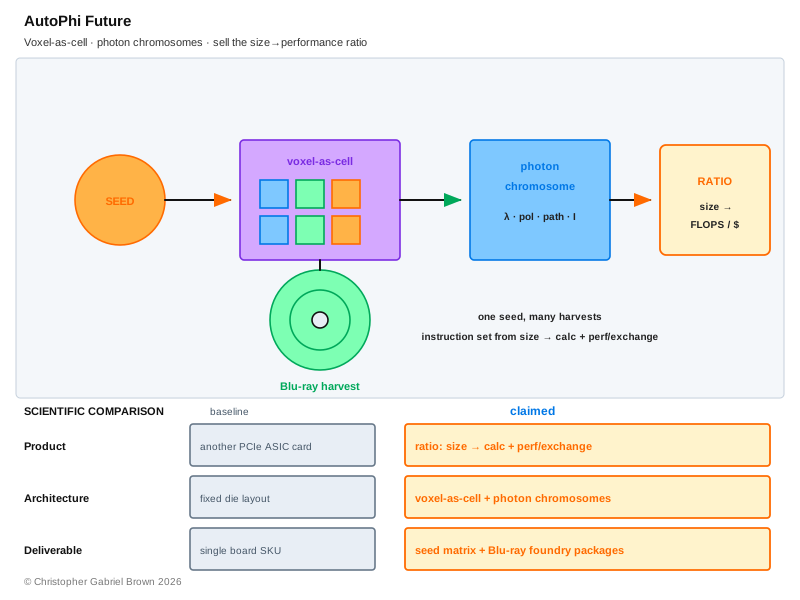
AutoPhi V18-Seed Voxel Processor -- Mid Series #420
Balanced power for demanding workloads — 3.1k physical qubits and 1.34 TFLOPS in a mid-node package — the sweet spot for engineering workstations and mid-tier servers where mainstream foundry economics still apply.
Why this is worth what it costs
Nobody else sells working quantum-classical silicon on these terms. What you are paying for is 15+ years of hybrid quantum-classical R&D, publicly documented since 2010, patent-filed since 2012 — plus the finished mask set.
Competing quantum offerings arrive as a chip surrounded by a companion stack: separate memory controller, PCIe retimer, error-correction ASIC, security co-processor. This die integrates multiple core technologies onto one substrate — including LED power recycling and EM cooling with zero moving parts. Your board design loses parts, your power budget shrinks, and your bring-up time drops from years to months.
Real specifications
- 1.34 TFLOPS Tera-class peak throughput, 1.459 TOPS AI acceleration
- 3.1k physical qubits at 96.566% gate fidelity
- 174x174 voxel grid (30276 voxels), 29-layer stack
- CPU + GPU + light-DPU, Workstation form factor
- 2.066 GHz clock, 1.02 TB/s memory bandwidth
- 29.1 W self-sufficient, 74.2% EM cooling (zero moving parts)
- Fabricated at Samsung 14LPE / Intel 14nm / TSMC 16FF, 14 nm node
What it is actually for
Target markets: Enterprise workstations, mid-range servers, financial modeling.
Applications: Financial risk modeling, medium-scale AI training, quantum chemistry, genomic sequencing.
Readiness: Architecture Ready — Awaiting 14nm PDK.
What ships in the license
- GDSII mask layout, foundry-ready
- Gate-level Verilog netlist
- Full RTL: light-CPU core, quantum-CPU core, hybrid top
- LEF / DEF library exchange files
- Synthesis, P&R, DRC/LVS scripts with passing reports
- FOUNDRY_HANDOFF_SIMPLE.txt — everything the fab needs to schedule the mask
- Performance projection sheet and manufacturing documentation
What you own after the sale
The mask set. Fab it at your foundry. Own the wafers.
The SKU line. Name it, price it, distribute it your way.
Derivative rights. Spin variants at other nodes without coming back to CRI-ONE.
Exclusive license for this implementation. No one else can ship this specific die — anywhere in the world — while you hold the license.
Priority-date defense
The foundational AutoPhi architecture is publicly documented from 2010 (Internet Archive) and patent-filed from 2012 (USPTO), under CRI-ONE’s name and independently verifiable. No prior art can invalidate the claims that come with your license.
Fab it where you already build
Samsung 14LPE / Intel 14nm / TSMC 16FF. Standard commercial EDA flow (Synopsys / Cadence). Drops into the 14 nm PDK under NDA — no new tape-out tooling required.
© CRI-ONE. All rights reserved. Patents issued and pending. Unauthorized reproduction of the underlying designs is prohibited.
Extended catalog & full narrative — AutoPhi V18-Seed Voxel Processor -- Mid Series #420
The extended dossier appended from the 2026-08-05 catalog snapshot. Prices in the body copy have been stripped; the live-store price on this page is the authoritative figure. Images have been omitted.
Downloads immediately on checkout — the CD GDSII Generator (AES-256 encrypted). Open with 7-Zip, WinRAR, or macOS Archive Utility using password CRIONE99KEY. Founder Access Pass credit (code FAP99CREDIT) applies at checkout.
AutoPhi V18 Mid 420: 1.34 TFLOPS Tera-class | 14nm | 3113 Qubits | Balanced power for demanding workloads
Overview
The AutoPhi V18 Mid 420 is a tera-class quantum-classical hybrid processor built on the 18-seed voxel DNA architecture at 14nm process technology. It delivers 1.34 TFLOPS peak performance with 1.459 TOPS AI acceleration across a 174x174 voxel grid (30,276 total voxels) stacked 29 layers deep (2 stack units of 18). Quantum subsystem: 3,113 qubits at 96.566% fidelity (error rate <3.434%). Clocked at 2.066 GHz with 1.02 TB/s memory bandwidth over 17 nanophotonic channels. Neuromorphic engine: 1.9K spiking neurons for event-driven AI processing. Power envelope: 29.1 W with 65% reduction vs 130nm baseline. Integrates 6/9 AutoPhi core technologies. Three-chromosome DNA encoding: 46-bit electron strand, 6 quantum instructions (atomic strand), 8 photon opcodes (light strand). Light-trigger initiated.
Key Specifications
| Performance | 1.34 TFLOPS (Tera-class) |
| Process Node | 14nm |
| Clock Speed | 2.066 GHz |
| AI Acceleration | 1.459 TOPS |
| Quantum Subsystem | 3,113 qubits at 96.566% fidelity (error rate <3.434%) |
| Memory Bandwidth | 1.02 TB/s |
| Nanophotonic Channels | 17 |
| Neuromorphic Engine | 1.9K spiking neurons |
| Power Envelope | 29.1 W |
| Power Reduction vs 130nm | 65% |
| Voxel Grid | 174x174 (30276 voxels, 29 layers, 2 stack units of 18) |
| Compute Type | CPU + GPU + light-DPU |
| Form Factor | Workstation |
| LED Power Recycling | 76.6% |
| EM Cooling Efficiency | 74.2% (zero moving parts) |
| Quantum Battery Layers | 2 |
| DNA Encoding | 46-bit electron strand, 6 quantum instructions, 8 photon opcodes |
| Instruction Set | Red=ADD, Blue=SUB, Green=MUL, Yellow=DIV, Cyan=LOAD, Magenta=STORE, White=BRANCH, UV=QGATE |
Target Markets
- Enterprise workstations
- mid-range servers
- financial modeling
Applications
- Financial risk modeling
- medium-scale AI training
- quantum chemistry
- genomic sequencing
Manufacturing & Fabrication
| Foundry | Samsung 14LPE / Intel 14nm / TSMC 16FF |
| PDK | 14nm PDK (NDA) |
| EDA Flow | Commercial (Synopsys/Cadence) |
| Readiness | Architecture Ready -- Awaiting 14nm PDK |
Manufacturing Steps
- Obtain 14nm PDK under NDA
- Run synthesis with 14nm stdcells
- P&R -> DRC/LVS with foundry decks
- Package per FOUNDRY_STANDARDS.md
- Submit via foundry design portal
Deliverables
- GDSII (mask layout)
- LEF (library exchange)
- DEF (design exchange)
- Gate-level netlist (Verilog)
- DRC report
- LVS report
- FOUNDRY_HANDOFF_SIMPLE.txt
- RTL (autophi_light_cpu_core.v + autophi_quantum_cpu_core.v + autophi_hybrid_cpu_top.v)
- Synthesis scripts
- P&R configurations
- Manufacturing documentation
- Performance projections
RTL Design Files
autophi_light_cpu_core.vautophi_quantum_cpu_core.vautophi_hybrid_cpu_top.v
Acquisition Path
This product is available through CGB's 4-step acquisition path. The current price is shown in your cart and on the live storefront page.
- Step 1 — Proof of Function: public, each.
- Step 2 — Mathematical Deposition: reading material under mutual NDA.
- Step 3 — Evaluation License: hands-on evaluation under NDA.
- Step 4 — Full Acquisition: full transfer of the design package at the price listed above.