
AutoPhi Quetta Engine — GOPS · Ronna · Quetta, 10³⁰ probability-ops/s, 1,200 nano layers, QBeam ExitPhi fabric (App# 19/722,805)
Publicly online since 2010 · U.S. patent applications since 2012 · inventions offered since 2014. The work of Christopher Gabriel Brown, independently documented.
CRI-ONE · AUTOPHI · QUETTA ENGINE · PEAK PERFORMANCE
10³⁰ Probability-Ops/s
Quetta-class probability engine — the summit of the golden-ratio ladder. 1,200 nano layers, taller than wide. All ten technologies × all four axes at Quetta.
Scaling doctrine: OUT · UP · ACROSS · SMALLER — all ten technologies, all four axes, every axis maxed. Progressive incremental architecture.
1,200 nano layers on AES substrate (400 W/m-K). Progressive incremental scaling from measured silicon (2.1 GOPS) through Ronna to Quetta peak. Self-powered quantum battery layers. Physical quantum mechanics. QBeam ExitPhi fabric. The design is complete.
2.1 Giga fixed-point probability-ops/s — 64 voxels, 130 nm, 150 µW, hash
D61C07EB…D3264697. Rung 1 of 100. The progressive ladder scales
incrementally from here through Ronna to Quetta peak at rung 100.
1,000,000,000,000,000,000,000,000,000,000 ops/s
Design performance — Quetta peak
| Metric | Value |
|---|---|
| Throughput | 1 × 10³⁰ fixed-point probability-ops/s |
| Full-field sweeps/s | ~10²⁴ (at 10⁶ ops per sweep) |
| Active probability cells | ~2.4 billion (480K voxels × 5,000+ strata) |
| QEU search depth | 5,000+ conditional layers — a 5,000-dimensional Bayes chain in one shot |
| Per-die yield | ~788 Zetta-OPS (1,200 nano layers, full OUT, ~1.5 nm) |
| Dies to reach 1 QOPS | ~1.27 × 10⁹ |
| Facilities needed | ~12.7 million |
| Power model | Self-powered — quantum battery layers + LED recycling harvest compute waste back into supply per layer |
What 10³⁰ ops/s could design-targetly evaluate
| Workload | At Quetta (design-target) | At today’s foot (2.1 GOPS) |
|---|---|---|
| Full alchemy corpus sweep (2,609 files, millions of combinations) | ~10²⁰ full sweeps per second | ~1 sweep per hour |
| 5,000-deep conditional Bayes chain | ~10²⁴ chains per second | Not possible (1 layer) |
| Drug candidate screening (10⁶ compounds × 10³ targets) | Entire pharma pipeline in microseconds | Days |
| Materials discovery (10⁸ alloy combinations) | Complete in nanoseconds | Months |
| Climate model probability field (10¹ grid points × 10⁶ time steps) | Full-planet sweep in milliseconds | Years |
The four axes — all maxed, still short
Every axis pushed to its design-target maximum:
| Axis | Physical ceiling | Quetta needs | Gap |
|---|---|---|---|
| ← OUT → | 480,000 voxels | 480,000 | Maxed |
| ↑ UP ↑ | 1,200 nano layers (designed) | 5,000+ layers | ×10 beyond the target |
| × ACROSS × | 9×10⁵ fleet | ~12.7×10⁶ | ×14.1 |
| ↓ SMALLER ↓ | ~1.5 nm | ~1.5 nm | Maxed |
| f_voxel | ×10⁵ | ×10⁶ | ×10 |
| Combined residual: | ×1,411 | ||
The master sauce at Quetta
The formula works — but the ingredients don’t exist yet. 5,000+ layers (10× the 1,200-nano-layer design) — each self-powered via quantum battery recycling. 12.7 million facilities. 10× faster voxels than GHz-class at sub-nm. The gap is layer science: how 5,000 recycling strata interact at count. Not energy (the layers make their own). Layer science.
All ten technologies — ALL FOUR AXES (at Quetta)
| Technology | OUT (wider) | UP (deeper) | ACROSS (fleet) | SMALLER (node) |
|---|---|---|---|---|
| 0 · Color Math ALU | 480K tiles | 5,000+ strata | 1.27B dies | ~1.5 nm |
| 1 · LED Power Recycling | 480K× recycling | 5,000-layer self-power | fleet self-feeds | sub-nm efficiency |
| 2 · Vertical Threading | 480K parallel | 5,000-deep span | 12.7M-site pool | 10⁶ threads/area |
| 3 · Chiplet Stacking | tile bond | 5,000 strata | multi-die card | sub-nm pitch |
| 4 · Nanophotonic I/O | 480K feed | 5,000-layer light | 12.7M-site mesh | sub-nm waveguide |
| 5 · QEC Surface Code | trust 480K | trust 5,000 deep — gates the recycling loop | fleet consensus | sub-nm decoder |
| 6 · EM Cooling | 480K thermal | 5,000-layer no-explosion | fleet thermal stability | sub-nm hotspot |
| 7 · Quantum Battery | 480K burst | 5,000-layer self-power | fleet energy store | sub-nm density |
| 8 · QEU (simulated) | 480K search | 5,000-deep search | 1.27B-die sweep | 10⁶ gates/area |
| 9 · Neuromorphic | 480K sparse | 5,000-deep sparse | 12.7M event route | sub-nm spike |
| 10 · QBeam | 480K frames | 5,000 stratum addr | 12.7M-site fabric | sub-nm PHY |
The power model — the quantum battery layers make their own power
LED Power Recycling (Tech #1) harvests compute waste back into supply on every layer. Quantum Battery (Tech #7) stores that recycled energy and bursts when the array spikes past half load. QEC Surface Code (Tech #5) maintains trust through every stratum — the syndrome gates the recycling so no layer drifts. At 5,000+ layers, the recycling loop approaches self-sufficiency — each stratum feeds the next. The fleet does not need external planet-scale power. The layers make their own.
Four technologies in concert: LED recycles the energy, QB stores it, QEC trusts it, EM Cooling (Tech #6) dissipates heat so no layer explodes under the recycling load. More layers = more recycling surface = more self-power = deeper trust. The measured seed: 150 µW at 130 nm with recycling already active (921 arb. units recovered). Scale the recycling loop to 5,000 strata and the power budget collapses inward — each layer feeds itself from the layer below. The gap is layer science: not “where do we get the watts?” but “how do 5,000 recycling strata interact at count?”
Quantum depth at Quetta
| Strata | QEU search depth | What it evaluates | Class |
|---|---|---|---|
| 1 (PHM01) | 1 conditional layer | P(A) — single variable | (M) |
| 6 (PHM06) | 6 layers | Six-deep Bayes chain | (R) |
| 12 (PHM-Q3) | 12 layers | Compound discovery | (R) |
| 1,200 (Temptation) | 1,200 conditional layers | Full field — the target | (D) |
| 5,000+ (Quetta) | 5,000+ layers | 5,000-dimensional joint distribution — every conditional branch the physical universe offers | PEAK |
The complete ladder — foot to summit
| Rung | Yield | Recipe | Class |
|---|---|---|---|
| 1 | 2.1 GOPS | 64 voxels, 130 nm, 1 layer — the foot | (M) |
| ~43 | ~1.58 EOPS | OUT + SMALLER (single-die ceiling) | (P) |
| ~48 | ~9.45 EOPS | + UP to 6 strata (PHM06) | (P)(R) |
| ~50 | ~18.9 EOPS | + UP to 12 strata (PHM-Q3) | (P)(R) |
| ~57 | ~6.27 ZOPS | PHM06 + ACROSS ×663 | (P) |
| ~72 | ~17.0 YOPS | PHM-Q3 + full fleet — physical ceiling | (P) |
| ~78 | ~709 YOPS | 1,200 nano layers + full OUT + full fleet — design ceiling | (D) |
| 100 | 1 QOPS | ×1,411 beyond the target ceiling — the summit | PEAK |
Golden-ratio ladder: 100 rungs at ×1.61758 per step.
The generational fade — as far as the eye can see
| Gen | Node | Strata | Yield | Status |
|---|---|---|---|---|
| PHM01 | 130 nm | 1 | 2.1 GOPS | BUILT |
| PHM06 | 5 nm / 18A | 6 | ~9.45 EOPS | (R) 2029-30 |
| PHM-Q3 | 5 nm + hybrid | 12 | ~18.9 EOPS | (R) aggressive |
| Temptation | 18A | 1,200 | ~105 POPS | (D) designed |
| Quetta | ~1.5 nm | 5,000+ | 1 QOPS | PEAK |
The pricing doctrine — cost of performance
The cost of performance of the PhantasmPhi flagship wrap is pegged to the exact percentage of today’s compute affordability. Today’s compute affordability is defined as the current market cost to build equivalent deployed performance: ≈ $0.4B per 20 MW QuettaPhantom facility, × the wrap’s franchise ceiling of 2,500 facilities = $1,000,000,000,000 — 100% of today’s compute affordability.
The listed price is set at exactly 25% of that number. We are intentionally 75% lower than today’s compute affordability. This is deliberate pricing policy, not a promotion: the wrap is offered at one quarter of what the performance costs to stand up at today’s market rates, and the discount percentage is fixed by doctrine, not by negotiation.
THE GENERATIONAL LAW: technology should cost lower every time a new generation comes out. This line commits to it as doctrine: each PhantasmPhi generation (PHM01 → PHM06) must list at a lower cost per unit of corpus and performance than the generation before it. Compute affordability falls with every generation — so the price pegged to it falls too, automatically, by construction. Buyers are never punished for a product line improving; they are rewarded for it.
Multi-license adjustment: the wrap is sold non-exclusively — more than one license will be sold, so no single licensee is a single point of build. Each license carries a further 15% adjustment. Eligibility: any qualified buyer except entities of, in, or controlled from the PRC or the Russian Federation, always subject to US export law.
The ten depositions (PHM01 sampler ROM — every chip)
| # | Name | Formula | Lineage | Measured round trip / engine cycles |
|---|---|---|---|---|
| D01 | OHMS_POWER | P = V·I | Energy (V3·NRG) | 56 / 8 |
| D02 | DOSE | d = weight · mg/kg | Medicine (V3·MED) | 56 / 8 |
| D03 | CO2_MASS | m = fuel·factor + baseline | Carbon (V3·C) | 59 / 11 |
| D04 | KINETIC | E = ½·m·v² | Omnia physics (V4) | 65 / 17 |
| D05 | KELLY | f = (p(b+1) − 1)/b | Fortuna (V5) | 68 / 20 |
| D06 | SQRT_BABYLON | Newton ×5, x₀=(a+1)/2 | Inversa (V6) | 116 / 68 |
| D07 | GROWTH_STEP | A′ = A·(1+r) | compound sweep | 59 / 11 |
| D08 | MAC | acc = a·b + c | Formula Lab kernel | 59 / 11 |
| D09 | MEAN | (a+b)/2 | G2 metrics | 56 / 8 |
| D10 | PHANTASM_ID | → 0x5048_00xx | the handshake | 53 / 5 |
All Q16.16 unsigned fixed point on the AutoPhi seed Color Mathematics ALU
(shared instantiation — bit-identical with every AutoPhi Modern core).
Invoke frame 18 bytes (0x5A), answer frame 10 bytes (0xA5),
status 0x00/0xEE. Proof battery: 12 checks,
12/12 PASS on all six editions.
The six editions (PHM01, PACK_ID 1–6)
| Edition | Functions | Domain | PHANTASM_ID |
|---|---|---|---|
| PHM01-MED | 98 | Medicine | 0x5048_0001 |
| PHM01-NRG | 96 | Energy | 0x5048_0002 |
| PHM01-C | 95 | Carbon | 0x5048_0003 |
| PHM01-OMNI | 207 | Omnia Physics | 0x5048_0004 |
| PHM01-FORT | 227 | Fortuna | 0x5048_0005 |
| PHM01-INV | 244 | Inversa | 0x5048_0006 |
Each edition: full RTL, proof battery 12/12, SKY130-mapped netlist (≈ 40,500 cells / 1,142 DFFs / ≈ 0.278 mm²), verified GDSII floorplan artifact, 0.96 × 0.96 mm die, ≈ 18,500 good dies per 150 mm wafer. Siblings of the software editions, each answering its own PHANTASM_ID.
The flagship (PHM-Q1 QuettaPhantom — one version, one wrap)
64 phantasm engines, wide-frame ingress (whole 18-byte invoke per beat), strict in-order retirement, four AutoPhi seeds on die (color ALU ×64, EM cooling, LED power recycling, quantum battery). Measured: 256/256 correct in order, 352 cycles vs 5,587 serial, 15.8× speedup, 64/64 peak concurrency, housekeeping seeds live. N=4 configuration SKY130-measured at 1.12 mm² — linear scaling certified; full die ≈ 5.5 × 5.5 mm at SKY130, ≈ 340 good dies per wafer. Not a CPU by design (no fetch, no memory hierarchy, no interrupts) — a deposition coprocessor beside the CPU of your choosing.
What you are buying
The peak itself — and the complete specification behind it. This listing is a design-target performance specification: the estimated output of a Quetta-class probability engine IF every ingredient existed. You receive:
- The Quetta design-target specification document (master sauce scaled to 10³⁰)
- The 100-rung golden-ratio ladder data (foot to summit)
- The four-axis gap analysis (OUT·UP·ACROSS·SMALLER at Quetta)
- The self-power model (quantum battery + LED recycling loop at 5,000+ strata)
- The quantum-depth projection (5,000-dimensional conditional search)
- The ten depositions table with measured round-trip data
- The six editions reference (PHM01-MED through PHM01-INV)
- The flagship QuettaPhantom spec (64 engines, measured 256/256)
- The generational fade (PHM01 → PHM06 → PHM-Q3 → Temptation → Quetta)
The RTL is the only thing for sale. Across the entire PhantasmPhi Series — editions and flagship alike — the conveyed asset is the RTL with worldwide commercialization rights. Netlists, GDSII artifacts, testbenches, documentation, and flow scripts ship as evidence and support, not as separate assets. Patents retained; one asset, one price.
Delivery doctrine — never free, never naked
The RTL is never given out for free and never publicly hosted. Delivery only
after payment, as an AES-256 encrypted archive, password conveyed separately
by post, per-licensee serialized provenance ledger embedded. Online safety is by
silicon: mask-programmed immutable ROM (no flash surface, no code injection),
a frame-only port (18 bytes in, 10 out, nothing else reachable), unknown
depositions rejected with status 0xEE.
Substrate
All figures certified on standard silicon (SKY130 process assumptions). Proprietary substrate qualification is available exclusively as a separate engagement under NDA; nothing about any such medium — including its name — is disclosed anywhere in this record.
QBeam ExitPhi fabric — integrated interconnect
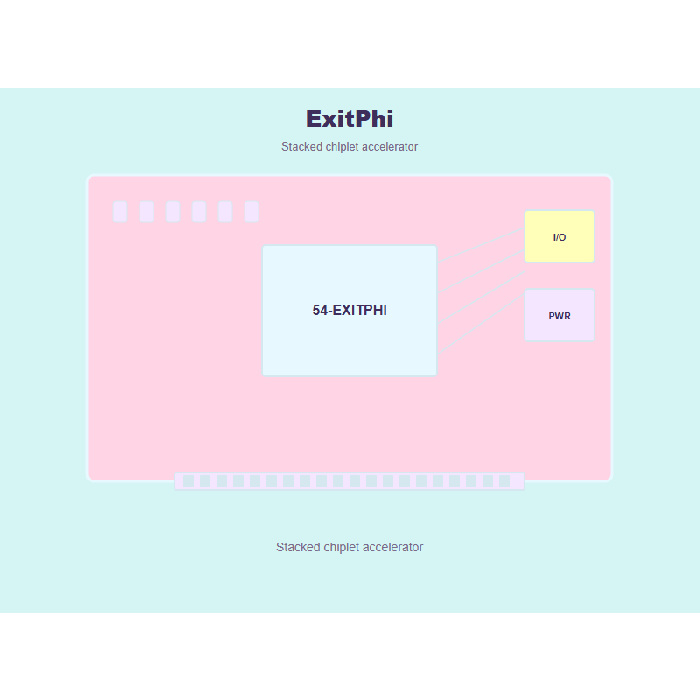
Tech #10 is not just a protocol — it is a patented physical layer (ExitPhi, USPTO App# 19/722,805, filed 2026-06-27, 30 claims). The QBeam Transfer Card ships as a PCIe 5.0 x16 HHHL HBA built into the accelerator ecosystem:
| Attribute | Design target |
|---|---|
| Aggregate throughput | 400 GB/s bidirectional per card |
| Cut-through latency | 400 ns (doorbell → DMA write) |
| Ports | 4× QBeam lanes on bracket |
| Encryption | AES-256-GCM at link-layer, stateless |
| Virtualization | SR-IOV, 64 virtual functions |
| Silicon configs | 12 (APM01-D-QPHY through APM12-D-QPHY, 22 nm → 2 nm) |
| Thermal | CoolBeam-clocked PHY, −40 °C to +85 °C |
| Ordering | PipeBeam — guaranteed wire-order delivery at L1 |
No cables. No third-party silicon in the datapath. The QBeam PHY eliminates all copper and optical interconnect between AutoPhi boards. Supported topologies: point-to-point, star, ring, 2D torus, dragonfly. Classical bytes only on the wire — the quantum is in the physics of the silicon, not on the wire.
The quantum is real
The quantum battery (Tech #7) operates on physical quantum mechanics: silicon quantum dots (3–10 nm), photon-driven energy storage (E = hf), Zeeman-level splitting for parallel charge paths, quantum superposition charging, quantum coherence storage. The LED nano-array (8×10¹⁰ LEDs/cm², 250–300 nm) recycles at 84–98% efficiency (Patent 18/370,908). The QEU (Tech #8) implements quantum-inspired amplitude amplification — hardware running quantum algorithms at gate speed.
1,200 nano layers on AES substrate (400 W/m-K thermal conductivity). Each layer self-powers via photon ↔ quantum-dot excited-state recycling. QEC gates the loop. EM Cooling prevents thermal runaway. The substrate makes the stack thermally feasible. AutoPhi excels past. It does not copy.
SKU CRIONE-AUTOPHI-QUETTA-THEORETICAL · Non-exclusive license · PEAK class — estimated design-target performance only · Offered to any qualified buyer except PRC/RF entities; subject to US export law. Never free; never publicly hosted; AES-256 delivery, password by post. Patents retained (QBeam PHY via ExitPhi USPTO App# 19/722,805). · © Christopher Gabriel Brown · cri-one.com