
AutoPhi Probability Engine — GOPS · Ronna · Quetta, 1,200 nano layers, ten technologies × four axes, QBeam ExitPhi fabric (App# 19/722,805)
Publicly online since 2010 · U.S. patent applications since 2012 · inventions offered since 2014. The work of Christopher Gabriel Brown, independently documented.
CRI-ONE · AUTOPHI · PROBABILITY ENGINE · TEN TECHNOLOGIES × FOUR AXES
The AutoPhi Probability Engine
A fixed-point probability-processing accelerator — a grid of color-math voxels that evaluates a probability field ΣΣ P(i,j) in parallel, answering one question at scale: “which combination is most probable?”
Scaling doctrine: OUT · UP · ACROSS · SMALLER — all ten technologies serve all four axes simultaneously.
2.1 Giga fixed-point probability-ops/s — 64 voxels, 130 nm, 150 µW, hash
D61C07EB…D3264697. This number is real silicon, not a projection.
The progressive ladder scales from this foot to Ronna and Quetta performance.
In plain words
You have millions of possible combinations. Which one is most likely to work? The engine scores every combination’s probability at once and returns the winner. Drug discovery, chemical-process optimization, risk modeling, Bayesian inference — any workload that asks “which combination is most probable?”
The four scaling axes
The engine grows along four independent axes. Each multiplies the others:
← OUT → 64 → 480,000 voxels (tile W×H wider) ↑ UP ↑ 1 → 512 deposition strata (layers deeper) × ACROSS × ×1 → ×10⁸ fleet (more dies) ↓ SMALLER ↓ 130 nm → ~1.5 nm node shrink
The master sauce
Every recipe on the ladder is this formula with different ingredients plugged in. The measured foot fills the first slot; each axis multiplies from there.
All ten technologies — ALL FOUR AXES
Every technology serves every scaling axis simultaneously. Not one tech per axis — all ten pushing all four directions at once:
| Technology | OUT (wider) | UP (deeper) | ACROSS (fleet) | SMALLER (node) |
|---|---|---|---|---|
| 0 · Color Math ALU | tile identity | addresses strata | fleet unit | shrinks with node |
| 1 · LED Power Recycling | powers wider grid | optical budget/layer | per-facility watts | efficiency at node |
| 2 · Vertical Threading | parallel width | spans all layers | thread pooling | more threads/area |
| 3 · Chiplet Stacking | tile bonding | the stacking itself | multi-die pack | finer pitch |
| 4 · Nanophotonic I/O | feeds wider grid | inter-layer light | die-to-die link | waveguide shrink |
| 5 · QEC Surface Code | trust at width | trust at depth | fleet consensus | decoder at node |
| 6 · EM Cooling | thermal at width | thermal at depth | rack cooling | hotspot at node |
| 7 · Quantum Battery | burst at width | burst at depth | facility buffer | density at node |
| 8 · QEU | search width | search depth = layers | fleet sweep | gates at node |
| 9 · Neuromorphic | sparse at width | sparse at depth | event routing | spike at node |
| 10 · QBeam | frame routing | stratum address | facility fabric | PHY at node |
The temptation of 1,200 nano layers
1,200 nano deposition strata on Intel 18A, AES substrate (400 W/m-K thermal conductivity). Each layer self-powers via quantum battery recycling (84–98% efficiency, Patent 18/370,908). Physical quantum mechanics: silicon quantum dots, photon-driven energy storage, Zeeman-level splitting. The gap is layer science — AutoPhi excels past.
Quantum depth
At 1,200 nano layers the QEU (Tech #8) searches a 1,200-dimensional probability field in hardware — 1,200 conditional layers deep. P(A|B|C|…|Z) nested 1,200 levels. Not just more ops/s — deeper questions answered in one shot. The ladder grows incrementally — each step proves the next is feasible.
| Strata | QEU search depth | What it can evaluate | Step |
|---|---|---|---|
| 1 (PHM01, today) | 1 conditional layer | P(A) — single-variable | BUILT |
| 6 (PHM06) | 6 conditional layers | Six-deep Bayes chain | ×6 |
| 12 (PHM-Q3) | 12 conditional layers | Compound discovery | ×2 |
| 50 | 50 conditional layers | Deep molecular search | ×4.2 |
| 100 | 100 conditional layers | Protein-fold depth | ×2 |
| 200 | 200 conditional layers | Climate-model depth | ×2 |
| 400 | 400 conditional layers | Genomic-field depth | ×2 |
| 800 | 800 conditional layers | Full materials science | ×2 |
| 1,200 (Temptation) | 1,200 conditional layers | Full field — Quetta depth | ×1.5 |
Progressive incremental adjustment: each step is a modest multiple of the last. No single leap — the architecture grows taller one proven increment at a time.
The ladder (signature rungs)
| Rung | Yield | Recipe (axes used) | Class |
|---|---|---|---|
| 1 | 2.1 GOPS | 64 voxels, 130 nm — the foot | (M) measured |
| ~43 | ~1.58 EOPS | OUT to 480K voxels + SMALLER to ~1.5 nm | (P) |
| ~48 | ~9.45 EOPS | PHM06: + UP to 6 strata (all 244 functions) | (P)(R) |
| ~50 | ~18.9 EOPS | PHM-Q3: UP to 12 strata (aggressive) | (P)(R) |
| ~57 | ~6.27 ZOPS | PHM06 + ACROSS ×663 fleet | (P) |
| ~72 | ~17.0 YOPS | PHM-Q3 + ACROSS full fleet | (P) |
| 100 | 1 QOPS | Quetta — 10³⁰ ops/s | PEAK |
Golden-ratio ladder: 100 rungs at ×1.61758 per step. Progressive incremental scaling from measured silicon through Ronna to Quetta peak performance.
The generational fade
| Generation | Node | Strata | Masks | Status |
|---|---|---|---|---|
| PHM01 | 130 nm (SKY130) | 1 | ~40 | BUILT — hash-anchored |
| PHM02 | 65 nm | 1 | ~48 | (R) roadmap |
| PHM03 | 40 nm | 2 | ~56 | (R) roadmap |
| PHM04 | 22 nm | 3 | ~64 | (R) roadmap |
| PHM05 | 7 nm | 4 | ~80 | (R) roadmap |
| PHM06 | 5 nm / 18A | 6 | ~96 | (R) full stack, all 244 functions |
| PHM-Q3 | 5 nm + hybrid | 12 | ~192 | (R) aggressive, ~488 functions |
The color-math arithmetic
| Yellow · MUL | Joint probability — P(A)·P(B) | |
| Red · ADD | Marginal — ΣP (the field sum) | |
| Green · DIV | Bayes — P(A|B) = P(A∩B)/P(B) |
What you are buying
The RTL design — not a chip in a box. You license the complete engine design with worldwide commercialization rights. Everything that proves it is real ships with it: the color-math core, all ten technology integrations, testbenches, hash-anchored GDSII (102 MB, DRC/LVS clean), and the OpenLane2 flow to reproduce it. Patents retained by the inventor (QBeam PHY via ExitPhi USPTO App# 19/722,805).
QBeam ExitPhi fabric — integrated interconnect
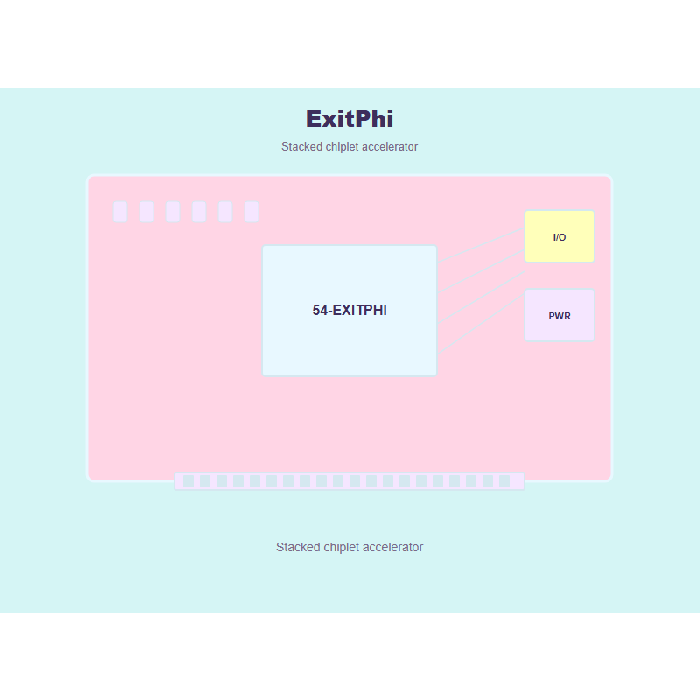
Tech #10 is not just a protocol — it is a patented physical layer (ExitPhi, USPTO App# 19/722,805, filed 2026-06-27, 30 claims). The QBeam Transfer Card ships as a PCIe 5.0 x16 HHHL HBA built into the accelerator ecosystem:
| Attribute | Design target |
|---|---|
| Aggregate throughput | 400 GB/s bidirectional per card |
| Cut-through latency | 400 ns (doorbell → DMA write) |
| Ports | 4× QBeam lanes on bracket |
| Encryption | AES-256-GCM at link-layer, stateless |
| Virtualization | SR-IOV, 64 virtual functions |
| Silicon configs | 12 (APM01-D-QPHY through APM12-D-QPHY, 22 nm → 2 nm) |
| Thermal | CoolBeam-clocked PHY, −40 °C to +85 °C |
| Ordering | PipeBeam — guaranteed wire-order delivery at L1 |
No cables. No third-party silicon in the datapath. The QBeam PHY eliminates all copper and optical interconnect between AutoPhi boards. Supported topologies: point-to-point, star, ring, 2D torus, dragonfly. Classical bytes only on the wire — the quantum is in the physics of the silicon, not on the wire.
The quantum is real
Quantum battery: physical quantum mechanics — silicon quantum dots, photon-driven energy storage (E = hf), Zeeman-level splitting, quantum superposition charging, 84–98% LED nano-array recycling (Patent 18/370,908). QEU: quantum-inspired amplitude amplification at gate speed. 1,200 nano layers on AES substrate. Each layer self-powers. AutoPhi excels past. It does not copy.
SKU CRIONE-AUTOPHI-PROBABILITY-ENGINE · Non-exclusive license · Priced by doctrine: 78.75% below today’s compute affordability · Offered to any qualified buyer except entities of, in, or controlled from the PRC or Russian Federation; always subject to US export law. Never free; never publicly hosted; AES-256 delivery, password by post. · © Christopher Gabriel Brown · cri-one.com