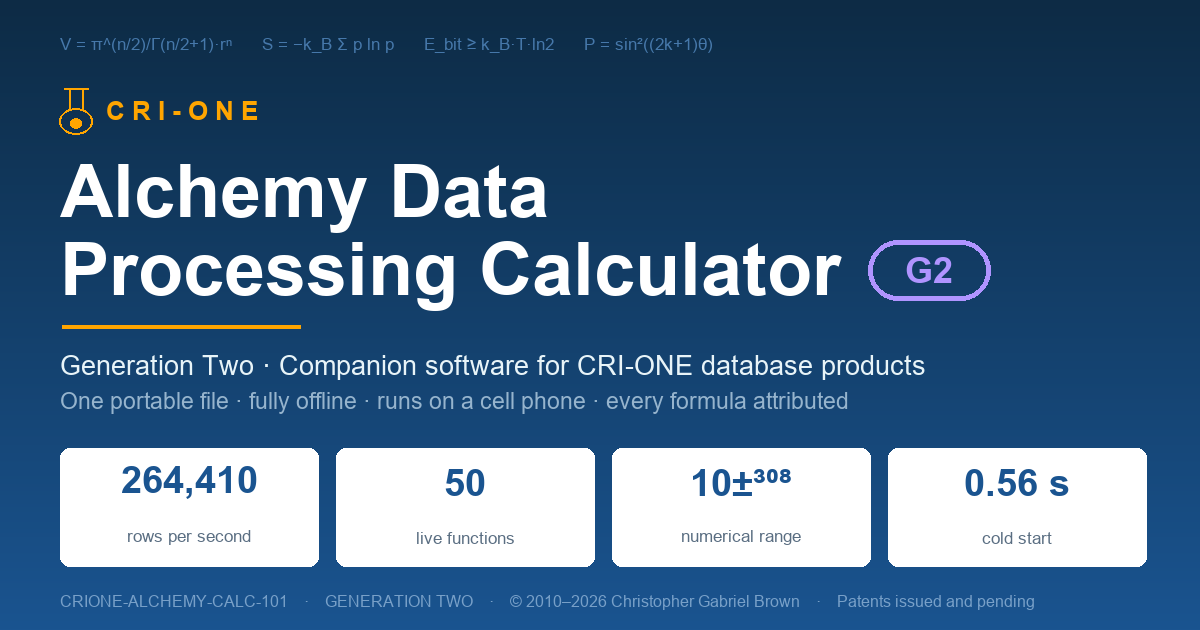
Small software that runs large database probabilities on demand. Load your
licensed CRI-ONE database — the calculator recognizes every dataset automatically and unlocks
its processing module. One portable file, fully offline, and it runs on a cell phone.
Your data never leaves the device.
Generation Two adds a 50-function live library (the ten CGB
Mathematical Depositions plus an attributed open-science corpus), an instruction
editor for writing your own formulas, the AutoPhi math accelerator,
a live Fractal Lab, editable data cells, and a shipped provenance
ledger naming who and what for every calculation.
Measured performance
| Database size | Engine pass | Method matching | Search | Sort | Full statistics |
|---|---|---|---|---|---|
| 10,000 rows | 0.12 s | 0.41 s | 0.05 s | 0.06 s | 0.02 s |
| 100,000 rows | 0.38 s | 2.6 s | 0.14 s | 0.13 s | 0.18 s |
Numerical range
The calculator carries the full IEEE-754 double range and reports it honestly: magnitudes from 10−308 to 10308 display in scientific notation rather than collapsing to zero or to an unreadable digit string. Formation probability is held in exact log form (10−n), so it never underflows regardless of element count. Factorial-scale quantities run through a Lanczos log-gamma, and probability sums use log-sum-exp so terms below the underflow floor still contribute.
Processing modules
Five modules work with no database at all. The rest unlock themselves as you load the packages you have licensed.
- Formula Lab — molar mass, CRI reactivity, elemental composition, formation probability, the CRI-ONE productivity score, plus the G2 metrics: elemental entropy, electronegativity spread, rarity index, and the G2 depth score.
- G2 Function Library — 50 live functions with plots: the ten CGB Mathematical Depositions (dimensional fold, entropic bridge, golden spiral convergence, harmonic decay, photon chromosome encoding, quantum counting paradox, recursive growth bound, thermal noise floor, voxel resonance, zero-point fabrication) plus the open formula corpus across Mathematics, Physics & Energy, Chemistry & Carbon, and Medicine. Every function names its origin.
- Instruction Editor — write your own formulas (0.5*m*v^2), variables detected automatically; test, save, export/import. Your instructions run in the library and the accelerator — and belong to you.
- AutoPhi Math Accelerator — sweep any instruction across 100,000+ points, timed; benchmark the device against the Landauer thermal floor (CGB Deposition 8).
- Fractal Lab — the CGB deposition #106 formula z = z2 + c running live: click-to-zoom Mandelbrot and Julia sets with the deposition's own coordinates as presets.
- Column Statistics — n, min, max, sum, mean, median, standard deviation, quartiles, and geometric mean over every numeric column of any loaded dataset, with a histogram per column. Compensated summation and log-space geometric means hold precision across data spanning many orders of magnitude.
- Method Matcher — elements → preparation method → probability, from your licensed lite-alchemy engine data.
- HYDROPHI Ledger — the 11-table environmental database with accrument totals calculated live.
- MetalloDrugDB Explorer — all 300 multi-element pharmaceutical compounds; one tap opens any compound in the Formula Lab.
- Compound Rankings — re-rank any ranking export with your own weighting of value, novelty, probability, availability, recycle, and cost.
- BOM Calculator — load any bill of materials; edit quantities and build counts, costs recompute live.
- Data Browser — every loaded dataset, sortable and searchable, with on-demand engine runs (now adding G2 columns), method matching, in-place cell editing, and CSV export.
Provenance — who and what
Mathematical formulas and laws of nature are unpatentable — no one owns them. G2 treats that honestly: every calculation in the library names its origin, inside the software and in the shipped ledger PROVENANCE.md. The ten CGB Mathematical Depositions are © Christopher Gabriel Brown, with the classical science each builds on credited alongside; every borrowed formula credits its originator and year — Bayes (1763), Einstein (1905), Shannon (1948), Landauer (1961), Cockcroft & Gault (1976), Mosteller (1987), and the rest. CRI-ONE claims the curation, presentation, engineering and code — not the open science of others.
Real export formats are read natively. Columns exported as $45.00, 1,234.5, 12% or (500) are recognized as numbers, so your database exports cost, sum and sort without being cleaned up first.
Works with
- CRI-ONE HYDROPHI DATABASE — licensed separately
- MetalloDrugDB — 300 Compounds — licensed separately
- CGB Mathematical Depositions — the ten depositions ship built in as working functions; the full deposition record is licensed separately
- Lite-alchemy engine data (elements, methods, probabilities JSON)
- Any alchemy JSON or CSV export
What the buyer receives
- One portable software file. No installation, no subscription, no internet required.
- Runs in any modern browser — desktop, laptop, tablet, or cell phone.
- Data stays on the device; nothing is uploaded anywhere.
- Loaded databases are remembered between sessions.
- Custom instructions written in the editor belong to the buyer.
- Quick-start guide, license and IP notice, the PROVENANCE.md attribution ledger, and a fictional demo dataset for testing.
Licensed to the buying entity named on the purchase receipt. No redistribution, no public posting, no sublicensing, no derivative works, no IP transfer, no warranty. Database packages are licensed separately.
Christopher Gabriel Brown — Inventor · Author · Visionary
Email: christopher@cri-one.com · crioneaka@outlook.com
Mail: 1341 Wellington Cove, Lawrenceville, GA 30043-5255, USA
Communication by phone (+1 770-776-7023), email, or postal mail. No brokers, no intermediaries. Available exclusively to companies incorporated, headquartered, and primarily operating in the USA. USD only.
© 2010–2026 Christopher Gabriel Brown, CRI-ONE. All rights reserved. Patents issued and pending.
Complete instruction list — all 50 functions
Every instruction in this edition, with its formula and its origin. Mathematical formulas and laws of nature are unpatentable; each borrowed formula credits its originator and year, and the ten CGB Mathematical Depositions are © Christopher Gabriel Brown.
CGB depositions (10)
| Instruction | Formula | Origin — who and what |
|---|---|---|
| 1 · Dimensional Fold | V(n-sphere) = π^(n/2) / Γ(n/2+1) · rⁿ ⟹ peaks at n* = 5, → 0 as n → ∞ | CGB Deposition 1 © Christopher Gabriel Brown — builds on the classical n-sphere volume via Leonhard Euler's Gamma function (18th c.) |
| 2 · Entropic Bridge | S = −k_B Σ pᵢ ln pᵢ ≥ ∮dQ/T (Shannon = Clausius = Helmholtz) | CGB Deposition 2 © Christopher Gabriel Brown — builds on Claude Shannon (1948), Ludwig Boltzmann & Rudolf Clausius (19th c.), Rolf Landauer (1961) |
| 3 · Golden Spiral Convergence | lim F(n+1)/F(n) = φ = (1+√5)/2 ⟹ r_opt = φ⁻² ≈ 0.382 wire/gate area | CGB Deposition 3 © Christopher Gabriel Brown — builds on Leonardo of Pisa “Fibonacci” (1202) and Euclid's extreme-and-mean ratio (~300 BC) |
| 4 · Harmonic Decay | Σ 1/n² = π²/6 ⊗ ∫₀^∞ e^(−λt)cos(ωt)dt = λ/(λ²+ω²) | CGB Deposition 4 © Christopher Gabriel Brown — builds on Leonhard Euler's Basel solution (1734) and Pierre-Simon Laplace's transform (c. 1785) |
| 5 · Photon Chromosome Encoding | C = ⌊log₂(Δλ/δλ)⌋ + ⌊log₂(2π/δθ)⌋ + ⌊log₂(I_max/I_min)⌋ bits/photon | CGB Deposition 5 © Christopher Gabriel Brown — builds on Claude Shannon's information theory (1948) and Max Planck's quantum (1900) |
| 6 · Quantum Counting Paradox | 2ⁿ states ≠ 2ⁿ computations ⟹ P = sin²((2k+1)θ), k* = ⌊(π/4)√N⌋ | CGB Deposition 6 © Christopher Gabriel Brown — builds on Lov Grover's quantum search algorithm (1996) |
| 7 · Recursive Growth Bound | T(n) = a·T(n/b) + n^c ⟹ compare c against log_b(a) | CGB Deposition 7 © Christopher Gabriel Brown — builds on the Master Theorem of Jon Bentley, Dorothea Haken & James B. Saxe (1980) |
| 8 · Thermal Noise Floor | E_bit ≥ k_B·T·ln2 ⟹ FLOPS_max = P_budget / (k_B·T·ln2) | CGB Deposition 8 © Christopher Gabriel Brown — builds on Rolf Landauer's limit (1961) |
| 9 · Voxel Resonance | Ψ(v) = Π[αₖ sin(2πfₖ/Nₖ) + βₖ e^(−γₖd²)] · det(M_seed) | CGB Deposition 9 © Christopher Gabriel Brown — original composite formulation |
| 10 · Zero-Point Fabrication | Σ ½ħω → ∞ ⟹ ζ(−1) = −1/12 ⟹ E_reg = −ħcπ²/(720d³) | CGB Deposition 10 © Christopher Gabriel Brown — builds on Hendrik Casimir (1948) and Euler–Riemann zeta regularization ζ(−1) = −1/12 |
Mathematics (8)
| Instruction | Formula | Origin — who and what |
|---|---|---|
| Quadratic roots | ax² + bx + c = 0 ⟹ x = (−b ± √(b²−4ac)) / 2a | Classical mathematics — Babylonian tablets (~1800 BC); general solution tradition of al-Khwarizmi (c. 820). Unpatentable, public domain |
| Combinations & permutations | C(n,k) = n! / k!(n−k)! · P(n,k) = n!/(n−k)! (log-gamma — no overflow) | Classical combinatorics — Pingala (~200 BC), Blaise Pascal (1654); computed via Cornelius Lanczos's log-gamma approximation (1964). Public domain |
| Bayes' theorem | P(A|B) = P(B|A)·P(A) / [P(B|A)·P(A) + P(B|¬A)·P(¬A)] | Rev. Thomas Bayes (published 1763), generalized by Pierre-Simon Laplace (1774). Public domain |
| Normal distribution | φ(x) = e^(−(x−μ)²/2σ²) / σ√2π · Φ(x) via erf | Abraham de Moivre (1733), Carl Friedrich Gauss (1809); erf approximation from Abramowitz & Stegun's Handbook 7.1.26 (Hastings, 1964, US-Gov public domain) |
| Logistic growth | P(t) = K / (1 + ((K−P₀)/P₀)·e^(−rt)) | Pierre François Verhulst (1838). Public domain |
| Compound & continuous growth | A = P(1 + r/n)^(nt) · A = P·e^(rt) | Classical finance mathematics; continuous compounding via Jacob Bernoulli (1683) and Euler's e. Public domain |
| Shannon channel capacity | C = B · log₂(1 + S/N) | Claude Shannon (1948), with Ralph Hartley (1928) — the Shannon–Hartley theorem. Public domain |
| Prime counting estimate | π(n) ≈ n/ln n · sharper: n/(ln n − 1) | Carl Friedrich Gauss & Adrien-Marie Legendre (1790s); Prime Number Theorem proved by Hadamard & de la Vallée Poussin (1896). Public domain |
Physics & Energy (12)
| Instruction | Formula | Origin — who and what |
|---|---|---|
| Mass–energy E = mc² | E = m·c² | Albert Einstein (1905). A law of nature — unpatentable, public domain |
| Kinetic energy & momentum | KE = ½mv² · p = mv | Classical mechanics — Isaac Newton (1687), Gottfried Leibniz's vis viva; modern ½mv² formalized 19th c. Public domain |
| Ohm's law solver | V = I·R · P = V·I (leave exactly one of V/I/R blank) | Georg Simon Ohm (1827); electrical power after James Prescott Joule. Public domain |
| Coulomb's law | F = k·q₁·q₂ / r² | Charles-Augustin de Coulomb (1785). Public domain |
| Ideal gas PV = nRT | P·V = n·R·T (leave exactly one blank) | Émile Clapeyron (1834), combining Robert Boyle (1662), Jacques Charles, Joseph Gay-Lussac and Amedeo Avogadro. Public domain |
| Carnot efficiency | η = 1 − T_cold / T_hot | Sadi Carnot (1824). Public domain |
| Battery C-rate & runtime | E = Ah·V · I = C·Ah · runtime = 1/C | Standard electrical-engineering C-rate convention (20th c. industry practice). No single originator; unpatentable arithmetic |
| Solar PV yield | E = A · η · H_sun · PR | Standard photovoltaic yield estimation (industry practice, late 20th c.). Unpatentable arithmetic |
| Wind turbine power | P = ½·ρ·A·v³·Cp (Betz limit Cp ≤ 16/27 ≈ 0.593) | Kinetic flux ½ρAv³ (classical); Betz limit — Albert Betz (1919), independently Frederick Lanchester (1915). Public domain |
| Radioactive decay | N(t) = N₀·e^(−λt), λ = ln2 / t½ | Ernest Rutherford & Frederick Soddy (1902). A law of nature — public domain |
| Photon energy E = hc/λ | E = h·c / λ | Max Planck (1900) and Albert Einstein (1905). Public domain |
| Faraday electrolysis | m = Q·M / (z·F), Q = I·t | Michael Faraday's laws of electrolysis (1834). Public domain |
Chemistry & Carbon (10)
| Instruction | Formula | Origin — who and what |
|---|---|---|
| Dilution C₁V₁ = C₂V₂ | C₁·V₁ = C₂·V₂ (leave exactly one blank) | Standard laboratory chemistry (C₁V₁ = C₂V₂ conservation). No single originator; unpatentable arithmetic |
| pH / pOH | pH = −log₁₀[H⁺] · pH + pOH = 14 | Søren Peder Lauritz Sørensen (1909). Public domain |
| Henderson–Hasselbalch | pH = pKa + log₁₀([A⁻]/[HA]) | Lawrence Joseph Henderson (1908) and Karl Albert Hasselbalch (1917). Public domain |
| Arrhenius rate | k = A·e^(−Ea/RT) | Svante Arrhenius (1889). Public domain |
| Gibbs free energy | ΔG = ΔH − T·ΔS · K = e^(−ΔG/RT) | Josiah Willard Gibbs (1873–1878); equilibrium link after Jacobus van 't Hoff. Public domain |
| Nernst equation | E = E° − (RT/zF)·ln Q | Walther Nernst (1889). Public domain |
| Beer–Lambert | A = ε·l·c | Pierre Bouguer (1729), Johann Heinrich Lambert (1760), August Beer (1852). Public domain |
| Hydrocarbon combustion — CO₂ ledger | CₓHᵧ + (x+y/4)O₂ → xCO₂ + (y/2)H₂O | Stoichiometry on Antoine Lavoisier's conservation of mass (1770s–80s). Public domain |
| Carbon-14 dating | t = (t½/ln2)·ln(N₀/N), t½ = 5,730 yr | Willard Libby (1946–49, Nobel 1960); 5,730-yr “Cambridge half-life” (1962). Public domain |
| Percent yield & atom economy | yield% = actual/theoretical · 100 · AE% = M(product)/ΣM(reactants) · 100 | Standard chemistry; atom economy after Barry Trost (1991, concept — the arithmetic is unpatentable). Public domain |
Medicine (10)
| Instruction | Formula | Origin — who and what |
|---|---|---|
| Body mass index | BMI = kg / m² | Adolphe Quetelet (1832); the name “body mass index” after Ancel Keys (1972); WHO bands. Public domain |
| Body surface area (Mosteller) | BSA = √(cm·kg / 3600) | R. D. Mosteller (1987, NEJM). A published clinical formula — unpatentable |
| Creatinine clearance (Cockcroft–Gault) | CrCl = (140−age)·kg·(0.85 if female) / (72·SCr) | Donald Cockcroft & Matthew Gault (1976, Nephron). Public domain |
| Half-life & steady state | t½ = 0.693/k · steady state ≈ 5·t½ | Standard pharmacokinetics, foundational work of Torsten Teorell (1937). Public domain |
| Loading dose | LD = C_target · Vd · kg / F | Standard clinical pharmacokinetics (Rowland & Tozer convention). Unpatentable arithmetic |
| Maintenance dosing | rate = Cl · C_ss / F | Standard clinical pharmacokinetics (Rowland & Tozer convention). Unpatentable arithmetic |
| Clearance ↔ Vd ↔ t½ | Cl = k·Vd · t½ = 0.693·Vd/Cl | Standard pharmacokinetics — clearance/volume/half-life identities. Public domain |
| Mass dose → molar dose | n = dose / M(formula) — molar mass from the built-in engine | Standard chemistry applied to dosing; molar masses from IUPAC values. Unpatentable arithmetic |
| IV drip rate | gtt/min = volume·dropFactor / minutes | Standard clinical/nursing formula. No single originator; unpatentable arithmetic |
| Cardiac output (Fick) | CO = VO₂ / [(CaO₂ − CvO₂) · 10] | Adolf Eugen Fick's principle (1870). Public domain |
9c5ede4676d31cb727fb5b4cdbdb48bd37ac4ff73d75a1f6cc34b706e80357b1Alchemy Data Processing Calculator G2
Publicly online since 2010 · U.S. patent applications since 2012 · inventions offered since 2014. The work of Christopher Gabriel Brown, independently documented.