
113-magnum-quantum-battery
Why you'd want it
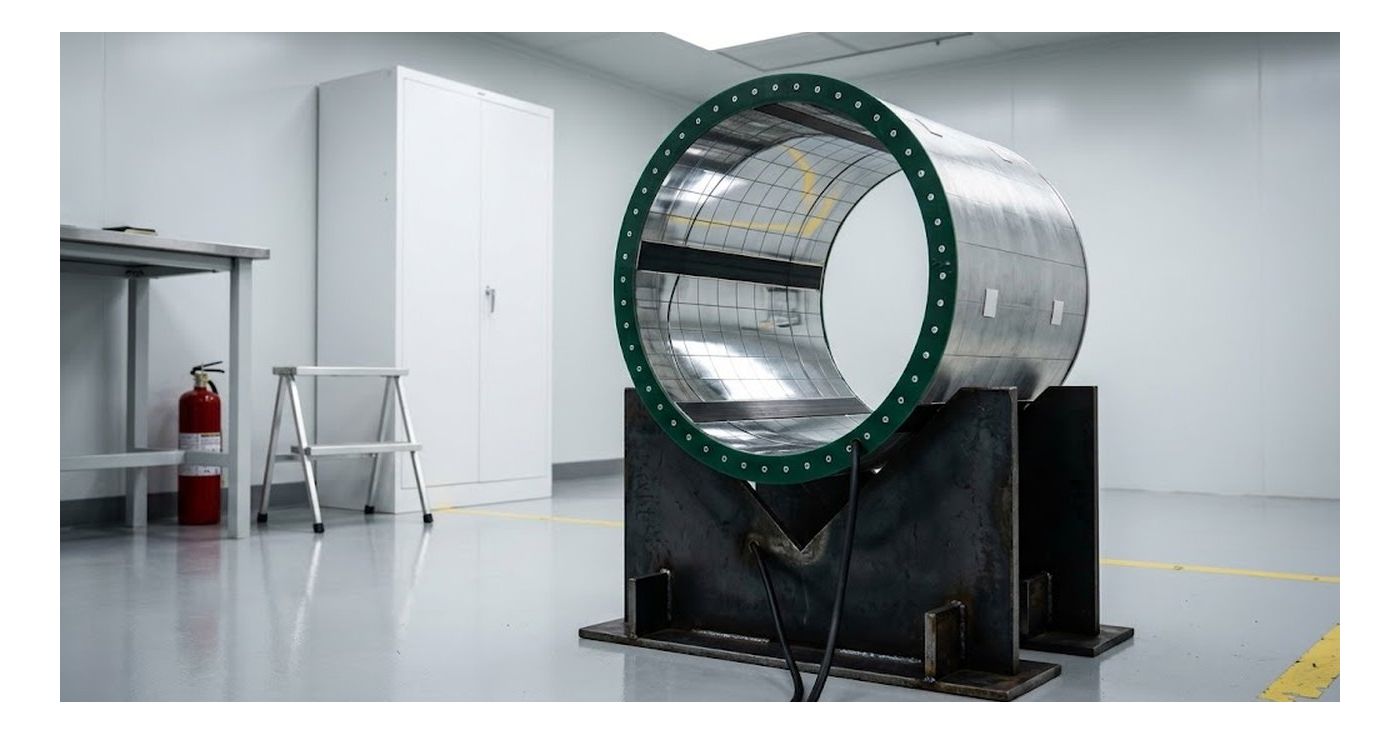
The quantum battery element made big: a mirror-lined light trap feeds solar cells, and a CMOS controller stores the current in quantum battery chips and gives it back out.
- Who it's for: energy-storage, solar and building-energy engineering firms, and labs working on light trapping and thermoelectrics.
- The problem it solves: one controlled system that collects light, stores it, keeps itself cool and puts its waste heat to use, in four sizes from one chip to a battery-pack string.
- What you get: Blu-ray engineering package: system spec, OpenSCAD model, controller firmware with a passing simulator, BOM, commercialisation rights. Design targets, not tested hardware.
Asset valuation: $4,000,000,000. Project 113 · cri-one.com portfolio · Author: Christopher Gabriel Brown. Magnum Quantum Battery Series: Element, Bench, Rack and String. Builds on Project 78 (FocusPhi Reflective Tunnel) and Project 05 (Quantum Battery).
Picture a barrel lined with mirrors, closed at both ends except for one small window. Light that gets in through the window bounces from mirror to mirror and has almost no way back out, so it keeps bouncing until something catches it. In the Magnum, what catches it are solar-cell strips set into every fourth mirror segment. Sunlight and room light come in through lenses that funnel a wide view into that one small window, and a ring of tiny LEDs can add light of its own when there is energy to spare. The current the cells make is saved in quantum battery chips, the same small chips as the Quantum Battery project, and given back out when it is needed. That is the whole idea: the quantum battery element made big. A small chip stores; the Magnum is many of them, fed by a light trap.
It runs like an electric engine, with eight words: ON and OFF, START and STOP, SLOW and FAST, HOT and COLD. Inside, a CMOS controller does the rest, in the battery's own steps of give, take, save and add momentum. It keeps the cells cool, because cool cells make more current. It sends the heat it removes to warm water or air instead of wasting it, and it wins back a little extra current from the hot and cold sides. The controller firmware is written and passes a full simulated day in which every watt-hour is accounted for, because nothing comes out that did not go in. The Magnum comes in four sizes: Element (one chip), Bench, Rack, and String, which is modules wired together like a battery pack. It is a concept-stage engineering package, not tested hardware. It extends the FocusPhi Reflective Tunnel and the Quantum Battery, and those are covered by pending patent applications.
Valuation
Pre-production blueprint usage right, patent pending, non-exclusive. The Magnum sits where three markets meet: battery energy storage (it stores and exports electricity), concentrator photovoltaics (lenses and a light trap feeding small solar cells), and thermoelectric and heat-recovery systems (it cools its cells and puts the removed heat to use).
Patent position
The Magnum is built from parts that are already patent pending. Its storage element is the Project 05 quantum battery chip, which sits under U.S. application 18/370,908 (filed 2023-09-21, AutoPhi: quantum battery integration and electromagnetic propulsion IC). Its CMOS firing sequence comes from the Project 03 electric jet, which sits under the umbrella application 19/540,453 (filed 2026-02-13, Integrated Technology Portfolio). The light trap is the Project 78 FocusPhi Reflective Tunnel, built on the inventor's six 2017 founding inventions. The Magnum's own combination (light trap, quantum battery chips, tri-generation control and layered concentrator) is documented here as a dated public offering; it is not yet the subject of its own filing.
Market opportunity
- Battery energy storage systems: about $51B (2025) → $106B (2030) (MarketsandMarkets; other publishers range from $37B to $77B for 2025).
- Concentrator photovoltaics: about $1–1.2B (2025), growing roughly 6–12 % a year (TechSci Research, DIResearch).
Comparable transactions
- No public sale of a comparable pre-production package is on record. As an estimate (not a sourced figure): non-exclusive pre-production energy-technology licences generally clear in the low millions, with milestones and royalties for manufacturing rights.
Estimated valuation range
Realistic clearing band for a non-exclusive blueprint usage right: $1M (research / single-buyer evaluation) → $15M (strategic non-exclusive with manufacturing / deployment rights). The upper end assumes silicon validation of the Project 05 chip, whose figures are design values not yet measured.
Listed catalog price: $1,964,775,000 — twice the FocusPhi Reflective Tunnel alone, set by the inventor; a public anchor for direct enquiry. The actual clearing price is negotiated inside the range above with the buyer, scope (non-exclusive, territory, field of use) and milestone structure.
Description
Project 113 — Magnum Quantum Battery Series (SKU MAGNUM-QB-SERIES)
Status: Concept (L1), with a parametric OpenSCAD model (L2 start) and controller firmware that compiles and passes a full simulated day. Design targets only, not hardware-validated. Builds on Project 78 (FocusPhi Reflective Tunnel) and Project 05 (Quantum Battery), with the CMOS sequencing of Project 03 (Electric Jet).
Overview
The Magnum is the quantum battery element upscaled: a large quantum battery system built from small quantum battery chips. An optical reflective tunnel, mirror-lined and closed except for one small input window, traps ambient and solar light until photovoltaic harvester strips absorb it. A CMOS energy controller saves the harvest in quantum battery chips and gives it back out. The control loop is the quantum battery's own series of steps: give, take, save and add momentum.
1. The energy cycle
2. Tunnel fittings (the light trap)
- Input window: anti-reflection-coated fused silica in a high-reflector end cap; the small aperture is what keeps light inside.
- LED ring: 48 visible LEDs (400–800 nm) around the window, inside the cavity, each with a collimator lens aimed down the tunnel.
- Harvester segments: every fourth ring segment carries a PV strip on its inner face (32 harvester zones); the mirror segments bounce light onto them.
- Far end: a high reflector; light is meant to be absorbed inside, not emitted.
- Cooling: Peltier tiles on the harvester segments' outer faces, run by the controller.
3. Controller board
tunnel_ec, 160 × 100 mm, 4-layer FR-44. Tri-generation control (cool · heat · current · store)
One controller runs four flows at once so each unit of energy does as many jobs as possible before it leaves. Current is the main output, every harvester zone held at its maximum-power point. Cool: PV loses about 0.4 % of output per °C, so the coolers run while the current they win back is worth more than they use. Heat: the heat taken off the cold side goes to a water or air heating loop instead of the room. Recover: where hot and cold sides meet, thermoelectric modules return a little extra current. Store: the rest goes to the battery chips. Energy in (light, LED drive, any electricity fed in) always equals energy out (electricity, useful heat, losses); the gain is in use, not in energy.
5. Concentrator options (two to four layers of optics)
- Primary: a Fresnel lens facing the sun, or a compound parabolic concentrator (CPC) for diffuse light.
- Secondary: a small CPC or homogeniser at the focus (standard two-stage concentrator practice).
- Coupler: a plano-convex lens in the input window, matching the light cone to the tunnel.
- LED optics: a 10 mm collimator on each LED of the input ring.
Direct sun: concentration of hundreds of times onto small, cooled, high-efficiency cells. Diffuse ambient light: about 2 to 10 times, set by the étendue limit of optics, which no number of layers can beat. Two or three layers are recommended: each extra surface loses a little light.
6. The Magnum Quantum Battery Series
Storage scales with the number of chips, collection with the tunnel aperture and length. The series is specified by chip count and tunnel size rather than a total, because the per-chip capacity is a Project 05 design value not yet measured in silicon.
7. Controller firmware
The user sees eight words, like the controls of an electric engine: ON / OFF (ignition), START / STOP (run the cycle), SLOW / FAST (throttle, 8 notches from a 2 s to a 10 ms cycle), HOT / COLD (send waste heat to the heating loop, or reject it and cool harder), plus STATUS. Everything else is automatic every 10 ms, including an over-temperature trip at 85 °C. The firmware is written in C for the MSPM0 and compiles with no warnings. A PC simulator runs one full day at the board's 10 ms loop and passes every check:
8. CAD
cad/magnum_bench.scad: an OpenSCAD model of the Magnum Bench, built from the FocusPhi segment geometry: tunnel, harvester segments, Peltier tiles, end caps with the window, LED ring with collimators, one to four lens layers (Fresnel or CPC primary), and the controller box. It is sun-facing, with the concentrator above the tunnel, and every part can be exported separately.
Honest physics
- The tunnel stores light only briefly: about 1.3 µs for a 1 m tunnel (Project 78 THEORY §4.4). Lasting storage is in the battery chips.
- "Amplify" means capture, not gain. The mirrors raise the share of incoming light that reaches the harvesters. Net output cannot exceed the light harvested plus energy previously stored.
- LED re-injection recycles, it does not create. The Project 05 round trip is 40–60 %, so the LEDs run on surplus only.
- Maturity: concept and simulation. No schematic, layout, prototype or measurement yet. The quantum battery chip figures are Project 05 design values, unverified in silicon.
Patent position
Patent pending through its parts. The storage element, the Project 05 quantum battery chip, sits under U.S. application 18/370,908. The CMOS sequencing comes from the Project 03 electric jet, which sits under the umbrella application 19/540,453 (Integrated Technology Portfolio). The light trap is the Project 78 FocusPhi Reflective Tunnel. The Magnum's own combination is documented here as a dated public offering and is not yet the subject of its own filing.
What the Buyer Receives
- README, SPEC (11 sections), STATUS with the inventor's decisions, MANIFEST.json.
- The controller BOM: real catalogue parts and indicative quantities.
- The controller firmware: the core, the MSPM0 board loop, and the PC simulator with its tests.
- The OpenSCAD model and its preview images.
- Worldwide commercialisation rights to the package (non-exclusive).
What the Buyer Does NOT Receive
The underlying patents and applications are retained by the inventor. This is a documentation and commercialisation-rights transaction, not a patent licence or assignment; a licence or assignment is a separate written transaction. Also not included: prototype hardware or measurements; the controller schematic and layout; quantum battery silicon; optical ray-trace of the concentrator; regulatory filings.
How this is delivered
This package ships on a single Blu-ray disc, posted to the delivery address on your order. The archive on the disc is AES-256 encrypted; the passphrase is sent separately, by email, once the disc is despatched, so the disc alone is of no use to anyone who intercepts it. Discs are despatched by tracked, signed-for post. Allow 5 business days for mastering and verification before despatch.
© 2026 Christopher Gabriel Brown. All rights reserved. Patents and underlying IP retained by the inventor. Design targets only. First to market: documented public offering.
Footnotes
Project 113. Family: energy storage and light harvesting. Purchase: when you buy, you buy the use of that blueprint only.