
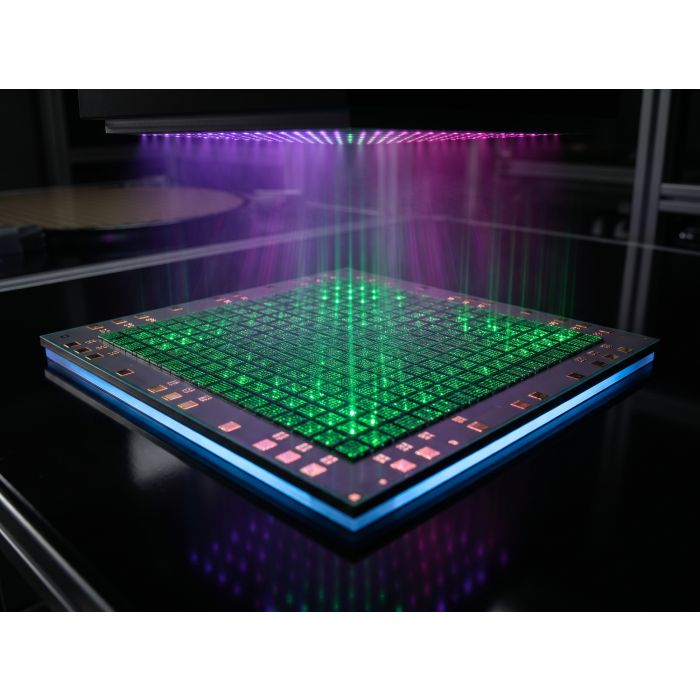
ND1-C20-E — Nano Synthetic Electro-Photosynthesis — Complete Shelf
Why you'd want it
A Blu-ray that turns electricity into light and back inside its own silicon, at nano scale — shipped as 5,050 ready-to-fabricate blueprints plus our GDSII generator.
- Who it's for: IC design teams and research buyers who want to tape out a nano photosystem die at the foundry of their choice.
- The problem it solves: getting more useful work out of each watt through optical concentration and electro-Peltier heat recycling, bounded by the first law in hardware.
- What you get: blueprint and right to build: Verilog RTL for the voxel photosystem, 5,050 numbered configurations, Project 67 standalone GDSII generator, per-buyer ed25519 license key — on Blu-ray, mailed by hand.
Asset valuation: $500,000,000,000 — quote-only collector list. The ND1-C20 voxel line was named in the 2017 Invent Depositions (#957 and #1609–#1616, ISBN 978-1-979767897). Patent-pending, not patented. Non-exclusive. USA buyers only. Every disc carries an ed25519 LICENSE.key bound to the buyer; every GDSII the generator produces embeds the buyer's identity onto layer 254.
Electricity in, light inside, electricity back out — bounded at every step by the first law. ND1-C20 is a nano synthetic electro-photosynthesis die: a silicon chip the size of a thumbnail that makes its own light with on-die micro-LEDs, catches it in tiny per-voxel cavities, and converts it back to electricity, recycling the waste heat through a thin-film Peltier layer on its back. It is not a solar cell and it is not free energy. The honest claim is that more useful work comes out of each watt you feed in, because the die wastes less.
The disc you are buying is not the chip. It is the complete set of blueprints — 5,050 numbered configurations across five silicon grades, ten packages, and 101 lots — plus the Project 67 standalone GDSII generator that turns any one of those blueprints into a fab-ready layout on your own hardware. CRI-ONE ships the tool, not the output. You run the generator, on your own computer, on an ed25519 license key burned to the disc at the moment it leaves the drive. The generator stamps your identity onto layer 254 of every GDSII it writes. Your layout is yours; it never exists on our systems.
The voxel line was written down in 2017, in the Invent Depositions #957 and #1609–#1616 (ISBN 978-1-979767897). This disc is the direct realisation of #1609–#1616: the engine of Project 115, shrunk to a 500-nanometre voxel and tiled by the billion per die. The "engine" is a stack of a multi-junction photosystem analog (a top layer tuned to green light, a bottom layer tuned to infrared), an integrated Fabry-Perot cavity between two VCSEL-grade mirrors, and a thin-film electro-Peltier tile underneath. Each voxel has its own cavity and its own Peltier zone. One 400-square-millimetre die carries about 1.6 billion of them, and a 300-millimetre wafer carries about 280 billion.
Honest-frame instruments ride in every configuration: a hardware-fused η_combined cap that software cannot raise, a metrology bus that reports the loop gain g per super-pixel as a diagnostic (not a product claim), and a per-voxel Peltier clamp that enforces the Carnot bound in silicon. Grade E, which is a defect-mapped sensor-only tier, carries the same instruments as Grade A; the only thing the grade changes is how many voxels the RTL instantiates and the die area it targets.
This is for engineering buyers and licensees who put silicon on a tape-out schedule. The buyer receives the blueprint and the right to build at the foundry of their choice; everything else — the IP, the design authorship, the layer-254 forensic signature, the ed25519 keypair — stays with CRI-ONE. Non-exclusive. USA companies only. USD only. Email and postal mail only. Patent-pending, not patented. The $500B catalog list is a collector / quote-only line; write Christopher at christopher@cri-one.com for a real purchase path.
Valuation
Pre-production blueprint usage right, patent-pending, non-exclusive. The analog closest in the market is specialty photonic/semiconductor IP comparable to Ayar Labs and Lightmatter on the photonic-photosystem side, and specialty power-IC lines comparable to Analog Devices / Vicor on the electro-Peltier recycling side. On the integration side the closest comp is wafer-scale compute IP like Cerebras, remapped from compute tiles to photosystem voxels on the same AutoPhi die footprint.
Patent landscape
The photonic-compute and multi-junction PV spaces are heavily patented (Nvidia, Google TPU, Cerebras, Lightmatter, Ayar Labs, NREL spin-outs) but still growth-oriented. Novel architectural claims around on-die cavity-concentrated photosystem recycling and electro-Peltier integration remain patentable; silicon-photonics filings grew roughly three-fold between 2020 and 2024, and specialty-power-IC filings continue to climb with the datacenter buildout.
Market opportunity
- AI chip market: $120B (2026) → ~$500B (2032).
- Specialty power semiconductor (GaN / SiC / thermoelectric): $30B (2026) → ~$75B (2030).
- Silicon photonics IC: $1.6B (2024) → ~$7B (2030).
- Specialty photosystem / artificial-photosynthesis research: a nascent category; the ND1-C20 line targets a credible first-mover position at nano scale.
Why $500B as the catalog list
The $500B is the author's valuation of the complete blueprint-and-build right across the full 5,050-configuration shelf, held as a single collector / quote-only line on the catalog. The value reflects: (a) the 2017 deposition priority date on the voxel line (#1609–#1616); (b) the integration with Project 67's GDSII generator and the anti-theft architecture (per-buyer ed25519 license keys, layer-254 fingerprints, physical Blu-ray delivery); (c) the exhaustiveness of the 5,050-configuration grid relative to the single-die comps; and (d) the first-mover position on nano-scale synthetic electro-photosynthesis specifically. The $500B is above the CgbInstallments ACH ceiling of ~$120M (Stripe $1M/charge × 120 payments) by design — the normal members checkout clears individual per-SKU configurations well under that ceiling; the complete shelf is sold under contract.
Comparable transaction references
Specialty IP license deals on comparable technology (wafer-scale compute, specialty photonic IP) have historically cleared in the $10M–$500M range per non-exclusive buyer, with exclusive or portfolio-wide transactions running into the billions. The $500B list is the ceiling; actual per-contract pricing is set from the buyer's intended fab scope, foundry choice, and geographic reach.
How to buy
Write Christopher directly at christopher@cri-one.com. USA companies only, USD only, email and postal mail only. Patent-pending, not patented. Non-exclusive. The author replies in writing.
Description
CRI-ONE Project 120 — ND1-C20-E: Nano Synthetic Electro-Photosynthesis — Complete Shelf
Version: 1.0.0 (first catalog release — the shelf is design-stage; nothing taped out, built, or measured)
Date: 2026-11-12
License: Proprietary — All rights reserved. IP is retained, never assigned. The buyer receives a blueprint and the right to build; the creator retains everything else. See the LICENSE.md inside each per-configuration kit on the disc for the ten-section instrument.
CRI-ONE Project 120, "ND1-C20-E: Nano Synthetic Electro-Photosynthesis — Complete Shelf," is the digital catalog of CRI-ONE's nano photosystem die, delivered on a signed Blu-ray disc that contains 5,050 ready-to-fabricate blueprints plus the standalone GDSII generator used to turn any one of them into a fab-ready layout on the buyer's own hardware. The shelf carries one physical product, mailed by hand; the 5,050 configurations ship inside it. CRI-ONE does not sell fab-ready GDSII and never holds a .gds file.
1. The engine, in one paragraph
The ND1-C20 is a silicon die whose active surface is tiled with sub-micron voxels. Each voxel is one photosystem-analog cell with its own integrated Fabry-Perot cavity between VCSEL-grade mirrors, its own thin-film electro-Peltier back-tile, and its own send/receive re-emit layer. An on-die micro-LED matrix (ultraviolet at 370 nm plus infrared at 940 nm) illuminates the voxel grid from directly above. The cavity concentrates the pump light intracavity, the multi-junction stack converts it to electricity, and the Peltier back-tile reclaims part of the waste heat as additional electricity. Nothing exceeds Carnot; nothing exceeds the first law. The die is both a photosystem and an AutoPhi compute substrate when the AutoPhi lanes are enabled.
2. What ships on the disc
3. The 5,050 configurations
Five grades × ten packages × 101 lots = 5,050 blueprints. The grade controls voxel count and die area; the package controls the carrier the pin ring synthesises to; the lot is a numbered RTL fingerprint used for leak attribution.
Package choices: bare die + spreader; QFN-24; QFN-48; BGA-64; BGA-121; BGA-196; BGA-256; BGA-400 (the flagship footprint); BGA-625; BGA-900. Lot numbers run from LOT-000 through LOT-100, each a serial-numbered RTL fingerprint engraved in the RTL as non-functional whitespace and ordering variations, and in the generated GDSII on layer 254. SKU shape: ND1-E-<grade>-<pkg>-L<lll>.
4. The two honest multipliers
Optical concentration: every voxel owns its own Fabry-Perot cavity between integrated DBR mirrors. At a finesse of around 300 the per-voxel intracavity intensity gain is over 300× the pump; the cavity multiplies intensity, not throughput, so total energy per second is still capped by total die input power.
Electro-Peltier recycling: each voxel sits on a thin-film thermoelectric tile (ZT ≈ 1.4 at 300 K, standard practice today). The combined-efficiency identity is η_combined = η_PV + η_TE × (1 − η_PV). At η_PV = 0.50, an η_TE of 0.25 yields η_combined = 0.625 (a 25% gain over the PV-only path); at η_TE = 0.44 it yields 0.72 (a 44% gain). Nothing exceeds Carnot.
5. The first-law bound, stated out loud and enforced in silicon
P_die ≤ (P_µLED,die + any outside feed) × η_combined. The η_combined ceiling is a hardware fuse — set once per die at probe and sealed — not a software register. Grade A, B, C, D and E all carry the same fuse mechanism; the honest-frame instruments (metrology bus, loop-gain g readout, per-super-pixel Peltier clamp) are standard across the shelf. No configuration in the catalog advertises a surplus. The metrology bus reports g as a diagnostic, not as a product claim.
6. Delivery — Blu-ray, by hand
Every order ships on a Blu-ray disc (25 GB single-layer, or 50 GB dual-layer where the archive requires it), burned at CRI-ONE and mailed by Christopher by hand. USPS Priority Mail or equivalent, with tracking. The VPS is not in the delivery path; CRI-ONE's server never streams the archive. The disc is signed: its per-buyer LICENSE.key carries an ed25519 signature over the order and customer binding, and the generator verifies that signature on every run. A copied disc fails the check and the generator refuses to produce any GDSII.
7. Security — the six layers
- Customer-group restriction: the PDP is public (noindex) but add-to-cart is members-only. Anons get a 302 to sign-up.
- License-locked generator: the standalone generator refuses to run without the ed25519 LICENSE.key signed by CRI-ONE's private key, which lives only at /root/keys/nd1_e_ed25519 on the VPS.
- GDSII fingerprint on layer 254: every output embeds {customer_id, order_id, sku, timestamp} as TEXT records on layer 254 of the GDSII. A leaked GDSII identifies the buyer.
- RTL fingerprint: every delivered RTL zip carries a unique SHA-256 via non-functional whitespace and ordering variations plus a MODULE_SIGNATURE constant, unique per buyer.
- Signed physical disc: no download URL; the disc is signed at burn time and the generator verifies it on every run. There is no HMAC streaming endpoint.
- Shipment audit log: every burn-and-ship event writes to the mgfj_nd1_e_shipment_log MySQL table with disc serial, ISO SHA-256, license-key signature, carrier, tracking, operator, status.
8. Honest scope — what is NOT on the disc
Nothing taped out at a foundry. Nothing fabricated. Nothing measured. Every performance figure in NODE_CONFIG.yaml is an engineering design target. The disc never carries a pre-generated .gds file, a pre-synthesised netlist, or a pre-placed-and-routed layout — the buyer produces fab-ready output on their own hardware by running the included generator. CRI-ONE does not produce or store GDSII for this product.
9. Provenance
The ND1-C20 engine is the direct realisation of depositions #1609–#1616 ("pico nano voxel and elemental compounds for chip processing printing in three dimensions") from the 2017 Invent Depositions (ISBN 978-1-979767897), under the broader #957 synthetic electro-photosynthesis frame. The foundational equation a + m² = E (#190/#191) is unchanged; derivations live in Project 27 (Mathematical Depositions). Parent engineering document: Project 115 (Synthetic Electro-Photosynthesis).
10. Terms
Non-exclusive, perpetual, non-sublicensable, non-transferable license to use the enclosed RTL and GDSII generator for the licensee's own products. Multiple SKUs require multiple licenses. USA companies only. USD only. Email and postal mail only — no phone calls, no brokers, no intermediaries. EAR / Entity List / OFAC SDN / DDTC Debarred screening. No re-export to PRC / Russia / Belarus / Iran / DPRK / Syria / Cuba. Governing law: Georgia. Arbitration: AAA commercial, Atlanta.
Patent status
Patent-pending where noted, not patented. The "patent" tags in the 2017 Invent Depositions are CRI-ONE's internal deposition indices, not USPTO grant numbers. Live U.S. applications on related subject matter include 17/687,656; 63/552,008; 17/454,808; 29/839,062; 29/892,202; 19/455,625; 19/865,443 and 19/865,419 — applications, not grants.
Author
Christopher Gabriel Brown — CRI-ONE — cri-one.com — christopher@cri-one.com. © 2017–2026, IP retained by CRI-ONE.