
Mainframe Summ
Why you'd want it
The Mainframe Summ: the Summ, played in time. The Summ Engine tower with the reactor's whole rack floor stood up inside it, 100 tables and 10,000 cards, and a manager, the Mainframe, that keeps every barrel on the beat. Storage and momentum on CMOS, at the scale of a 128 m tower.
- Who it's for: compute-hosting, AI-infrastructure, energy-storage and district-energy developers, and firms that already follow the Summ Engine, the Quantum Battery, the Magnum, the QRS-117 / QRS-118 reactor or QBeam.
- The problem it solves: the same silicon delivers a fraction of its ceiling when it is played out of time. The Mainframe listens to every chip over QBeam and keeps each cycle matched to the chip's own rhythm: add momentum is add match. Six match factors held together give 3.8 times the output of the same hardware with each at 80 %.
- What you get: Blu-ray engineering package: the Mainframe note (the principle, the six match factors, the tempo tracker), the specification, the momentum numbers, the register and QBeam frame map, the compressed barrel, the heat cycle, the manager firmware with its one-day simulation, its C port, the tracker in Verilog with its model, the OpenSCAD model and the scale calculator. Design values, not tested hardware.
Project 121 · cri-one.com portfolio · Author: Christopher Gabriel Brown. The Mainframe Summ: the Tower and the Campus. Builds on Projects 114, 117, 118, 05, 113, 76, 78, 49, 99 and 27.
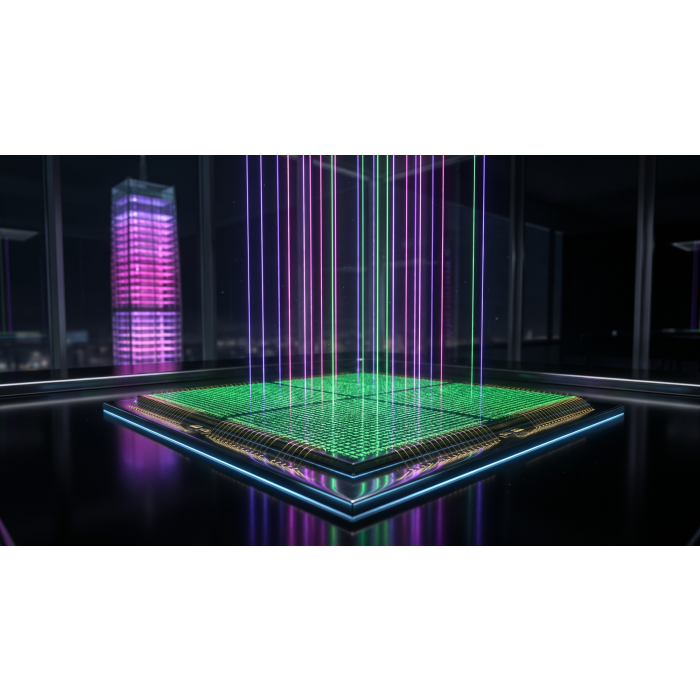
Picture the Summ Engine's glass tower in a city at dusk, its floors glowing magenta and violet. Now watch the glow: every floor pulses together, and one wave of light climbs the tower from the street to the roof, like a beat. That beat is the product. The inventor's words for it: the cycle of the performance is the music... without the sound time experience there is low performance. A chip has its own tempo, its own pitch and its own shape, and it plays them whether anyone cues it or not. Drive it in time and it rings; drive it loosely and the same silicon goes quiet. In this machine, adding momentum never means playing faster. It means tightening the lock.
Behind the glass of every floor lie thirteen short mirror-lined barrels, each ringed with sixty-four small cells, one for every quantum battery chip behind it. Beside them stand the server tables: the whole rack floor of the inventor's reactor, a hundred tables and ten thousand cards, stood on end inside one tower. On a low floor sit two matching cabinets: the Mainframe. Every chip in the building sends it a short message a thousand times a second, saying where its beat landed. The Mainframe works out how well each barrel is in time, six ways (rhythm, pitch, phase, timbre, dynamics, tempo), and sends each one its next cycle. The messages travel as light, floor to floor, with no cables. The chips' storage is the flywheel; the tables are where the momentum goes; the Mainframe is the drummer. On the inventor's five-level maturity ladder it stands at L3: specified and simulated, with a manager firmware simulation that runs and passes its checks. The figures that wait on first silicon, the chip's own storage and timing, stand at L1 as design values. L4 is the next step: a first article built and measured. Its parts are covered by pending patent applications.
Valuation
Product name: the Mainframe Summ. Project 121.
Pre-production blueprint usage right, patent pending through its parts, non-exclusive. The Mainframe Summ sits where three markets meet: compute hosting and AI infrastructure (one tower carries the reactor's whole rack floor: 100 tables, 10,000 cards, a design throughput of 20 exaOPS, extrapolated, not measured), battery energy storage and pulse power (26,624 quantum battery dies, 39.94 MWh design reservoir, 4.16 – 10.40 MW peak at the terminals), and district heating and cooling (its cold side sells cold off-season and its heat loop sells heat).
Patent position
Patent pending through its parts, all equally: the quantum battery chip (U.S. application 18/370,908), the CMOS sequencing umbrella (U.S. application 19/540,453), the all-in-one umbrella (U.S. application 19/835,210), and the reactor-scale compute facility and its continuation-in-part (U.S. applications 19/865,419 and 19/865,443).
Market opportunity
- AI-compute infrastructure: the category's recent precedent band runs from about $23B to $157B, median about $62B (as used for the QRS-118 listing).
- Battery energy storage systems: about $51B (2025) → $106B (2030) (as used for the Summ Engine listing).
- District energy: the Negative Microwave utility plant sells district cooling off-season; the heat loop sells heat.
Comparable transactions
- No public sale of a comparable pre-production package is on record.
Listed price
$1 trillion, set by the owner.
What moves the value up
- The bench sweep the principle paper asks for: one afternoon, the cycle swept from 5 ms to 2,000 ms on a quantum battery die, the charge per cycle recorded.
- A measured quantum battery die.
- One barrel built with its ring of cells and its tracker closed, the six match factors read off it.
- One Tower built and metered for a year with its tables running.
Maturity marker
L3 — specified and simulated; the figures that wait on first silicon at L1. At L3: the tower is specified from the Summ Engine's own sheet; the manager is written as firmware with a one-day simulation that runs and passes its checks, as a C port and as Verilog with a bit-accurate model; one parameter sheet with 113 checks feeds every file; the inherited Magnum controller and firmware stand at L3 on their own status. At L2: the tower and campus model (OpenSCAD). At L1, as design values unverified in silicon: the quantum battery die's 1,500 Wh and its 75 MW burst, the chip's settling time and Q, and the reactor card's throughput (extrapolated). L4 is the next step: a first article built and measured.
Description
Project 121 — Mainframe Summ (SKU MAINFRAME-SUMM)
Status: L3, specified and simulated; the figures that wait on first silicon at L1. The tower is the Summ Engine's, from its own sheet; the tables are the reactor's; the manager is the tempo tracker of the inventor's principle paper Performance Is Music, built on the quantum battery's programmable CMOS engine and its station firmware. One parameter sheet with 113 checks feeds every file; the manager firmware runs a one-day simulation; the tracker is written in Verilog with a bit-accurate model. L4 is the next step: a first article built and measured. Builds on Project 114 (Summ Engine), Projects 117 and 118 (the reactor), Project 05 (Quantum Battery), Project 113 (Magnum Quantum Battery Series), Project 76 (QBeam Transfer), Project 78 (Reflective Tunnel), Project 49 (Solo Negative Microwave) and Project 99 (Normal Resonance), with the principle on file in Project 27.
Overview
The Mainframe Summ is the Summ, played in time. The Summ is the Summ Engine tower: the reservoir. The tables are the reactor's rack floor, stood on end inside it: where the momentum goes. The Mainframe is the manager for the CMOS that makes the calculation: it listens to every chip over QBeam and keeps every barrel on the beat. Storage and momentum on CMOS, at the scale of a building.
1. In the inventor's words
The cycle of the performance is the music... without the sound time experience there is low performance. Performance is the ideal ceiling multiplied by six match factors: rhythm, pitch, phase, timbre, dynamics and tempo. Each reaches one only when the firmware's cycle is in time with the chip's own. So add momentum is add match: more momentum means tighten the lock; it never means ignore the chip and spin. The chip plays a song whether you cue it or not. The firmware is the drummer. The Mainframe is that drummer for a whole tower.
2. Up, and in time
A 128 m glass tower, 32 floors of 4 m, 32 × 32 m in plan, its floors lit by their LED rings. On every floor: 13 compressed barrels, mirror-lined light traps half a metre across and one metre long, each with a ring of 64 small cells, one per quantum battery die; String cabinets along the north side; three server tables, and a fourth on four of the floors. The whole tower: 416 barrels, 26,624 quantum battery dies in 4 Strings of 104, and the reactor's entire rack floor: 100 tables, 10,000 cards, 25 tables to a String. Down the middle, the Reflective Tunnel standing on end. On the mechanical floor, the Mainframe: a hot-standby pair. Up the riser, eight QBeam relays. The Campus is 25 towers: 25 rack floors, 250,000 cards.
3. The Mainframe: what it hears, what it works out, what it sends
Every barrel sends one 64-byte message every millisecond: where its recycle peak landed in the cycle, its pump slope, its charge, its temperature, its energy counters. Every card sends one too: its queue, the gear it is asking for, and a flag one tick ahead of each load step. The Mainframe works out each barrel's six match factors, retimes its cycle, and sends back one 64-byte image of the chip's 32 parameter registers. The whole exchange, up and down a 128 m tower over eight relays, takes 140 microseconds of each millisecond.
At start-up each barrel sweeps its cycle from 5 ms to 2,000 ms and records the charge it gets per cycle: that is the chip telling the Mainframe its own tempo. From then on the tracker follows it: the cycle shortens a little as the chip fills and lengthens a little as it warms, and a phase lock holds the recycle peak on the centre of its beat. FAST and SLOW still exist; they lean on the tracker, they do not pick the period.
4. The six matches, and what holding them is worth
Six levers each at 80 % multiply to 0.26. Held together at one, the same silicon delivers 3.8 times as much. On rhythm alone, the tracker's cycle is worth 3.0 times the slowest notch of a fixed table. In the barrel the light keeps time too: with the Reflective Tunnel's mirror pair a photon makes 1,000 passes. The chip's settling time, its Q and its mode are design-stage estimates; the start-up sweep replaces them with the chip's own numbers.
5. The fold: the gear ratio
Momentum is cycling. Fold = (1 / cycle time) × output ratio × phases / 0.025, in 25 tiers from 1× to 200,000,000×, and 500,000,000× with programmable CMOS. The momentum transfer rate is the throttle; the fold tier is the gear ratio; storage is the fuel tank. The Mainframe starts every barrel at the programmable CMOS engine's sweet spot: 0.4 s charge, 0.4 s discharge, 1.25 cycles a second, 100 phases, output ratio 0.30, efficiency 87 %, a fold of 1,500×. From there the fold follows what the compute rows ask for, and efficiency is never traded for speed: the floor is 85 %.
What the fold buys: at the sweet spot the tower's 4.16 – 10.40 MW peak comes from 30.8 – 77.0 Wh of cycling reservoir, one part in 336,960 of the usable storage. The higher the fold, the smaller the reservoir that delivers the same power, and the rest stays in storage for the hold. The Mainframe commits 37.0 % of each die to momentum and holds the rest. At the terminals the tower delivers four to ten times its average pump.
6. No loss
Three things stop being paid. The swell: every drive change is ramped, so the half that a hard step wastes is kept. The lock: with the peak on the downbeat, power stops beating against itself. Recycling: four harvesters (thermal, photonic, electrical, reverse recovery) return 40 – 60 % of LED power. The tower is externally pumped: for its 923.5 kW site load the pump falls from 1.85 MW at the baseline round trip to 1.06 MW at the sweet spot, 43 % less.
7. Compressed barrels, smaller cells
The barrel shrinks from 1.0 m × 3.0 m to 0.5 m × 1.0 m, 10.4 times smaller, and its cells from eight long strips to 64 cells of 40 × 40 mm, one for each die: 19 times less cell. With the Reflective Tunnel's dielectric mirror pair the trap still captures 0.985 of the light. The smaller cells work under 19 times the light, which raises each junction's voltage by 77 mV, and the shorter barrel frees two metres of floor depth for the tables.
8. Like a heat cycle
The four words are four strokes. Pump is heat in, at the LED ring. Recycle is compression: the mirrors build the light up and the harvesters take back the waste. Store is work out, at the cold cells into the dies. Add momentum is the turnover, in time. An engine runs best at its own speed; so does this one. The cold side is the Negative Microwave, by catalog name: NM-SP-PHOTO for the envelope, NM-DC-ROOM for the tables, NM-HVAC-UTILITY for the Campus.
9. The tables: where the momentum goes
The card is the QBeam card's slot: 75 W. A table of 100 cards draws 7.5 kW, and one tower holds the whole rack floor with room to spare: 100 tables installed, 203 within its 14-hour hold. Ten thousand cards per tower, 750 kW of compute, a design throughput of 20 exaOPS (two POPS a card: extrapolated, not measured). The compute works its own momentum: the rows say what gear they need and when their load will step, and the pump beat is placed on it.
10. All nine technologies, wrapped
11. What ships
- The Mainframe note: the principle, the six match factors, the tempo tracker, the start-up sweep, the rules and the states.
- The momentum numbers: the music, all 25 fold tiers, the sweet spot, what the fold buys, recycling.
- System specification, status, patent position, site bill of materials.
- The register and QBeam frame map: 32 parameter registers, 16 monitoring channels, every frame byte by byte.
- The compressed barrel and the heat cycle.
- The manager firmware in Python with its one-day simulation; its C port, descended from the quantum battery's station firmware.
- The tempo tracker in Verilog with a bit-accurate model and test vectors.
- OpenSCAD model of the Tower and the Campus; the scale calculator (HTML) and its Python twin.
- The numbers script: one parameter sheet, 113 checks.
12. Honest limits
- The tower is externally pumped: 1.06 MW at the sweet spot for the full rack floor.
- The chip's settling time, Q and mode are design-stage estimates; the start-up sweep measures them.
- The tempo tracker is the one the principle paper proposes; it is first written here and is not in the Magnum's shipped firmware.
- The die's 1,500 Wh and its 75 MW burst are design values, unverified in silicon; the cards' throughput is extrapolated, not measured.
- The Python firmware, calculator and numbers script run and pass their checks; the C port, the Verilog and the OpenSCAD model are written and read through, not built.
- Maturity, level by level: L3 for the Mainframe, its tempo tracker and the numbers (specified and simulated, checks passing); L2 for the tower model (OpenSCAD); L1 for the figures that wait on first silicon. L4 is a first article built and measured; none is built yet.
| Date Launched | 2026-11-14 00:00:00 |
|---|