
Synthetic Electro-Photosynthesis
Why you'd want it
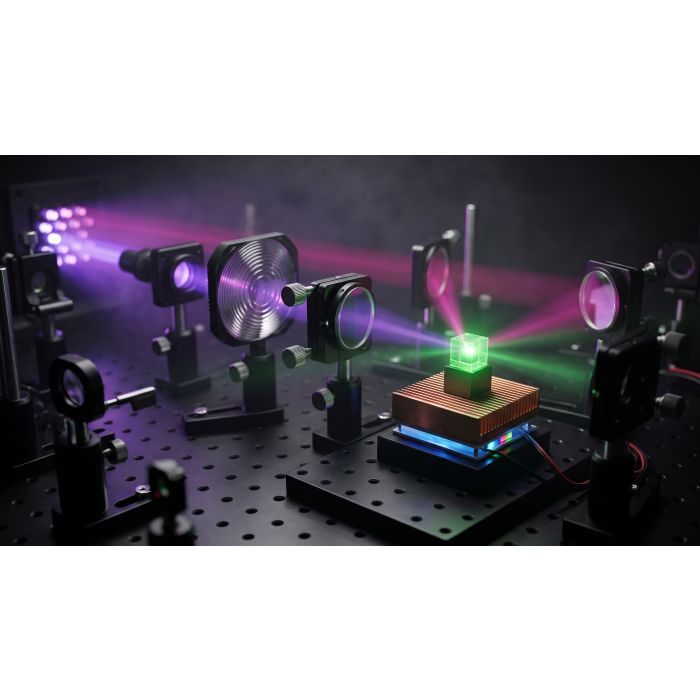
Synthetic Electro-Photosynthesis is the biggest part of the quantum battery — the Project 05 element made Magnum-scale (113) and raised into skyscraper form. An LED wall focused through multiplied lenses onto a green power-crystal that sends and receives (the inventor's 2017 root, deposition #957); its waste heat recycled by electro-Peltier; Project 48's engineered cell and Project 114's Summ Engine tower unified into one synthetic engine that scales from a chip to a tower. No sun, no wind — synthetic light in, concentrated and recycled, every watt bounded by what it is fed.
- Who it's for: energy-storage, compute-hosting and district-energy developers, and firms that already follow the Quantum Battery, the Magnum, the Summ Engine, the Private Energy Building or AutoPhi.
- What it is: the one synthetic-electro-photosynthesis line underneath Projects 48 and 114 — one green-crystal power-IC cell, two honest multipliers (optical concentration and electro-Peltier heat recycling), four scales from chip to tower, and the first-law bound stated on the page.
- What you get: the unified Project 115 blueprint: the 2017 root and deposition map, the cell stack, the concentration and recycling math, the four-scale table, and the two-face honest frame. Design values, not tested hardware.
Project 115 · cri-one.com portfolio · Author: Christopher Gabriel Brown. Synthetic Electro-Photosynthesis: the biggest part of the quantum battery, at Magnum scale, in skyscraper form. Unifies Projects 48 and 114 on the 2017 root (depositions #950–#960); derivations in Project 27.
Synthetic Electro-Photosynthesis
The biggest part of the quantum battery — built to Magnum scale, in skyscraper form. Projects 48 and 114, unified on the 2017 root: one engine from a chip to a tower, without changing the engine.
Synthetic light in, concentrated and recycled, every watt bounded by what it is fed.
What 115 is
This is the biggest part of the quantum battery: the element of Project 05, made Magnum-scale (Project 113) and raised into skyscraper form. Projects 48 (Private Energy Farms) and 114 (Summ Engine) are the same machine at two sizes. 48 is the engineered body — the cell, the optics, the heat recovery, the honest physics. 114 is that body stacked up, not out, into a tower. Project 115 is the one line underneath both, and it runs from a chip to a tower without changing the engine.
The engine is synthetic electro-photosynthesis: an LED wall focused through multiplied, colored lenses onto a green power-crystal that sends and receives. There is no sun and no wind — the light is synthetic, driven by input electricity. What makes it worth building is not free energy. It is two honest multipliers: optical concentration and electro-Peltier heat recycling, which together get more useful work out of each watt than a conventional cell does, bounded at every step by the first law.
1. The root — deposition #957 (2017)
The idea is dated. Christopher Gabriel Brown set it down in 2017 in the Invent Depositions (ISBN 978-1-979767897). The line #950–#960, in his words:
#957 — “multiplied uv or luminescence colored lens magnified and focused infrared LED wall to green solar crystal, send and receive as a synthetic electro-photosynthesis.”
#960 — “oscillating and inverted” re-emission — the “send and receive” made bidirectional.
Two 2019 lines name the economics and the chip form: #1655–#1658 “Solar Recycle Center” — “reflective focus and light combined, energy spent versus energy obtained… a study of refraction… less to make more… artificial solar LED recycle amplified” (a ratio study, not a free-energy claim); and #1609–#1616 — the same voxel architecture at chip scale. Foundational equation a + m² = E (#190/#191); derivations in Project 27.
The honest reading: “send and receive” is a photosystem that receives synthetic light and re-emits what it does not use — not a loop that creates energy. “Less to make more” is efficiency and recycling, not perpetual motion.
2. The one engine — the green-crystal power-IC cell
The IP is the cell, and it is the same cell at every scale. It is engineered like a power chip, not a solar panel: the bottleneck is the output side (busbar I²R, electromigration, cooling), not absorption. A multi-junction photosystem stack — a PS-II analog (GaAs + green chromophore, 1.42 eV) over a PS-I analog (1.10 eV), with UV (InGaP) and IR (Ge) absorbers for the two LED bands, a send/receive re-emit layer (dep. #960), heavy Cu/Ag metallization, microfluidic cooling, and the electro-Peltier recovery layer beneath.
Building-scale design targets: VOC = 2.50 V, J = 50 A/cm², P = 125 W/cm², single-pass η = 0.55 — just above the NREL 6-junction record (0.476), and labeled a design target, not a demonstrated result.
3. The two honest multipliers
This is why the line is worth building, and why it never breaks the first law.
3.1 Optical concentration — intensity, not energy
Cheap standard parts in series: a TIR collimator per LED, a Fresnel/aspheric condenser, and a Fabry-Perot cavity (the reflective tunnel), finesse F = π√R / (1 − R).
| Mirror R | Finesse F | Intracavity intensity gain |
|---|---|---|
| 0.90 | 30 | 30× pump |
| 0.99 | 312 | 312× pump |
| 0.999 | 3,140 | 3,140× pump |
Stacked with the lenses, the cell sees up to ~10⁶× the raw LED intensity — 600–3,000 synthetic “suns.” But the cavity multiplies intensity, not throughput. Total energy per second is still capped by total power in. The benefit is engineering, not energy creation.
3.2 Electro-Peltier heat recycling — recover what others waste
The cell's waste heat is a second source. A Peltier / thermoelectric back-layer recovers part as electricity: ηcombined = ηPV + ηTE×(1−ηPV).
| η PV | η TE | η combined | Gain |
|---|---|---|---|
| 0.50 | 0.10 | 0.55 | +10% |
| 0.50 | 0.25 | 0.625 | +25% |
| 0.50 | 0.44 | 0.72 | +44% |
The same layer runs the cold side in reverse (the Negative Microwave plant, Project 49). Nothing exceeds Carnot.
3.3 The first-law bound, stated out loud
Anything claiming more violates the first law. Concentration makes the cell efficient; electro-Peltier recycling claws back waste; neither invents energy. “Less to make more” means more useful output per watt in — not output without input.
4. Four scales, one architecture
The same cell, the same synthetic electro-photosynthesis, the same electro-Peltier recycle, packaged four ways:
| Scale | Product | Source | Output | Form |
|---|---|---|---|---|
| Chip | voxel photosystem | AutoPhi (#1609–#1616) | per-die | the engine in silicon, room-temperature CMOS |
| Handheld | AutoPhi Flash (Project 49 candidate) | 2 LEDs (UV+IR), internal optics | ~400 W thermal | a sealed unit; no external field |
| Building | Private Energy Farms (48) | synthetic LED wall + reflective-tunnel cavity | 1–90 MW | an LED-lit building; cavity concentration; Peltier cold side |
| Tower / Campus | Summ Engine (114) | synthetic LED rings, floor by floor | tower-scale | 32 floors, 416 racks, stacked up not out; 25-tower campus |
The source is always the LED (synthetic) — concentrated by lens and cavity, converted by the one cell, recycled by electro-Peltier. The building needs no heliostat field of ambient sun; the reflective tunnel concentrates the tower's own synthetic light, exactly as 114 already does. That is the reconciliation of 48 and 114: one synthetic engine, every scale.
5. The honest frame — the two faces and the gate
One number runs it: g, the loop gain per cycle (the LED's efficiency × the cavity's × the cell's × the pump's, times one plus the share of heat electro-Peltier returns).
- Face one — the design as written (Project 05's claim, g > 1): the loop carries its loads and exports a surplus. This is a claim to be measured, never a result in hand.
- Face two — every measurement on record (g < 1): the loop is a toll, not a source. The chips carry the loads for a while on stored charge, then the LEDs draw electricity from outside — the grid, or any generator. Concentration and electro-Peltier recycling make the toll small. The light stays synthetic either way.
- The gate between them is one measurement: the loop gain of a quantum-battery die under its own LED charging, in silicon. Everything else is engineering that already exists somewhere.
The package shows both faces and hides neither. No sun. No wind. Nothing built or measured. Design values only.
6. Provenance & terms
- Root: Invent Depositions (C. G. Brown, 2017, ISBN 978-1-979767897), #950–#960 and #1655–#1658; equation #190/#191; derivations in Project 27.
- Bodies: Project 48 (Private Energy Farms) — the engineered cell, optics, Peltier recovery, honest physics; Project 114 (Summ Engine) — the tower/campus packaging and the two-face arithmetic.
- Terms: U.S. patent-pending where noted. Offered non-exclusively, to everyone, on equal terms — not a monopoly, an open race.