
PCBWritePhi — Home Hobbyist Package
PCBWritePhi Home Hobbyist package
Project 112 · cri-one.com portfolio · personal use · rev 0.1
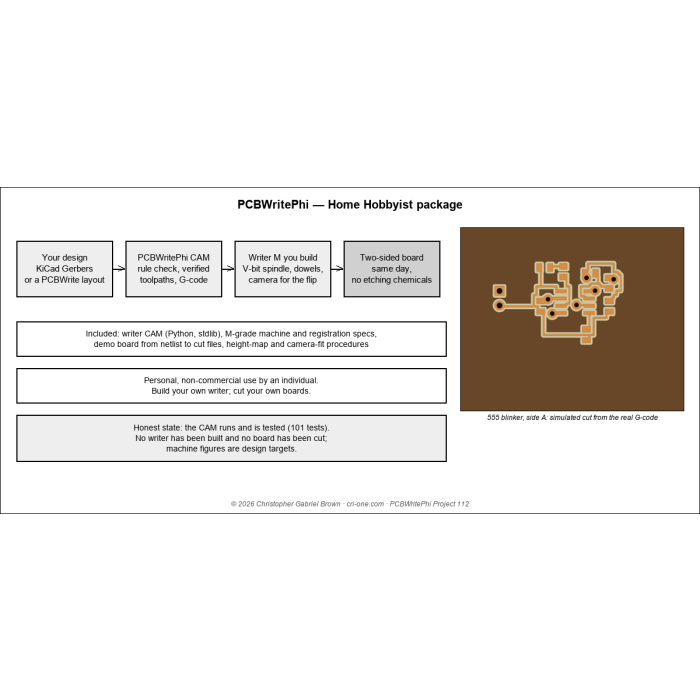
Build a bench machine that writes a working two-sided circuit board out of a copper-clad blank, the same day, with no etching chemicals. A V-bit cuts a narrow channel through the copper around every trace and pad on the top. The board is turned over onto two dowels, a camera finds three drilled holes, and the bottom is cut in register. Hollow copper rivets join the two sides, and the board is cut free with its tabs.
What you get
- The writer CAM, which runs now. It is stdlib Python with 101 tests. It reads Gerbers from any CAD tool, or a PCBWrite layout.
- Checks before it cuts: a design-rule check for your grade, exact verification of every toolpath against the copper, and a bridge check. It refuses to write G-code for a board that would come out shorted.
- What it writes: G-code for both sides, drilling, the outline with tabs, and cut-simulation previews. Arcs (G2/G3) keep the programs small.
- Options: rub-out of the unused copper, and SMD parts on either side.
- Warp and the flip: height-map probing makes the cut follow a warped blank. A camera fit lines up the bottom side, and the job is refused if the fit is poor.
- The grade M writer specification: a 30° V-bit spindle, the stage, dowel registration and the camera, as design targets to build from. Also the consumables (blanks, rivets, bits) and the registration kit.
- Controller: the G-code is a GRBL-compatible subset, so a stock GRBL-class controller can run a first writer. The firmware scope for a dedicated controller is included.
- A demo board taken from netlist to cut files: a 555 LED blinker, with its probing and camera-fit procedures worked through.
- Specification, status report, handoff notes and license.
Honest state
The CAM runs and is tested. No writer has been built and no board has been cut. Every machine figure is a design target. The warped-blank and camera-fit demonstrations use simulated measurements.
Coinciding work
PCBWrite (Project 111, sold separately) turns a KiCad schematic into a laid-out board. With --writer M, it lays the board out to this writer's rules and hands over the cut files in the same command. ICWritePhi (Project 110) is the chip-scale sibling.
Invention record
Anchored in the inventor's 2017-2018 invention record: a subtractively written, laser-cut conductor layer, with circuit-board-printer entries from the 2017 book.
Delivery: nothing downloads from the store. The package is sent by email after purchase, to the address on the order.
License: personal, non-commercial use by an individual resident in the United States. You may build writers for your own use and cut boards for your own projects. You may not sell writers or boards as a business, or redistribute the package. Full terms are in LICENSE.md of the package. Retained: patents, prosecution and enforcement rights, trademarks and the inventor record. This is not a patent license or assignment.
USA-only. USD-only. Final sale. Email and postal mail only.