

12-parkinsons-research-notes-discovery
Asset valuation: $24,000,000,000. Master index of all projects: PROJECTSINDEX. Status: Research Findings — Computational Analysis Date: January 12, 2026 System: Alchemy Data V2 Contact: christopher@cri-one.com This is NOT medical advice. These compounds have NOT been clinically tested.
Think of a lab notebook nobody has tidied for the visitor. The first pages hold the raw run and the first guesses, some wrong. The next pages cross those out and write the correction beside them. The last pages turn down anything that sounded surer than the evidence. That is how this package ships: three passes side by side, nothing redacted to make the discovery look better than it is.
Alchemy Data V2, the inventor's elemental database, made the run on the twelfth of January, 2026. It swept some twenty-four point four million combinations and returned twenty-nine research candidates across sixteen mechanism categories, each tied to Parkinson's biology - iron to tyrosine hydroxylase, zinc to the dopamine transporter, sulfur to the glutathione system. The February pass rewrote the metal-cofactor sections the first draft got wrong, added ferroptosis, and put the glutathione and N-acetyl-cysteine pathway first. The March pass downgraded that evidence from grade A to B-plus and labelled the zinc-halogen compounds untested hypotheses, possibly an artefact of how drugs are salted in databases.
These are research notes, not medicine or medical advice; nothing here has been synthesised for medical use or tested in cells, animals or people. They are for researchers wanting laboratory leads and licensees wanting the full working. A buyer walks away with all three passes, the raw discovery JSON, the four formal drawings, the patent application, the filing receipt and the USPTO correspondence. That application, filed in January 2026 and pending examination, and every invention right behind it stay with the inventor.
Description
Parkinson’s Research Notes — Discovery Package (SKU 2039)
Project: 12—Parkinson’s Research Discovery | Working title on the vault archive: 12-parkinsons-research-discovery | Discovery system: Alchemy Data V2 | Original discovery date: 12 January 2026 | Peer-review verification: 23 February 2026 (V2) | Scientific tightening: March 2026 (V3) | Package maturity: Level 1 — Research (computational discovery, awaiting laboratory validation).
Patent status. The subject matter of this package is disclosed in United States Patent Application No. 19/445,644 , titled “ Novel Metal-Amino Acid Complexes and Methods for Treating Parkinson’s Disease ,” filed with the United States Patent and Trademark Office on 12 January 2026 at 01:28:59 ET (Confirmation Number 4455, Patent Center Number 73928275, 20 total claims across 4 independent and 16 dependent claims, 4 formal figures). Application status is pending examination ; expected publication is 12 July 2027 (18 months from filing); if granted, the patent term runs to 12 January 2046. Sole named inventor: Christopher Gabriel Brown of Lawrenceville, Georgia, United States. Patent pending — no license, express or implied, is conveyed by the sale of this research-notes package; the invention rights remain with the inventor.
Very important — safety and scope. This is a research notes and discovery data package , not a medicine, not a supplement, not a treatment recommendation, and not medical advice . The compounds it describes have not been synthesised for medical use, not been tested in cell cultures, animals or humans by the inventor, not been reviewed or approved by the U.S. Food and Drug Administration or any other regulatory agency, and not been validated through clinical trials. Do not attempt to self-treat any medical condition on the basis of the contents of this package. Iron, copper, zinc, manganese, halogen compounds and every other elemental species described in the notes carry serious toxicity concerns that are documented inside the package and summarised in the Safety context table below. If you are a patient, consult a licensed physician; if you are a researcher, treat the contents as leads for laboratory investigation only.
Overview
The Parkinson’s Research Notes — Discovery Package is the complete working archive behind Alchemy Data V2’s computational scan of elemental combinations against pharmaceutical databases for compounds whose signatures overlap with known Parkinson’s-disease biology. The scan swept on the order of 24.4 million element combinations against approximately 257,500 catalogued synthesis methods and returned 29 research-candidate compounds spanning 16 mechanism categories . Every compound in the output shares at least one elemental overlap with a Parkinson’s-specific mechanism — dopamine synthesis, dopamine transporter function, mitochondrial complex support, glutathione-system support, alpha-synuclein aggregation, BDNF signalling, neuroinflammation, oxidative-stress protection or dopamine-neuron regeneration.
The package documents the discovery in three passes:
- V1 — January 2026: the raw computational output and first-pass interpretation. Preserved in the archive for completeness and historical audit.
- V2 — February 2026: the peer-review-corrected interpretation. V2 rewrites the metal-cofactor sections that V1 got wrong, adds ferroptosis as a mechanism of dopaminergic-neuron death, and elevates the glutathione / N-acetyl‑cysteine (NAC) pathway to its correct place as the most evidence-supported direction in the output.
- V3 — March 2026: the scientifically tightened version. V3 downgrades the NAC evidence claim from “Grade A” to the more honest “Grade B+” (small open-label pilot data, not large randomised controlled trials), removes suggestive language about treatment outcomes, and explicitly labels the novel zinc–halogen compounds as untested hypotheses that may equally well be a data artefact from how drugs are salted in pharmaceutical databases.
The package is deliberately shipped with all three passes side by side, together with the raw discovery JSON, the Python discovery script, the four formal patent drawings, the reference and formulation charts, the U.S. patent application text, the USPTO filing receipt, the USPTO response documents to the Office actions, the pre-scored USPTO forms, and the internal sales-pitch materials. Nothing has been redacted or edited to make the discovery look better than it is.
What the discovery system actually did
Alchemy Data V2 is Christopher Gabriel Brown’s computational database of elemental combinations, their transformation pathways, catalogued synthesis routes, and probability scores. For this project it did the following, in order:
- Enumerated candidate element combinations (for example C–H–O–N–Fe, C–H–O–N–S, C–H–O–N–Zn–F).
- Mapped each element to the biological mechanisms it participates in — iron to tyrosine hydroxylase, copper to dopamine beta‑hydroxylase, zinc to the dopamine transporter and to BDNF signalling, sulfur to the glutathione system, phosphorus to ATP synthesis, magnesium to NMDA modulation, and so on.
- Calculated a discovery score from mechanism coverage and synthesis feasibility, and a probability from the underlying elemental database. Both are internal scoring quantities: the discovery score reflects database coverage and mechanism overlap, not therapeutic probability , and the probability value is a mathematical calculation from the Alchemy system, not a clinical success rate .
- Cross-referenced each returned compound against published literature (PubMed) to check that the identified elements are, in fact, part of the biology.
The methodology is a correlation-finding tool for identifying compounds worth further investigation. It is not drug discovery, not clinical validation, and not a substitute for the standard sequence of synthesis → in vitro → in vivo → clinical trials.
Second signature (the strongest therapeutic direction on peer review) C–H–O–N–S — sulfur amino acids / glutathione precursors (probability 0.003296)
Genuinely novel compound class (zero prior published data) Zinc–halogen amino acid complexes (Zn–F, Zn–Cl, Zn–Br, Zn–I)
Human clinical-trial evidence available inside the output N-acetyl‑cysteine (NAC) — small open-label PD pilot studies from the Monti/Mischley group
All 29 compounds, ranked
This is the full Alchemy Data V2 Parkinson’s output as it appears in the package’s discovery JSON, with the V3 evidence grading applied. Where two compounds share a rank number they were tied in the underlying score.
Rank Elemental signature Alchemy probability Discovery score Biological class / interpretation V3 evidence grade
1 C–H–O–N 0.010094 50.5/100 Base organic amino-acid / catecholamine backbone — the class that includes L-DOPA , the gold-standard PD drug (C 9 H 11 NO 4 ) A — the class exists in the standard of care since the 1960s
2 C–H–O–N–S 0.003296 50.2/100 Sulfur amino acids — cysteine / N-acetyl‑cysteine / glutathione precursor pathway B+ — small open-label human PD pilot data (Monti et al.)
3 C–H–O–N–P 0.003273 50.2/100 Phospholipid / nucleotide / ATP class — mitochondrial energy and membrane support B+ — well-established mitochondrial and membrane biology
4 C–H–O–N–Cu 0.002966 50.1/100 Copper–amino-acid complexes — dopamine beta‑hydroxylase cofactor and pathological accumulator C — identification correct; supplementation likely harmful
5 C–H–O–N–Fe 0.002833 50.1/100 Iron–amino-acid complexes — tyrosine hydroxylase cofactor and pathological accumulator; drives ferroptosis in the substantia nigra C (identification) / F (for supplementation)
6 C–H–O–N–Zn 0.002757 50.1/100 Zinc–amino-acid complexes — BDNF/TrkB signalling and DAT modulation; dose-dependent alpha-synuclein risk above ~100 µM B — defensible at low dose; risk at high dose
7 C–H–O–N–Mg 0.002079 50.1/100 Magnesium–amino-acid complexes — NMDA antagonism, common deficiency in the elderly, symptomatic support B+ — safe, plausible neuroprotection, addresses common deficiency
8 C–H–O–N–Ca 0.001942 50.1/100 Calcium–amino-acid complexes — calcium-channel biology implicated in the selective vulnerability of nigral dopaminergic neurons B− — mechanistic relevance, no PD supplementation trials
9 C–H–O–N–Zn–F 0.001144 50.1/100 Zinc–fluoride amino-acid complex — NOVEL , zero prior published data for neurodegeneration D — untested hypothesis; fluoride neurotoxicity concerns
10 C–H–O–N–Zn–I 0.001083 50.1/100 Zinc–iodide amino-acid complex — NOVEL , zero prior published data; thyroid-adjacent signalling speculation D — untested hypothesis
11 C–H–O–N–Zn–Br 0.001040 50.1/100 Zinc–bromide amino-acid complex — NOVEL , zero prior published data; bromide has historical CNS-depressant toxicity (“bromism”) D — untested hypothesis
12 C–H–O–N–Zn–Cl 0.000979 50.0/100 Zinc–chloride amino-acid complex — NOVEL ; ZnCl 2 is a lab zinc source but not a therapeutic D — untested hypothesis
13 C–H–O–N–Fe–S 0.000944 50.0/100 Iron–sulfur cluster class — mitochondrial Complex I cofactor; Complex I deficiency is a hallmark of PD (MPTP target) B — real cofactors; the dysfunction is in assembly (frataxin/ISCU/NFS1), not shortage of raw atoms
14 C–H–O–N–Fe–S (variant) 0.000944 50.0/100 Tied entry — second Fe–S coordination pattern B — see rank 13
15 C–H–O–N–Zn–Si 0.000926 50.0/100 Zinc–silicon amino-acid complex — minimal evidence for silicon in neurodegeneration D — no therapeutic rationale
16 C–H–O–N–S–Zn 0.000919 50.0/100 Zinc–cysteine coordination — maps directly to metallothionein (MT-I/II) neuroprotection B+ — MT-I/II protect against MPTP in animal models
17 C–H–O–N–P–Zn 0.000912 50.0/100 Zinc–phospho compounds — conceptual relevance B− — plausible; no direct PD trial data
18 C–H–O–N–Fe–B 0.000847 50.0/100 Iron–boron amino-acid complex — boron has limited neuroprotection evidence C− — insufficient basis for inclusion in any practical formula
19 C–H–O–N–Cu–Zn 0.000827 50.0/100 Copper–zinc coordination — the classical Cu/Zn-SOD (SOD1) motif B — SOD1 is real; the therapeutic problem is misfolding and cellular distribution, not raw metal shortage
20 C–H–O–N–Zn–B 0.000824 50.0/100 Zinc–boron amino-acid complex C− — limited evidence
21–29 Multi-metal combinations — C–H–O–N–Mg–Fe (Mg–Fe), C–H–O–N–Ca–Mg, C–H–O–N–Ca–Zn, C–H–O–N–Fe–Cu–Zn (triple metal, complete dopamine pathway), C–H–O–N–Fe–S–Cu (mitochondrial + synthesis), C–H–O–N–P–Mg–Zn (ATP + signalling + transporter), C–H–O–N–S–P–Zn (glutathione + ATP + transporter — hits all 10 mechanism categories), C–H–O–N–P–Fe–S (ATP + Fe–S + glutathione — 9 mechanisms), and additional variants 50.0/100 each Increasingly speculative multi-element hybrids; several form the basis of patent Claims 3 and 4 (multi-metal and organic–inorganic hybrid compositions) C to D — increasingly speculative
Mechanism coverage across the 29 candidates
Every candidate returned by Alchemy Data V2 has at least one elemental overlap with a Parkinson’s-specific mechanism. The table below is the mechanism‑by‑mechanism count exactly as it appears in the summary report; a single compound can appear in several rows.
Mechanism category Compounds hitting it
Dopamine synthesis support (tyrosine hydroxylase, dopamine beta‑hydroxylase) 29 of 29 (100 %)
The V3 review is unambiguous on this point: of the entire 29-compound output, the sulfur amino-acid signature (C–H–O–N–S) — interpreted as the N-acetyl‑cysteine (NAC) → cysteine → glutathione axis — is the only direction with actual human Parkinson’s clinical data attached to it. The three key studies documented inside the package are:
Study Design Reading
Monti et al. 2019 (PLOS ONE, PMID 31048906 ) Open-label, 42 PD patients (21 NAC arm, 21 standard-care), 3 months of weekly IV NAC 50 mg/kg plus oral NAC 600 mg BID DaTscan SPECT showed increased dopamine-transporter binding in the caudate (~3.4 %) and putamen (~8.3 %) in the NAC arm vs. slight decrease in controls; UPDRS symptom scores improved. Small, open-label, unblinded, single group — encouraging pilot signal, not confirmatory.
Monti et al. 2016 (PLOS ONE, PMID 27708942 ) IV + oral NAC, PD patients Improved blood GSH/GSSG antioxidant ratio.
Coles et al. 2018 (PLOS ONE, PMID 29304084 ) Repeated-dose oral NAC in PD, MR spectroscopy read-out Confirmed that NAC actually crosses into the brain and raises brain glutathione in PD patients.
The reason it matters: glutathione depletion in the substantia nigra is one of the earliest detectable changes in Parkinson’s disease — documented since Sian et al. 1994 (Ann Neurol, PMID 8210224 ) — and it is present before significant dopaminergic neuron loss. Cysteine is the rate-limiting substrate for glutathione synthesis, NAC is the bioavailable delivery form, and GPX4 (glutathione peroxidase 4) — the enzyme that prevents iron-dependent ferroptosis — uses glutathione as its cofactor. The pathway therefore connects two of the strongest strands in modern PD pathology (glutathione depletion and ferroptosis) with a compound (NAC) that is cheap, widely available, and has small human PD pilot data. V3 grades it B+ — promising, awaiting large randomised confirmation . It does not grade it “A” and it does not promise a treatment outcome.
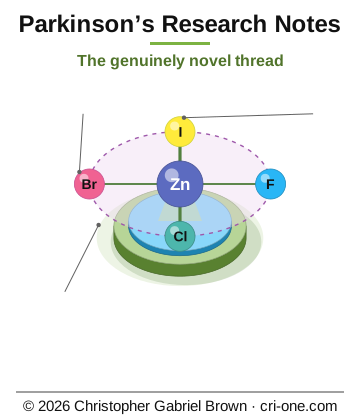
The genuinely novel thread — zinc–halogen amino-acid complexes
Four compounds in the output — C–H–O–N–Zn–F, C–H–O–N–Zn–Cl, C–H–O–N–Zn–Br and C–H–O–N–Zn–I — are unique to the Parkinson’s discovery. They do not appear in the diabetes discovery or the Alzheimer’s discovery from the same system. A thorough literature search across PubMed, Google Scholar and pharmaceutical databases returns zero published studies on any zinc–halogen amino-acid coordination complex for any neurodegenerative disease. This is either:
- a genuinely original prediction — a compound class the computational analysis flagged that no human researcher has ever investigated for neurodegeneration; or
- a data artefact — halogens appear extensively in pharmaceutical databases as counter-ions and salt forms (hydrochloride salts, fluorinated drug scaffolds), and the system may have detected their frequency in drug formulations rather than any biological activity.
The package does not pick between these two readings. It flags the compounds as untested hypotheses, notes the specific toxicities the halogens carry (fluoride neurotoxicity at chronic elevated exposure per the NTP systematic review; bromide CNS depression; unknown toxicity for novel Zn–halogen coordination complexes), and explicitly excludes these compounds from any suggested formulation.
The three metals (Fe, Cu, Zn) — the mistake V1 made and V2/V3 fix
The first-pass V1 report treated iron, copper and zinc as straightforwardly beneficial, on the reasoning that each is an enzymatic cofactor for a step of dopamine synthesis. V2 rewrote that section and V3 tightened it further. The package’s corrections table is reproduced below because it is the single most important honesty item in the archive:
V1 claim (January 2026) V2/V3 correction Supporting evidence
Iron presented as straightforwardly helpful (tyrosine-hydroxylase cofactor). Iron IS a TH cofactor, but it accumulates pathologically in the PD substantia nigra and drives ferroptosis and alpha-synuclein aggregation. Supplementation without documented iron deficiency would likely worsen disease. The therapeutic direction is chelation (removal), not addition. Dexter et al. 1989 (PMID 2731024 ) — nigral iron accumulation; UK Biobank Mendelian-randomisation studies — higher iron ↔ higher PD risk; Uversky et al. 2001 (PMID 11279227 ) — iron and copper promote alpha-synuclein aggregation.
Copper presented as straightforwardly helpful (DBH cofactor). Free (non-ceruloplasmin) copper is elevated in PD serum, catalyses oxidation of dopamine to toxic dopamine quinones, and promotes alpha-synuclein aggregation. Wilson’s-disease copper accumulation (ATP7B mutations) produces parkinsonism as a feature. Standard PD biochemistry literature; Wilson’s-disease clinical genetics.
“Zinc enhances dopamine reuptake.” Zinc’s effect on the dopamine transporter is complex, allosteric and dose-dependent; recent work suggests zinc may in fact inhibit reuptake at synaptic concentrations, effectively raising synaptic dopamine. Above ~100 µM in vitro, zinc promotes alpha-synuclein fibrillisation. Zinc is defensible only at low dose (≤ 15 mg elemental) and is contraindicated at high dose. Uversky et al. 2001 (PMID 11279227); modern DAT allostery literature.
“Metals prevent alpha-synuclein aggregation.” Iron, copper, and high-dose zinc all promote alpha-synuclein aggregation. This is the opposite of the V1 claim. Uversky et al. 2001 (PMID 11279227) and follow-on work.
Glutathione pathway underemphasised. NAC / glutathione is the strongest evidence-supported direction in the entire output; it should be foregrounded, not buried. Monti 2019 (PMID 31048906), Monti 2016 (PMID 27708942), Coles 2018 (PMID 29304084), Sian 1994 (PMID 8210224).
No mention of ferroptosis. Iron-dependent lipid peroxidation (ferroptosis), gated by GPX4/glutathione, is now recognised as a major mechanism of dopaminergic-neuron death in PD. Multiple 2020–2025 reviews and primary papers (Do Van et al.; Devos et al.).
Fe–S cluster supplementation implied. Fe–S dysfunction in PD is in the assembly machinery (frataxin, ISCU, NFS1), not a shortage of iron or sulfur atoms. Supplementing iron would worsen the problem. Frataxin / ISCU literature (Friedreich’s-ataxia adjacency).
Zinc–halogen compounds not addressed. Flagged as novel with zero published data; excluded from any practical formula pending laboratory investigation. PubMed / Scholar search: zero results.
No safety warnings. Iron accumulation, copper oxidation, zinc dose-dependency, manganese-driven parkinsonism, halogen toxicity, and L-DOPA absorption interference by divalent cations are all now called out. Multiple sources; see safety section below.
The patent application — U.S. 19/445,644
The patent application drives 12 distinct compound types across four independent claims, plus formulation, method-of-treatment, synthesis, and use claims. It is included in the package in both the human-readable Markdown source form and the USPTO-compliant text form, together with the four formal SVG figures, the four formal PDF figures, the USPTO filing receipt, the Office-action response documents (18/445,644 and 19/445,644), and the pre-scored USPTO forms.
Formal drawings 4 figures (Chemical Structures, Synthesis Scheme, Coordination Structures, Pharmaceutical Formulations)
Compound types covered 12 (4 halogen complexes, 3 boron/silicon complexes, 3 multi-metal complexes, 2 organic–inorganic hybrids)
Claim 1 Zinc–halogen amino-acid coordination complexes: Zn–F, Zn–Cl, Zn–Br, Zn–I.
Claim 2 Boron- and silicon-containing complexes: Zn–B, Zn–Si, Fe–B (each with amino-acid coordination).
Claim 3 Multi-metal amino-acid coordination complexes: Fe–Cu–Zn, Fe–S–Cu, P–Mg–Zn.
Claim 4 Complex organic–inorganic hybrid compounds: S–P–Zn and P–Fe–S with amino-acid coordination.
5–8 Amino-acid specificity for the four independent-claim compound families: glycine, alanine, serine, threonine, cysteine, methionine, aspartic acid, glutamic acid, lysine, arginine, histidine, and combinations thereof.
9 Pharmaceutical composition (compound of any of Claims 1–8 plus pharmaceutically acceptable carrier).
10–12 Formulation types — oral (50–500 mg active with starch, cellulose, magnesium stearate as capsule or tablet), injectable (10–100 mg/mL in saline or buffer, IV or IM), and transdermal (1–10 % w/w with penetration enhancers, patch or gel).
13 Method of treating Parkinson’s disease by administering a therapeutically effective amount of a compound of any of Claims 1–8.
14–16 Administration routes: oral (50–500 mg/day, once or twice daily), injectable (10–100 mg per injection, daily or weekly), transdermal.
17 Combination therapy with levodopa/carbidopa, dopamine agonists, MAO-B inhibitors, COMT inhibitors, or other PD medications.
18 Synthesis of Claim 1 compounds: amino-acid solution → zinc salt → halogen source (sodium fluoride / chloride / bromide / iodide or acid form) → pH 7–8, 60–80 °C for 2–4 h → crystallisation or chromatography → NMR / X-ray / MS characterisation.
19 Synthesis of Claim 3 compounds: amino-acid solution + Fe salt + Cu salt + Zn (or Mg) salt at pH 7–8, 60–80 °C for 4–6 h → purification → characterisation.
20 Use of any Claim 1–8 compound in the manufacture of a medicament for treating Parkinson’s disease.
FIG 1 Chemical structures — the C–H–O–N amino-acid backbone, the halogen substituent positions, and the coordination bond geometry for the Zn–X and Fe/Cu/Zn cases. SVG (editable) and PDF (submission-ready)
FIG 2 Synthesis scheme — the general amino-acid + metal-salt + halogen/boron/silicon source flow at controlled pH and temperature. SVG and PDF
FIG 3 Coordination structures — representative geometries for the four claim families (halogen, boron/silicon, multi-metal, hybrid). SVG and PDF
FIG 4 Pharmaceutical formulation diagrams — the oral, injectable, and transdermal presentations described in Claims 10–12. SVG and PDF
- PARKINSONS_RESEARCH_REFERENCE_CHART_11x17.svg — the 29-compound discovery grid, mechanism coverage, and evidence grading in a single wall-sized reference.
- PARKINSONS_FORMULATION_CHART_11x17.svg — the derived-formulation reference (see the caveat below the practical-formula table). Uses the safety-informed defaults.
Derived practical-formula reference (Level 1, not a recommendation)
The V2 findings include a derived-formula reference table that translates the evidence-graded discoveries into a supplement-level worked example, on the explicit V3 caveat that listing specific supplement doses in a research document risks being interpreted as a treatment recommendation, which it is not . The formula, reproduced here for completeness, is not a prescription, is not an offer to compound anything, and must not be treated as either:
Ingredient Daily amount used in the worked example Rationale in the notes
N-acetyl‑cysteine (NAC) 1,200 mg Core — the only ingredient with human PD pilot data.
Magnesium glycinate 400 mg Common deficiency, NMDA antagonism, symptomatic support.
Zinc picolinate 15 mg (LOW dose) BDNF support without crossing the ~100 µM alpha-synuclein aggregation window.
Copper gluconate 1 mg Offsets zinc-induced copper depletion; only under medical supervision.
Phosphatidylserine 100 mg Neuronal-membrane support.
Explicitly excluded Iron (accumulation and ferroptosis risk), high-dose zinc (alpha-synuclein risk), zinc–halogen compounds (zero safety data), manganese (parkinsonism risk).
Iron supplementation in PD Specifically contraindicated — adds to pathological nigral accumulation, drives ferroptosis. Reduces L-DOPA absorption.
Manganese Never supplement for PD — manganism produces a parkinsonian syndrome clinically similar to PD; manganese accumulates in basal ganglia and is directly neurotoxic.
Copper Excess is neurotoxic; free copper catalyses oxidation of dopamine to toxic quinones.
Zinc > 40 mg/day induces copper deficiency; > 100 µM tissue concentration promotes alpha-synuclein aggregation.
Divalent cations and L-DOPA Iron, zinc, copper and other divalent cations chelate L-DOPA in the GI tract, reducing absorption by 30–70 %. Separate metal supplements from levodopa/carbidopa by at least 2 hours.
MAO-B inhibitors Interactions of rasagiline / selegiline with novel metal–amino-acid complexes are unstudied.
Halogen-containing compounds Narrow therapeutic windows; fluoride neurotoxicity at chronic high exposure (NTP systematic review); bromism as historical bromide-toxicity precedent.
Market and audience context
- Over 1 million Americans currently live with Parkinson’s disease; projected 1.2 million by 2030.
- Global Parkinson’s treatment market is on the order of USD 4+ billion annually.
- Levodopa (a C–H–O–N compound — the class the discovery flagged as rank 1) has been the primary treatment since the 1960s; no disease-modifying treatment exists.
- Intended audience for this package: pharmaceutical R&D groups, biotech and contract-research organisations, academic medical centres, medicinal-chemistry departments, and independent researchers evaluating potential leads.
What Is in the Package
The archive is delivered as the complete working folder tree, unedited. Everything below ships on the Blu-ray.
README.md The project’s master index — safety disclaimer, methodology summary, target-mechanism list, top findings, statistics, and required-next-steps ladder.
METHODOLOGY.md How the discovery was actually done — what the discovery score is and is not, what the probability is and is not, and where the data sources came from.
SAFETY_DISCLAIMER.md The full safety statement with the specific metal and halogen concerns.
IP_NOTICE.md Open-research notice terms of use (as-is, no warranties, credit-the-author).
LICENSE Proprietary and confidential notice — copyright © 2026 Christopher Gabriel Brown, patent-pending, all rights reserved.
CITATION.cff Citation File Format entry for academic use.
CHANGELOG.md Keep-a-Changelog style version log.
MANIFEST.json Machine-readable manifest: 45 total files, key artefacts, patent-application record.
CONTACT_INFO.txt Direct contact information for the inventor.
CLAIMS_SUMMARY.md Human-readable summary of all 20 patent claims with statistics and coverage.
PARKINSONS_RESEARCH_PATENT_APPLICATION.md Full patent-application text — title, field, background, summary, detailed description with all 12 embodied compounds, synthesis examples, formulation examples, treatment methods, claims, abstract.
PATENT_FILING_RECEIPT.md USPTO filing receipt with the confirmation and Patent Center numbers and next-steps timeline.
USPTO_REQUIRED_FORMS_LIST.md Full list of required USPTO forms with URLs and fee tables (micro / small / large entity).
USPTO_RESPONSE_18-445-644.docx Office-action response for the parent 18/445,644 application.
USPTO_RESPONSE_19-445-644.docx Office-action response for the 19/445,644 application.
PLAYBOOK.md Internal go-to-market playbook — identity, one-liner, hook lines, reply patterns.
WEB_DESCRIPTION.html The peer-review-aligned public web description of the discovery.
START_HERE.html The recommended entry point when opening the package.
12-parkinsons-research-discovery.docx Consolidated Word-document build of the discovery.
12-parkinsons-research-discovery.zip Consolidated zipped mirror of the full package.
PARKINSONS_RESEARCH_REFERENCE_CHART_11x17.svg / .zip The wall-sized 11 × 17 discovery reference chart.
PARKINSONS_FORMULATION_CHART_11x17.svg The wall-sized 11 × 17 formulation reference chart.
PATENT_DRAWING_1_CHEMICAL_STRUCTURES.svg Formal FIG 1 — chemical structures (editable SVG).
PATENT_DRAWING_2_SYNTHESIS_SCHEME.svg Formal FIG 2 — synthesis scheme (editable SVG).
PATENT_DRAWING_3_COORDINATION_STRUCTURES.svg Formal FIG 3 — coordination structures (editable SVG).
PATENT_DRAWING_4_PHARMACEUTICAL_FORMULATIONS.svg Formal FIG 4 — pharmaceutical formulations (editable SVG).
Drawings_19-445-644_Parkinsons/ — submission-ready patent drawings
- FIG_1_Chemical_Structures.pdf and .svg
- FIG_2_Synthesis_Scheme.pdf and .svg
- FIG_3_Coordination_Structures.pdf and .svg
- FIG_4_Pharmaceutical_Formulations.pdf and .svg
USPTO_FORMS/ — pre-scored USPTO forms and instructions
- N417parkinsons.pdf — N417 filing receipt for this application.
- PTO-AIA-01-Oath-Declaration-Single.pdf — oath/declaration (single inventor).
- PTO-AIA-08-Oath-Declaration-Multiple.pdf — oath/declaration (multiple inventors, included for completeness).
- PTO-AIA-15-Transmittal.pdf — utility patent application transmittal form.
- PTO-SB-17-Fee-Transmittal.pdf — fee transmittal form.
- sb0015a.pdf — micro-entity certification.
- FILL_OUT_INSTRUCTIONS.md — step-by-step fill-out guide.
- FORM_DATA.txt — the inventor-side data used to score the forms.
- README.txt — USPTO folder read-me.
findings/ — discovery reports and raw data
- parkinsons_research_discoveries.json — the complete 29-compound discovery JSON, ~227 KB, machine-readable, with per-compound probability, mechanisms, transformation counts, and synthesis-method counts.
- PARKINSONS_RESEARCH_SUMMARY.md — quick summary of the discovery run.
- PARKINSONS_RESEARCH_REPORT.md — comprehensive discovery report.
- ENHANCED_DISCOVERY_SUMMARY.md — the enhanced-search pass that took the compound count from 14 to 29 and enumerated the novel patentable categories.
- PARKINSONS_RESEARCH_KNOWN_PROPERTIES_REPORT.md — V1 known-properties report (preserved for audit; contains the errors V2 corrects).
- PARKINSONS_RESEARCH_KNOWN_PROPERTIES_REPORT_V2.md — the peer-review-corrected report (~27 KB), full evidence walk-through per compound with the corrections table.
- PARKINSONS_KNOWN_PROPERTIES_REPORT_V3.md — the scientifically-tightened report (~25 KB), tightens language further and grades NAC as B+ rather than A.
_internal/ — source and internal working files
- run_parkinsons_discovery.py — the Python discovery script (~31 KB, executable) used to run the scan against Alchemy Data V2.
- config.py — discovery-script configuration.
- PARKINSONS_RESEARCH_PATENT_APPLICATION_USPTO_COMPLIANT.txt — USPTO-compliant plain-text application (~21 KB).
- PARKINSONS_RESEARCH_PATENT_APPLICATION_WITH_HEADER_FORMAT.txt — header-format variant.
- USPTO_FORMS_QUICK_REFERENCE.txt , USPTO_HEADER_FORMAT.txt , CURSOR_SAVE_TROUBLESHOOTING.md — internal working notes.
- alchemy_data_v2_output/ — the raw Alchemy Data V2 output folder from the run.
sales-pitches/ — positioning and demo materials
- PROOF_OF_FUNCTION_1.html / .pdf , PROOF_OF_FUNCTION_2.html / .pdf , PROOF_OF_FUNCTION_3.html / .pdf — three proof-of-function pitches.
- parkinsons-research-discovery26_PRODUCT_CARD.md — Magento product card (the store-side product metadata used to build the storefront listing).
- parkinsons-research-discovery26_STORE_PRODUCT_DESCRIPTION.html — the long-form store product description.
- parkinsons-research-discovery26_VAULT_DELIVERY_INSTRUCTIONS.html — delivery-side instructions.
Required steps before any medical use of the findings
- Synthesis — create the specific compounds under the patent’s synthesis methodology and characterise by NMR, X-ray crystallography and mass spectrometry.
- Cell studies — test on dopaminergic neuron lines (SH-SY5Y and primary cultures).
- Animal studies — MPTP and 6-OHDA rodent PD models.
- Safety studies — human toxicology and Phase I safety trials.
- Clinical trials — Phase II and Phase III efficacy, ideally randomised placebo-controlled, powered to detect DaTscan and UPDRS changes.
- FDA approval — regulatory submission and review.
This package ships on a single Blu-ray disc, posted to the delivery address on your order. The archive on the disc is AES-256 encrypted; the passphrase is sent separately, by email, once the disc is despatched — so the disc alone is of no use to anyone who intercepts it.
Discs are despatched by tracked, signed-for post. Allow 5 business days for mastering and verification before despatch.
© 2026 Christopher Gabriel Brown. All rights reserved. Patent pending — USPTO Application No. 19/445,644.
File names inside the package may use older working titles.
Photo

Footnotes
- Product number 8458.
- Family: health research.
- Purchase: When you buy, you buy the use of that blueprint only.