Description
51-pcie8-standard — Performance (SKU 2082)
Patent Status: Patent pending. The CS-50 substrate is covered by USPTO Non-Provisional Utility Application 19/710,460, filed 2026-06-17, under 35 USC 111(a). Title: “Computational-Storage Apparatus with Inline AES-XTS Encryption Tweaked by Physical-Page Address and a Near-Data Compute Engine Sharing a Single Translation-Layer Command Port.” Additional family applications: USPTO 19/693,405 (CGB Framework umbrella, filed 2026-05-30—20 claims, names AutoPhi under Deposition 3: Voxel Resonance); USPTO 19/646,681 (Hyper Quantum Map, filed 2026-04-14); USPTO 19/540,453 (Integrated Technology Portfolio umbrella—Software for Data + Cri-One hardware family). CS-51-specific extensions (N-port FTL arbitration, N-instance ACE fabric, peer arbitration, post-quantum hybrid, confidential attestation) are scoped for a Continuation-in-Part (CIP) filing under 35 USC 120 before the CS-50 PCT window closes 2027-06-17. CIP draft: 26 claims across 6 independent claim families. All applications pending examination. Inventor: Christopher Gabriel Brown.
Overview
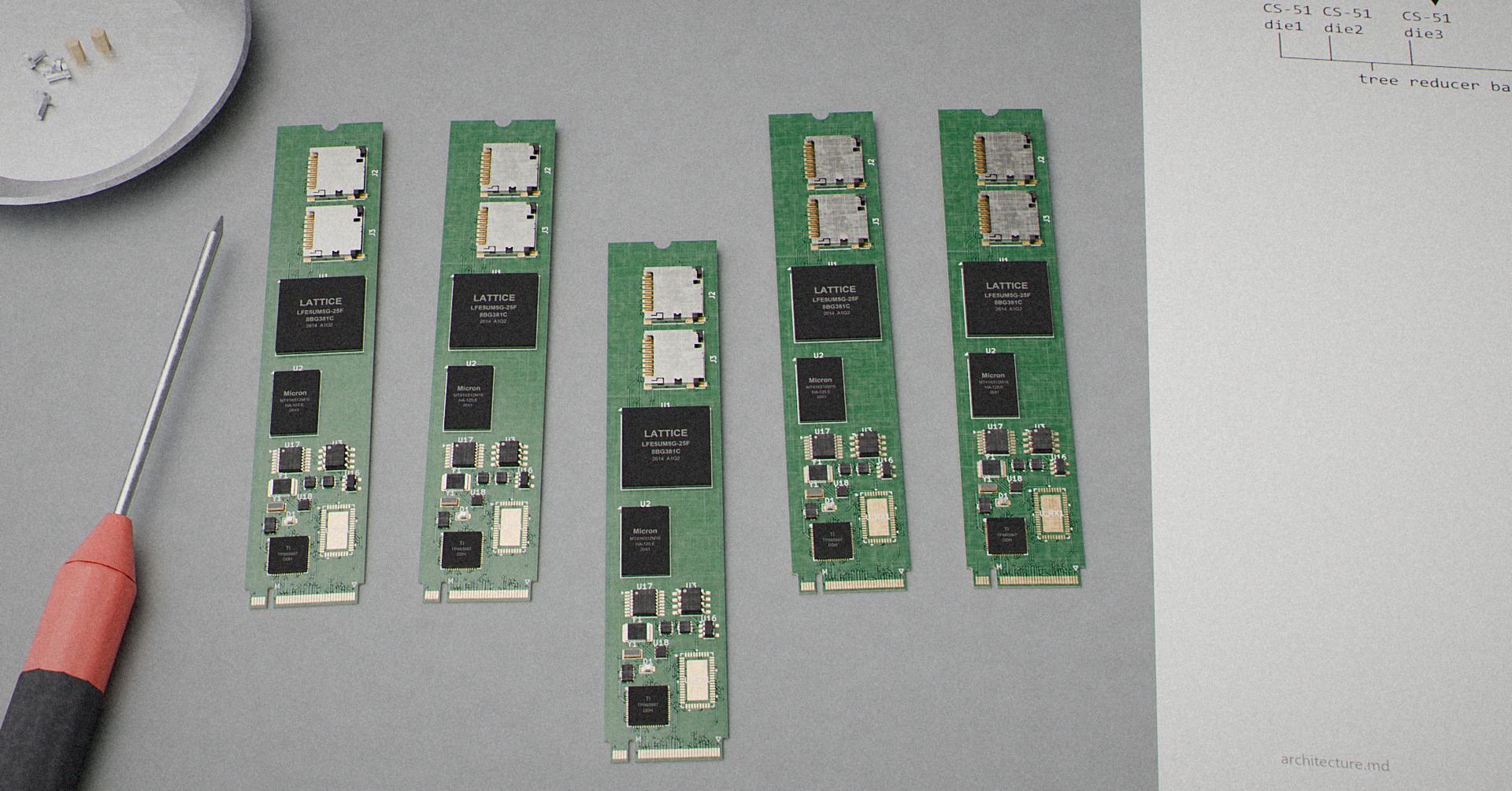
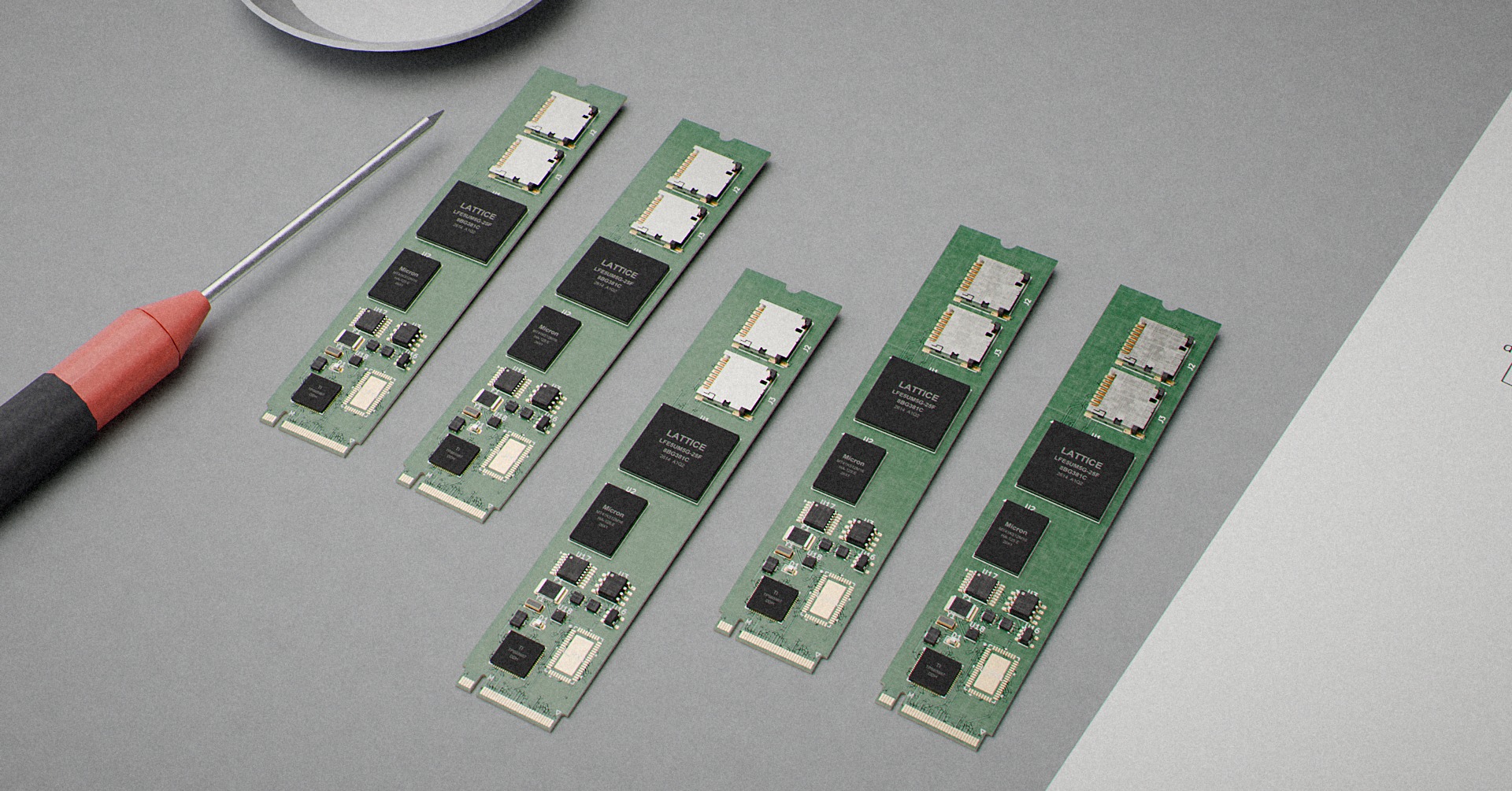
CS-51 is the scale-out and performance member of the AutoPhi computational-storage chip family—a single-die (or multi-chiplet) integrated circuit that fuses secured NVMe solid-state storage with programmable near-data compute, targeting hyperscale fleets and AI-pipeline preprocessing workloads. It inherits the filed CS-50 substrate (physical-page-tweaked AES-256-XTS encryption, reserved-CID single-port FTL arbitration, vendor-opcode 0xC1 doorbell invocation) and extends it with N-channel FTL parallelism, an N-instance AutoPhi Compute Engine (ACE) fabric with tree/ring reduction, a chip-to-chip peer arbitration plane, five named AI-pipeline kernels, post-quantum hybrid encryption (CRYSTALS-Kyber KEM key wrap), and TPM-class confidential attestation.
This is a soft-IP product —the same product class as ARM Cortex, Synopsys DesignWare, or Cadence Tensilica—packaged as a complete computational-storage chip design rather than a single IP block. The buyer receives engineering blueprints and foundry-handoff artifacts; they fab the silicon on their own foundry account. Patent ownership stays with the inventor.
The complete bundle comprises the frozen CS-50 baseline plus the CS-51-specific extension files. Every refutable claim in the package is machine-verifiable via a single command ( python verify.py —12/12 checks green).
Lineage
WonderPhi (Project 36, the universal driver in software) → CS-50 (Project 50, the driver fused with secured storage and one ACE on one die) → CS-51 (Project 51, multi-channel secured storage + N ACE instances + peer fabric on the same substrate). The WonderPhi constitution version is 1.0.0 PERMANENT, inherited from CS-50.
Host Interface and Physical Specifications
Parameter Specification
Host link PCIe 8.0 ×4 (~256 GB/s usable per direction)
Controller DRAM HBM3e on-substrate (8–16 GB, ~1.2 TB/s)
Packaging Multi-chiplet UCIe (Universal Chiplet Interconnect Express) G2 substrate, 25 mm × 35 mm canonical
Target form factor E1.L (24-die NAND, 32–64 TB capacity per drive)
BGA package BGA-1536 (0.50 mm pitch; 384 power balls, 384 ground balls, 64 PCIe Gen8 differential pairs, 128 UCIe single-ended, 16 sideband)
Capacity target 4 TB (8 TB stretch) per CS-50 baseline; 32–64 TB at E1.L
Process node target ACE tiles: TSMC N3; IO and NAND-CTRL tiles: N5/N6; HBM3e: vendor node
Power envelope Standby: 2.5 W; Active: 15.0 W per compute tile; Burst: 40.0 W total peak
Thermal Worst-case 95 °C junction at 65 °C ambient
OpenLANE2 design name cs51_top
Clock period (design target) 0.500 ns (2 GHz)
Clock port host_clk
Die area (OpenLANE2 target) 800 × 800 µm (placement density 50%)
Inline AES-256-XTS Encryption with Physical-Page Tweak
The AES-XTS path is interposed between the FTL and the NAND media. Every write payload is encrypted, and every read payload is decrypted. The tweak input is the packed physical-page address (PPA) —not the host logical block address. The PPA is a 25-bit identifier: 3-bit NAND channel selector, 2-bit die selector, 12-bit block selector, and 8-bit page selector. Two 256-bit cryptographic keys (data key Key1 and tweak key Key2) are loaded at power-on and never appear on any host-readable port.
Encryption formula per block j within a data unit:
T_base = AES-256-enc(Key2, PPA-derived tweak) T_j = T_base · α^j in GF(2^128) C_j = AES-256-enc(Key1, P_j XOR T_j) XOR T_j
Decryption is the inverse. Because the tweak is the PPA, ciphertext at rest is bound to its physical location: relocating the same plaintext from PPA P1 to PPA P2 yields different ciphertext because T_base(P1) ≠ T_base(P2). The AES-256 core passes NIST Known-Answer Tests and IEEE 1619 XTS-AES-256 test vectors.
Multi-Channel FTL Command Arbiter
Parameter Specification
Module autophi_multichannel_ftl.v (6,405 bytes)
Testbench autophi_multichannel_ftl_tb.v (11,736 bytes)
Status Passing —4/4 iverilog test cases
Test cases (1) N=2 host-priority; (2) N=2 bridge-after-idle; (3) N=4 round-robin (3 bridges, 6 fires); (4) N=4 host preemption
Input command ports N (parameterized)
Output port Single FTL command port
Arbitration policy Host strict-priority + round-robin among N−1 bridge ports with rotating priority pointer
CID semantics Reserved-CID range (0xE000–0xEFFF, 4,096 distinct CIDs) inherited from CS-50
Ready-signal property Ready outputs are functions only of the FTL ready signal, not of masters' valid signals—eliminates circular dependency through the NVMe engine's doorbell-pulse-style valid output
N-Instance ACE Scale-Out Fabric
Parameter Specification
RTL module autophi_ace_scaleout.v (11,930 bytes)
Testbench autophi_ace_scaleout_tb.v (12,738 bytes)
Status Passing —5/5 iverilog test cases
Test cases (1) N=1 SCAN; (2) N=4 SCAN matches N=1; (3) N=1 VOXEL; (4) N=4 VOXEL associativity; (5) N=4 uneven striping (count=15)
Architecture N instances of CS-50 autophi_compute_engine.v (instantiated unchanged) + tree reducer for SCAN/VOXEL/XFORM
Start handshake 2-cycle handshake to avoid event-ordering race
Reducer topologies Binary tree (depth ceil(log2(N))) or ring reducer
Python simulator: ace_scaleout.py (20,297 bytes)— 18/18 self-test PASS. Covers all 8 compute operations at N=1 (byte-identical to CS-50 reference) and N=4 (VOXEL, SCAN, VECTOR_DOT, TOPK, ARGMAX, EMBED_LOOKUP, SOFTMAX byte-identical; XFORM Merkle fold documented).
AI-Pipeline Kernel Set
CS-51 adds five named AI-pipeline kernels to CS-50's existing VOXEL, SCAN, and XFORM operations, all invoked through the same NVMe vendor opcode 0xC1:
Kernel Operation ace_op Selector
VOXEL Fold payload bytes into a fixed-bin histogram (inherited from CS-50) 1
SCAN Predicate-match: return LBAs whose payload contains a host-supplied needle (inherited from CS-50) 2
XFORM Streaming transform / Merkle fold (inherited from CS-50) 3
VECTOR_DOT Signed integer inner product between payload bytes and a host-supplied query vector (CS-51 new)
TOPK Return top-K records by host-supplied scoring function (CS-51 new)
ARGMAX Return the LBA with the largest score (CS-51 new)
EMBED_LOOKUP Fetch fixed-prefix embeddings by global token ID—stripe-local indexing via (global_token_id − stripe_base_lba) (CS-51 new)
SOFTMAX Numerically-stable softmax probabilities across a stripe (CS-51 new)
Chip-to-Chip Peer Arbitration
Parameter Specification
RTL module autophi_peer_arb.v (12,717 bytes)
Testbench autophi_peer_arb_tb.v (9,044 bytes)
Status Passing —2/2 iverilog test cases
Test cases (1) 2-peer SUM reduction (100+7=107); (2) 2-peer SUM (1000+234=1,234)—with point-to-point peer fabric crosswiring + mock local ACEs
Framing 128-bit logical peer frame (tag / src / desc / payload)
Election Primary die = lowest non-faulted PEER_ID
Degenerate path Reduces to N=1 single-die mode cleanly
PCIe Peer-to-Peer Transport Bridge
Parameter Specification
RTL module autophi_p2p_bridge.v (8,845 bytes)
Testbench autophi_p2p_bridge_tb.v (14,907 bytes)
Status Passing —6/6 iverilog test cases
Test cases (1) TX encap format; (2) TX tag increment; (3) RX decode match; (4) RX reject non-MWr (silent drop—10 cycles, peer_rx_valid never asserts); (5) RX reject wrong-BAR (silent drop); (6) Loopback pair (A.peer_tx → A.tlp_tx → B.tlp_rx → B.peer_rx)
Architecture Two-FSM bridge: 128-bit peer frame → single 256-bit MemWr TLP (4DW header in low half, payload in high half); inverse on RX
Parameters THIS_BAR, PEER_BAR, REQUESTER_ID (per-instance differentiation)
Security Non-MWr TLPs and MWr TLPs to a non-matching BAR are silently dropped
Peer-Fabric Topology Model
Simulator: peer_fabric.py (13,506 bytes)— 24/24 self-test PASS. Five topologies modelled:
Topology N=2 (µs) N=8 (µs) N=32 (µs) N=64 (µs)
TREE 1.30 2.10 3.80 5.65
RING 1.18 1.57 2.79 4.40
HOST_MEDIATED 1.55 3.35 10.55 20.15
UCIE_INTRA_PKG 1.07 1.38 2.58 4.18
CXL_CACHE 1.55 2.85 5.05 7.15
Verdict: UCIe intra-package wins at every N≥2. RING is the multi-package fallback. At N=64, UCIe is 4.8× faster than HOST_MEDIATED on the reduction path.
UCIe Chiplet Architecture
The canonical CS-51 package is a UCIe G2 substrate carrying multiple tile types:
Tile Count Process Node Function
ACE Compute 2–12 (6 canonical) N3 AutoPhi Compute Engine instances + per-tile reducer fragment
IO 1 N5 PCIe 8.0 ×4 PHY + MAC + TLP + NVMe engine
HBM3e 1 Vendor 8 GB stack, ~1.2 TB/s bandwidth
NAND CTRL 1 N5 FTL + inline AES-XTS + multi-channel arbiter
UCIe peer-fabric lane 4 — 32 GT/s per lane intra-package
Variant SKUs:
SKU ACE Count HBM Target Deployment
CS-51-S 2 4 GB Edge / single-host
CS-51-M 4 8 GB Datacenter mid-tier
CS-51-L (canonical) 6 8 GB Hyperscale fleet
CS-51-XL 12 16 GB AI-pipeline preprocessing optimized
AI-Pipeline Performance Comparison (Design Targets)
Benchmark script: benchmarks/ai_pipeline_demo.py (8,210 bytes). Workload: per-query retrieval over a ~0.93 GiB embedding table (1,000,000 records × 1,024 bytes each); Top-K = 32; batch = 64 queries; per-query result = 512 bytes.
Metric Traditional Gen5 NVMe SSD CS-51 (design target)
Approach Host reads full table region over PCIe, CPU runs Top-K + dot + softmax Near-data EMBED_LOOKUP + TOPK + VECTOR_DOT + SOFTMAX across 6 ACE tiles, UCIe reduction
PCIe read bandwidth ~14 GB/s (Gen5 sequential best-case) ~256 GB/s (PCIe 8.0 ×4 usable)
Data crossing PCIe bus ~1 GB (entire table) ~32 KB (reduced result only)
Latency speedup Baseline ~38× lower latency
PCIe traffic reduction Baseline ~31,250× less data on the bus
Disclaimer: CS-51 numbers are design targets sourced from peer_fabric.py (24/24 self-test PASS) and published UCIe link rates. CS-51 silicon does not yet exist; numbers are not measured.
Post-Quantum Hybrid Encryption
Parameter Specification
Bulk encryption AES-256-XTS with physical-page tweak (unchanged from CS-50)
DEK wrap Hybrid: classical AES-Key-Wrap under cKEK concatenated with CRYSTALS-Kyber-encapsulated shared secret
Kyber parameter set At least Kyber-768 (NIST PQ level 3); Kyber-1024 selectable for level 5
Standards NIST FIPS 203 (ML-KEM / CRYSTALS-Kyber); NIST SP 800-56C Rev. 2; NIST SP 800-38F (AES-KW)
Wrap storage Wrapped DEK at a fixed PPA on NAND, itself encrypted under AES-XTS with that fixed PPA as tweak
Recovery Boot-time requires both classical cKEK authentication and successful Kyber decapsulation against host-attested trust anchor
Backwards compatibility Classical-only wrap detectable from wrap header; supported in legacy mode
Forward compatibility Wrap header carries a 16-bit primitive-set identifier for future PQ primitives
Security budget: Effective DEK security ≥2 128 even with one primitive broken (classical or post-quantum). Bulk AES-256-XTS: 2 256 classical / 2 128 quantum (Grover). Kyber-768 KEM: 2 252 classical / 2 166 quantum.
Confidential Storage Attestation
Parameter Specification
Trust root Hardware-rooted fused identity key burned at manufacture; not user-replaceable; DICE-compatible
Attestation algorithm Hybrid signature: EdDSA over Ed25519 (classical) + Dilithium-3 (post-quantum)
Report magic 0x434E50_413531 ("CNFA51")
Report size ~3.5 KB (244 bytes header + Ed25519 signature + ~3,300 byte Dilithium-3 signature)
Report contents Firmware SHA-256 hash, bootloader SHA-256, encryption-mode identifier ( "PPAES-XTS" ), wrap-format identifier ( "KYBR_HYB" ), host-supplied nonce, device serial, attestation pubkey, Dilithium pubkey ID
Key-release gating DEK derivation refuses unless host supplies key-release secret bound to a verified attestation report via HKDF(host_master, attest_pubkey, firmware_hash, "cs51-confidential")
Signing time (Dilithium-3) ~20 ms bit-serial at 100 MHz (boot-time only)
Ed25519 signing time ~5 ms at 100 MHz
Interop targets CCC RATS (Remote Attestation Procedures, RFC 9334); TCG SED (legacy support); TCG DICE; Intel TDX / AMD SEV-SNP / Arm CCA chaining; NVIDIA H100 confidential computing chaining; FIPS 140-3 Level 3
NVMe Vendor-Opcode Invocation
The host invokes any ACE operation through a single NVMe doorbell write with vendor opcode 0xC1. The 256-bit submission-queue entry layout:
SQE Bit Range Field Meaning
[7:0] opcode 0xC1 — ACE invocation
[10:8] ace_op 1=VOXEL, 2=SCAN, 3=XFORM (+ CS-51 AI ops)
[31:16] CID Host-supplied command identifier
[63:32] NSID NVMe namespace identifier
[95:64] ace_count Number of LBAs the engine traverses
[191:96] reserved Future extension
[231:192] ace_lba Starting logical-block-address (low 40 bits)
[255:232] reserved Upper SLBA bits
A separate 128-bit parameter buffer ( ace_param ) accompanies the doorbell write. The NVMe engine synthesises a single completion-queue event (CQE) carrying the ACE result back to the host. Host-visible ABI is unchanged from CS-50—fan-out across N ACE instances and peer dies is transparent.
Inherited CS-50 RTL Modules
Module Function Status
autophi_aes256_xts.v Inline AES-256-XTS encryption/decryption with physical-page tweak Passing (NIST KAT + IEEE 1619 vectors)
autophi_aes256_core.v AES-256 encrypt/decrypt core Passing
autophi_aes_inline.v AES inline data-path wrapper Passing
autophi_aes_path.v AES path routing Passing
autophi_aes_sbox.v AES S-Box Passing
autophi_compute_engine.v Single-instance ACE (VOXEL/SCAN/XFORM) Passing
autophi_ace_bridge.v ACE-to-FTL bridge with reserved-CID marking Passing
autophi_cmd_arb.v Single-port FTL command arbiter Passing
autophi_ftl_core.v Flash Translation Layer (L2P mapping, sequential allocator) Passing
autophi_nvme_engine.v NVMe engine (doorbell, SQE decode, CQE synthesis) Passing
autophi_nvme_cpl_tlp.v NVMe completion TLP assembler Passing
autophi_pcie8_top.v PCIe 8.0 controller top-level Passing
autophi_pcie8_phy.v PCIe 8.0 physical-layer abstraction Passing
autophi_pcie8_mac.v PCIe 8.0 MAC + LTSSM Passing
autophi_pcie8_tlp.v Transaction Layer Packet parser/assembler Passing
autophi_gc_engine.v Garbage-collection engine Passing
autophi_ldpc_ecc.v Low-density-parity-check ECC block Passing
autophi_nand_model.v Behavioural NAND model Passing
autophi_dram_model.v DRAM controller model Passing
autophi_sd_native.v SD native interface Passing
autophi_sd_spi.v SD SPI interface Passing
autophi_sd_crc.v SD CRC module Passing
CS-50 Testbenches (Inherited, All Passing)
Testbench What It Tests Result
autophi_nvme_e2e_tb.v Host-to-host round-trip (write then read through L2P + NAND model) 5 PASS / 0 FAIL
autophi_walk_encrypted_tb.v Encrypted round-trip through AES-XTS path 8 PASS / 0 FAIL
autophi_walk_ace_tb.v Near-data SCAN with testbench-serviced fetches 3 PASS / 0 FAIL
autophi_walk_ace_real_tb.v Structural SCAN through bridge + arbiter + FTL 5 PASS / 0 FAIL
autophi_walk_ace_doorbell_tb.v Doorbell-invoked SCAN via vendor opcode 0xC1 5 PASS / 0 FAIL
autophi_pcie8_testbench.v Full controller-spine power-up (PHY, MAC, TLP, NVMe, FTL, GC, LDPC, AES, ACE) PASS (link-up asserted)
autophi_aes256_xts_tb.v AES-256-XTS NIST KAT + IEEE 1619 vectors PASS
autophi_aes256_xts_sector_tb.v AES-256-XTS sector-level test PASS
autophi_aes_inline_tb.v AES inline data-path test PASS
autophi_compute_engine_tb.v Single-instance ACE compute engine PASS
autophi_walk_tlp_loopclose_tb.v TLP loopback closure PASS
autophi_sd_native_tb.v SD native interface PASS
autophi_sd_spi_tb.v SD SPI interface PASS
Three-Layer WonderPhi Driver Stack (CS-51 Extensions)
Hardware — Verilog RTL
Module File Size State
N-port FTL arbiter autophi_multichannel_ftl.v 6,405 bytes Passing (4/4)
N-instance ACE + tree reducer autophi_ace_scaleout.v 11,930 bytes Passing (5/5)
Chip-to-chip peer arbitration autophi_peer_arb.v 12,717 bytes Passing (2/2)
PCIe P2P transport bridge autophi_p2p_bridge.v 8,845 bytes Passing (6/6)
Firmware — Freestanding C
Module Files State
Fan-out scheduler autophi_fw_scaleout.c (1,098 B) /.h (1,342 B) Stub
Peer-fabric controller autophi_fw_peer.c (1,754 B) /.h (1,500 B) Stub
Host Software — Linux C Drivers
Module Files State
Scale-out driver extension wonderphi_drv_scaleout.c (819 B) /.h (1,057 B) Stub
Reference user-space tool wonderphi_scaleout_example.c (922 B) Stub
Python Simulator Suite
Module Size Status Self-Test
ace_scaleout.py 20,297 bytes Passing 18/18 PASS (all 8 ops at N=1 byte-identical; N=4 VOXEL/SCAN/VECTOR_DOT/TOPK/ARGMAX/EMBED_LOOKUP/SOFTMAX verified)
peer_fabric.py 13,506 bytes Passing 24/24 PASS (5 topologies × multiple N values including UCIe + CXL variants)
multichannel.py 1,414 bytes Stub RTL version is canonical implementation
Foundry-Handoff Bundle Structure
The CS-51 handoff bundle mirrors the canonical foundry-handoff template designed for the Zettaflop-1Z accelerator (Project 23). The cri-one-pcie8-ssd-performance/handoff/ directory contains:
Directory Contents
rtl/ 23 synthesis-clean RTL modules (CS-50 inherited + CS-51 new)
testbench/ 14 testbench files (all passing under iverilog 12+)
docs/ 12 architecture, strategy, and specification documents
legal/ Tier 1 / Tier 2 / Tier 3 license terms + patent references
foundry_handoff/ Placeholder structure for DEF, GDSII, LEF, netlist, reports (DRC/LVS/timing/power), synthesis-clean Verilog
openlane/ OpenLANE2 flow configuration ( config.json targeting cs51_top )
package_design/ UCIe substrate specification
synthesis/netlists/ Post-synthesis netlist placeholder
scripts/ build_bundle.py (1,536 B), verify_bundle.py (2,389 B)
Verification and Build
Tool What It Verifies Result
python verify.py All refutable claims: RTL testbenches, simulator self-tests, benchmark, tapeout manifest checksums, document cross-references, compliance rules 12/12 PASS in
Prerequisites: Python 3.10+ (stdlib only, no external dependencies); iverilog 12+ for Verilog testbenches.
CIP Claim Families (Draft — 26 Claims)
Independent Claim Subject Dependent Claims
Claim 1 N-port FTL command arbiter with strict host priority + round-robin Claims 2–5
Claim 6 N-instance ACE fabric + tree/ring reducer on single die or UCIe chiplets Claims 7–11 (including 7 named kernel claims)
Claim 12 Chip-to-chip peer arbitration with single-doorbell fan-out Claims 13–15 (UCIe, CXL, runtime transport selection)
Claim 16 Post-quantum hybrid AES-XTS substrate (Kyber KEM + AES-KW) Claims 17–18
Claim 19 Confidential attestation tied to AES substrate —
Claim 20 AutoPhi family data-plane convergence (ties 19/710,460 and 19/646,681) —
Claims 21–22 Means-plus-function claims (N-stream arbitration, N-result reduction) —
Claim 23 Cartridge-on-die + Software-for-Data stack convergence (ties 19/540,453) Claims 24–26
Acquisition Tiers
Tier Price What Ships
Tier 1 — Mathematical Deposition $9,500 Patent spec + 20 claims + 8 figures + architecture overview + strategic docs (read-only, non-redistributable)
Tier 2 — Evaluation License $950,000 All of Tier 1 + complete RTL + Python sim + reference firmware + Linux driver. 90-day hands-on, NDA-gated. Fee credits to Tier 3.
Tier 3 — Full Use & Copy License $95,000,000 Complete foundry-handoff bundle (all of Tier 2 + KiCad + sign-off scripts + test patterns + tape-out manifest). Production rights to fab + ship + sublicense within field. Patent stays with inventor.
Full Acquisition Negotiated Tier 3 + patent assignment
CS-51 Family SKUs:
SKU Price
CS-51-PF (Peer-Fabric + VOXEL Mathematical Deposition) $250,000,000
CS-51-AI (AI-Pipeline Mathematical Deposition) $95,000,000
CS-51 Complete Scale-Out Bundle (PF + AI) $300,000,000 ($45M discount)
AutoPhi Engine (Board-Level PCB Automation)
The package includes the autophi_engine/ Python package—a board-layout automation engine with RAG-driven design-rule enforcement. Modules:
Subpackage Module Function
rag/ rules.py PCB design-rule database
rag/ stackup.py PCB stackup definitions
rag/ io_configs.py I/O configuration rules
rag/ components.py Component library
rag/ netlist.py Netlist generation
rag/ placement.py Component placement rules
rag/ routing.py Routing rules
rag/ superbase.py Superbase database interface
rag/ ti_knowledge.py TI reference knowledge base
rag/ ti_adj_catalog.py TI adjustable-output device catalog
rag/ project_ecosystem.py Project ecosystem context
layout/ board.py Board outline and layer management
layout/ router.py Trace routing engine
layout/ via_stitcher.py Via stitching for ground planes
layout/ placer.py Component placement engine
layout/ zone_filler.py Copper zone fill
output/ gerber.py Gerber file generation
output/ kicad_pcb.py KiCad PCB output
verify/ drc.py Design-rule checking
(root) engine.py Top-level automation engine
The engine includes 6 KiCad footprints in footprints/AutoPhi.pretty/ : TPS7A4700_RGW, LP3878_NGT, DS160PR810_NJX, AutoPhi_BGA256, DS280BR810_ZBF, TPS735_DRV, TPD4E004_DRY, PCIe_x16_Edge.
The TI references RAG knowledge base contains documentation for: DS160PR810, DS280BR810, LP3878-ADJ, MSP430F5529, TPS7A47, TPS735, TPS757, TPD4E004, SLLA335, SLLA414A, and hundreds of indexed application notes (SLYT-series, TIDU796, TIDRD10–TIDRD13, TIDUBG6, SNLU273, SSZT072, SLYP173).
Reference Design Files
The tidrd14/ directory contains the TI reference design TIDA-00423 schematic ( TIDA00423_Schematic.DSN ) and the accompanying Important Notice for Reference Designs (PDF).
The part-stock-mcp/ directory contains a parts-inventory MCP server (TypeScript/Node.js) with package.json, tsconfig.json, and Claude-settings template for integration.
What Is in the Package
- CS-50 frozen baseline ( cri-one-pcie8-ssd/ ): 35 Verilog RTL modules, 10 firmware source + 10 header files, 4 Linux driver files, 7 Python simulator modules, 5 KiCad production BOMs/CPLs (M.2 22110), 5 architecture docs
- CS-51 extension ( cri-one-pcie8-ssd-performance/ ):
- 4 new Verilog RTL modules + 4 testbenches (all passing: 4/4 + 5/5 + 2/2 + 6/6 = 17/17 iverilog tests)
- 4 firmware C/H stubs (scaleout + peer)
- 2 Linux driver stubs + 1 example tool
- 3 Python simulators (ace_scaleout 18/18 PASS, peer_fabric 24/24 PASS, multichannel stub)
- 1 AI-pipeline benchmark script
- 17 strategy / architecture / specification Markdown documents
- Complete foundry-handoff directory (23 RTL + 14 testbench + docs + legal + OpenLANE2 config + UCIe substrate spec + foundry report placeholders)
- Magento import CSV for store integration
- 5 build/verification/inventory scripts
- verify.py—single-command package truth-keeper, 12/12 PASS
- AutoPhi Engine ( autophi_engine/ ): 19 Python modules, 6+ KiCad footprints, TI reference RAG knowledge base with 25+ component datasheets and 80+ indexed application notes
- Patent documents: inventor depositions, prior-art queries, patent audit findings
- Reference design: TI TIDA-00423 schematic (OrCAD.DSN)
- Parts inventory MCP server (TypeScript)
How this is delivered
This package ships on a single Blu-ray disc, posted to the delivery address on your order. The archive on the disc is AES-256 encrypted; the passphrase is sent separately, by email, once the disc is despatched — so the disc alone is of no use to anyone who intercepts it.
Discs are despatched by tracked, signed-for post. Allow 5 business days for mastering and verification before despatch.
© 2026 Christopher Gabriel Brown. All rights reserved.
Footnotes
- Product number 8501.
- Family: autophi pcie cards.
- Purchase: When you buy, you buy the use of that blueprint only.