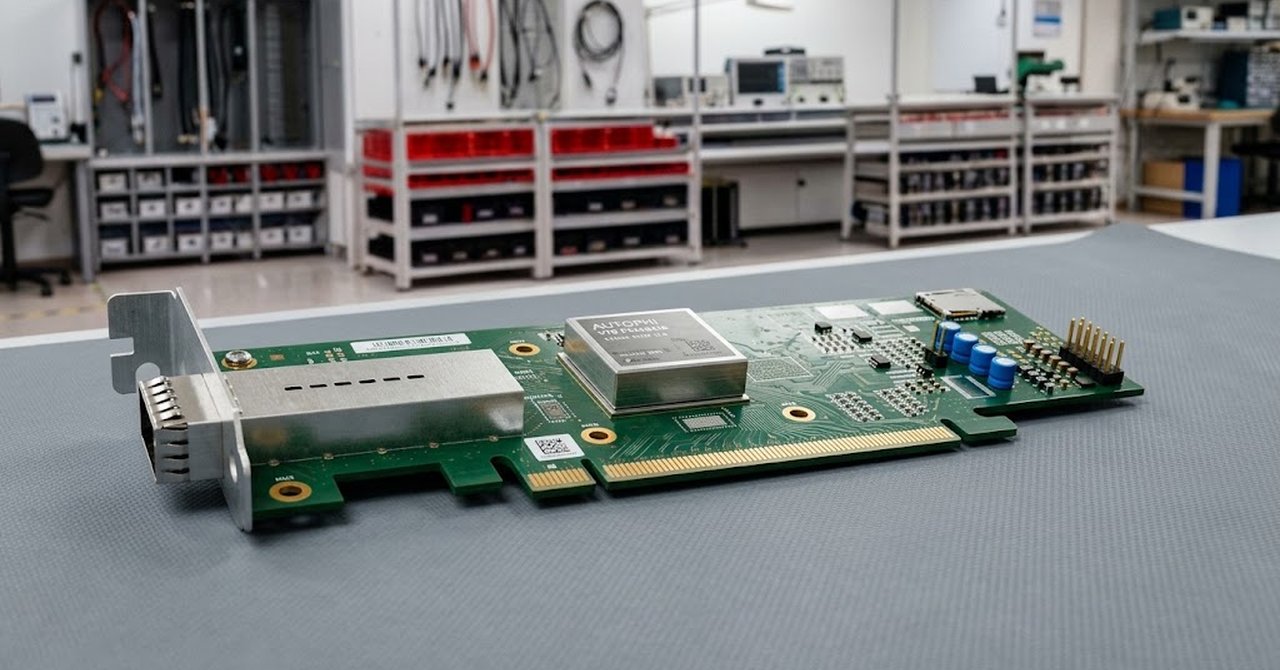
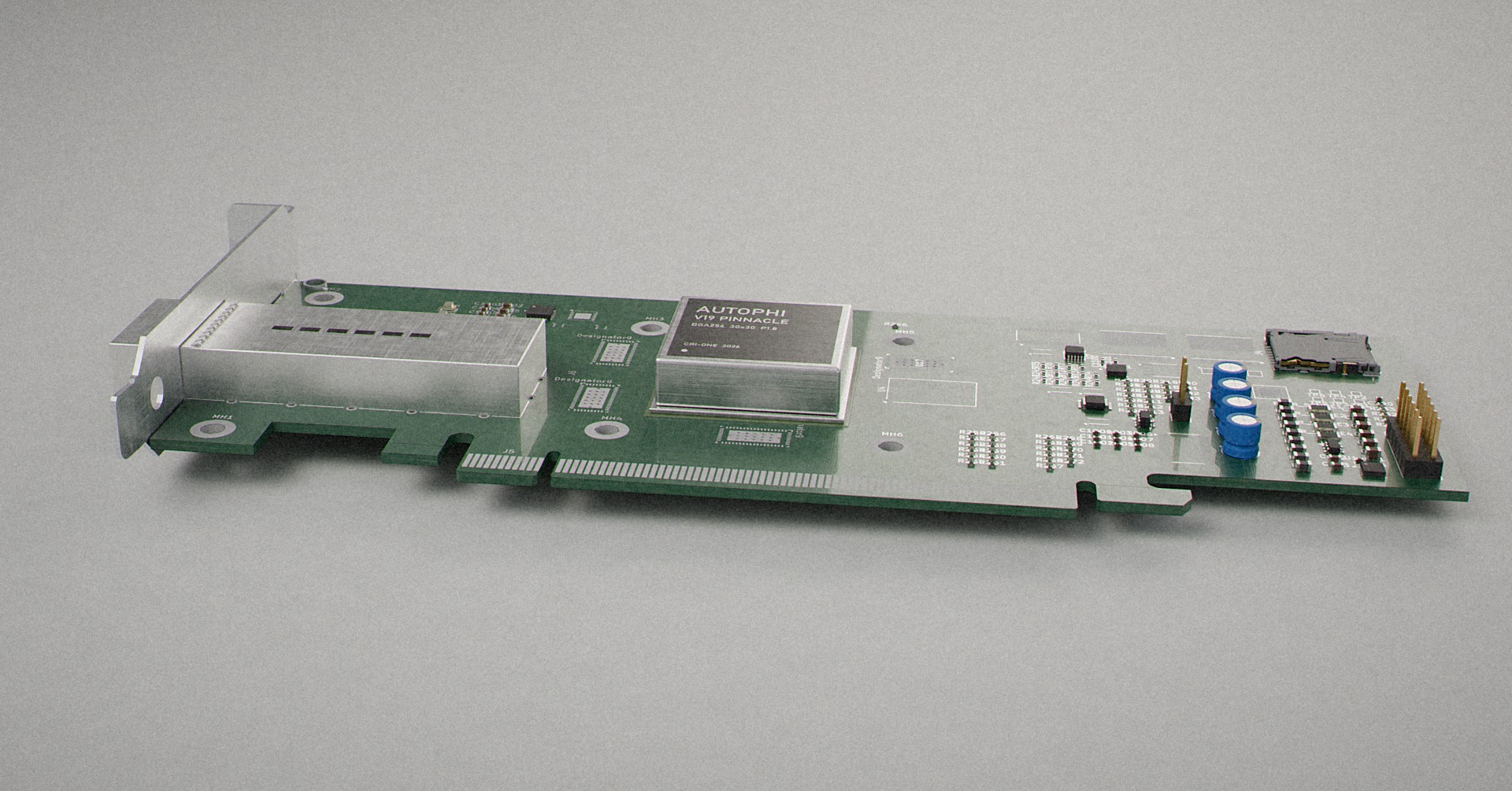
Description
AutoPhi BGA Library — 40-autophi-bga256 Source-of-Truth Package (SKU 2069)
Inventor / Licensor: Christopher Gabriel Brown, Lawrenceville, GA, USA. Patent posture: patent pending; method-claim filing in preparation covering the AutoPhi BGA package family, the two-phase interposer escape router, the dog-bone blind-via relocation technique, and the beat-grid via-collision mitigation. Coverage scope to be confirmed prior to engagement. All rights to seek additional patent protection are expressly reserved by the inventor. Underlying inventor corpus © 2017–2026 Christopher Gabriel Brown is referenced for provenance only and is not part of the distribution. Status: Release v1 frozen — canonical pinmap completion 256/256 (100%) on AUTOPHI_BGA256 and 1,536/1,536 (100%) on AUTOPHI_BGA1536, with the intermediate ladder (AUTOPHI_BGA576, AUTOPHI_BGA900, AUTOPHI_BGA1156) assigned and validating (0 TBD, BGA_LIBRARY_VALIDATE: PASS ). Board projects 35-autophi-quantum-pcie5 and 39-autophi-pcie5 consume these artifacts with schematic sync and KiCad CLI netlist export both reporting exit_code=0 .
Overview
Product 40 ( 40-autophi-bga256 ) is the dedicated source-of-truth project for AutoPhi BGA component definitions . It is the single upstream from which every board project in the AutoPhi portfolio pulls its custom ball-grid-array symbols, footprints, and pinmaps. It owns the AutoPhi BGA library end-to-end: the KiCad footprint files ( libs/footprints/AutoPhi.pretty/ ), the KiCad schematic symbols ( libs/symbols/ ), the pinmap CSV tables ( pinmaps/ ), the Python pipeline that regenerates each of those from the others ( scripts/ ), the governance rules that stop board projects from forking them ( docs/LIBRARY_GOVERNANCE.md ), and a full interposer PCB ( interposer/ ) that proves the largest package in the family (BGA-1536, 95 × 90 mm, 2.0 mm pitch) is actually routable on real HDI stackup with real vendor rules.
The deliverable spans the full 92 mm mechanical envelope of the AutoPhi package family — from the 20 × 20 mm BGA-256 seed footprint on the small end, through the 32 mm-body BGA-576 / BGA-900 and 38 mm-body BGA-1156 mid-range, up to the 95 × 90 mm BGA-1536 flagship. The library is not a paper specification: every symbol was generated by script from its pinmap, every pinmap was walked back to its footprint's pad geometry, and every geometry step is reproducible from a single PowerShell one-liner ( rebuild_provisional_seed.ps1 ) and validated by validate_bga_library.py . When the buyer wants to add a new AutoPhi BGA, the change control rule in LIBRARY_GOVERNANCE.md says all five artifacts (footprint, template pinmap, working pinmap, symbol, catalog row) land in the same commit — and the scripts here are what generate four of the five.
What separates this package from a generic KiCad BGA library is the interposer escape work . The interposer/ directory carries a complete KiCad 8 PCB ( autophi-1536-interposer.kicad_pcb , 5.3 MB) that fans out the BGA-1536 flagship at 2.0 mm board-side pitch to a 0.8 mm die-side pad grid across a 12-copper HDI stackup. Every via geometry, every clearance, every routing failure, and every one of the nine errors-worth-not-repeating is recorded in ESCAPE-THEORY.md with the measurements that produced them, the wrong predictions that preceded them, and the two-phase router ( escape_router_v3.py , 30 kB) that resolves them. The result is a 956-of-960 signal balls given a legal via layer with dog-bone blind-via relocation applied on 92 of 96 colliding sites — the four unroutable balls are called out by name.
Package Catalog — Confirmed Entries
Symbol Name Ball Count Body Size Pitch Class Assignment Status
AUTOPHI_BGA256 256 (16 × 16) 20 × 20 mm 1.0 mm Small / entry seed 256/256 — 100% canonical (Release v1)
AUTOPHI_BGA576 576 (24 × 24) 32 × 32 mm 1.27 mm Intermediate ladder Assigned — 0 TBD (validate PASS)
AUTOPHI_BGA900 900 (30 × 30) 32 × 32 mm 1.0 mm Intermediate ladder — canonical die home (29.0 mm span inside 32 mm body) Assigned — 0 TBD (validate PASS)
AUTOPHI_BGA1156 1,156 (34 × 34) 38 × 38 mm 1.0 mm Intermediate ladder Assigned — 0 TBD (validate PASS)
AUTOPHI_BGA1536 1,536 (48 × 32) 95 × 90 mm (board-side; die-side 37.60 × 24.80 mm) 2.0 mm (board), 0.8 mm (die) Flagship / V19-Pinnacle class 1,536/1,536 — 100% canonical (Release v1)
Ratio invariance across the family (assigned). Every AutoPhi BGA in the catalog uses the same 25.0% / 12.5% / 62.5% ball-role split for GND / POWER / signal, and every power ball has an adjacent GND return (measured 112/112 on the BGA-900). Differential pairs sit on horizontally adjacent balls in the same row, HSIO is placed on the outer rings for short escape routes, and MGMT is in the middle band with POWER / GND on a checkerboard through the core. The ratios were read off the BGA-256 and BGA-1536 assignments rather than chosen freely, so the whole ladder is dimensionally self-consistent.
Mechanical & Placement Envelope
Parameter Value Source
Global BGA interchange window (max body) 95.0 mm docs/BGA_CATALOG.md
Canonical PCB edge (left-bottom anchor) (61.100, 114.650) mm docs/BGA_CATALOG.md
Canonical BGA center (interchange anchor) (141.500, 95.400) mm docs/BGA_CATALOG.md
V19-Pinnacle IC package baseline (height) 10 mm (flat) docs/CANONICAL_DIMENSIONS_MATRIX.md
V19-Pinnacle IC package baseline (width) 32 mm V19 product page baseline
V19-Pinnacle pin range across SKUs 384 … 1,536 on-demand-two product family
V20 Epiphany reference package height 12 mm autophi-collections
AutoPhi Single Zetta reference (die stack) 5 mm, 36 × 36 mm per layer, 500 layers Special reference (informational)
Semiconductor Method Discovery 15 reference 10 mm chip, 32 mm square, 32 stacked layers Special reference (informational)
Power Policy (Conservative v1)
Policy Element Value
Board-level external input planning cap 75 W max
Assumed IC power model Hybrid — internal battery capability present, external input still required
Battery-related signal semantics INTERNAL_BATTERY (internal source), EXT_POWER_IN (required external), BAT_MGMT (control / monitor / protection)
Policy tag in pinmap notes power-policy-v1: hybrid internal battery + external input required; 75W max board input
Applied via scripts/apply_power_policy.py , scripts/finalize_power_rails.py , scripts/normalize_pinmap_notes.py
AUTOPHI_BGA256 — Detailed Pinmap Domain Layout
The BGA-256 pinmap is the seed for the entire family and uses a 16 × 16 grid across rows A–T (I, O, Q, S skipped per JEDEC BGA convention) and columns 1–16. Every one of the sixteen rows is seeded with the same domain template so that any board project can route it without surprises:
Ball Range (per row) Domain Function
Columns 1–4 MGMT Management-plane single-ended I/O (I2C, SPI, JTAG, UART, sideband)
Columns 5–6 POWER Rail balls per canonical voltage-domain assignment
Columns 7–8 GND Ground return, paired with adjacent POWER balls
Columns 9–14 HSIO High-speed differential I/O, horizontally-adjacent P/N pairs
Columns 15–16 GND Outer-band ground for HSIO return current
Rows seeded: A, B, C, D, E, F, G, H, J, K, L, M, N, P, R, T (16 rows, 256 balls total). Seed tag: domain-seed-v1 . Name-promotion tag: canonical-name-seed-v1 . Power-rail finalization tag: power-rail-seed-v1 / power-domain-normalize-v1 . Post-promotion completion is 100% assigned across the whole 256-ball array in the frozen v1 release.
Symbol / Footprint / Pinmap Alignment
The BGA library is treated as a strict source-of-truth pipeline. Every symbol is regenerated from a pinmap that was in turn generated from footprint pads, so drift between the three is measurable and refused by the validator:
Step Script Input Output
1. Generate template pinmap generate_bga_pinmap_template.py .kicad_mod footprint pads *_pinmap_template.csv
2. Normalize starter placeholders normalize_pinmap_placeholders.py *_pinmap_starter.csv *_pinmap_working.csv
3. Seed domain rows seed_ab_domains.py *_pinmap_working.csv , row list, seed tag Domain-tagged pinmap
4. Promote provisional names promote_provisional_signals.py Pinmap with TBD_MGMT_* / TBD_HSIO_* Canonical net names
5. Finalize power rails finalize_power_rails.py Pinmap with voltage-domain placeholders Named power rails (VDD_CORE, VDD_IO, VSS, VDDQ, VTT, VREF, VDDP)
6. Normalize notes normalize_pinmap_notes.py Multi-tag pinmap De-duplicated note strings
7. Generate KiCad symbol generate_bga_symbol_from_pinmap.py Working pinmap + footprint reference libs/symbols/AutoPhi_BGA_working.kicad_sym
8. Validate alignment validate_bga_library.py All four artifacts + LIB_ID footprint BGA_LIBRARY_VALIDATE: PASS
9. Report completion pinmap_completion_report.py Working pinmap Non-TBD coverage % + logical completion %
One-command reproducible rebuild: the entire seed-to-symbol path is scripted in scripts/rebuild_provisional_seed.ps1 with -Rows "A,B,C,D,E,F,G,H,J,K,L,M,N,P,R,T" and -SeedTag "domain-seed-v1" . It normalizes, seeds, promotes provisional names, regenerates the symbol, prints the completion report, and drops a timestamped checkpoint into pinmaps/checkpoints/ .
Interposer — What Actually Constrains BGA Escape
The interposer/ directory carries a fully-populated KiCad PCB ( autophi-1536-interposer.kicad_pcb ) that fans out the flagship BGA-1536 across a 12-copper HDI stackup. Every number in the accompanying ESCAPE-THEORY.md was measured on the board file or derived from its geometry, including the wrong predictions that preceded each measurement:
Interposer Parameter Value
Die side (U1) 1,536 pads, 48 × 32, 0.800 mm pitch, 0.35 mm pads, 37.60 × 24.80 mm
Board side (BGA1) 1,536 pads, 48 × 32, 2.000 mm pitch, 0.9 mm pads, 94.00 × 62.00 mm
Fan-out mapping Pure 2.5× radial scaling: die pad (i,j) → board pad (i,j), same array, bigger pitch
Stackup (12 copper) TOP, GND1, SIG1, SIG2, PWR1, SIG3, SIG4, PWR2, SIG5, SIG6, GND2, BOTTOM
Signal layers 6 (SIG1–SIG6)
Nets 960 signal balls; 576 on rails (GND, APH_VDD_CORE, 1V0) drop straight to a plane
Microvia geometry 0.20 mm pad / 0.10 mm drill (spanning TOP→ k )
Blind via geometry 0.40 mm pad / 0.20 mm drill (spanning k →BOTTOM)
Track width 0.075 mm (3 mil floor)
Netclass clearance 0.200 mm
min_hole_clearance 0.25 mm
Result 1 — Per-Layer Via Load Is Invariant
A ball landing on signal layer k needs two vias: a microvia spanning TOP→ k (crossing k signal layers) and a blind via spanning k →BOTTOM (crossing N − k +1). The sum is N +1 for every k — the layer choice cancels:
Lands on Micro crosses Blind crosses Total
SIG1 1 6 7
SIG2 2 5 7
SIG3 3 4 7
SIG4 4 3 7
SIG5 5 2 7
SIG6 6 1 7
960 balls × 7 = 6,720 barrel-layer crossings ÷ 6 = 1,120 via keepouts per signal layer, invariant under any assignment . Measured layer load on the full run came out 160 / 159 / 159 / 160 / 159 / 159 — exactly 960 ÷ 6. Doubling stackup from 6 to 12 signal layers buys 7% because the load scales as ( N +1)/ N . Layer balancing is still worth doing because it balances trace congestion (measured: failures fell from 56 to 37 on a 250-ball sample when layer choice went from shallow-first to least-loaded-first) — but not via congestion.
Result 2 — Netclass Clearance Is Not the Constraint (Predicted Wrong)
Netclass clearance Trace pitch Routed / 250
0.200 mm 0.275 mm 207
0.100 mm 0.150 mm 207
Identical. Trace pitch is not what is choking the escape; via placement is.
Result 3 — The Two Grids Beat Against Each Other
0.8 mm die and 2.0 mm board on a shared origin, ratio 2.5 — not an integer. The grids drift in and out of phase. 240 board pads land within 0.50 mm of a die pad; closest pair 0.283 mm. At that distance a 0.20 mm microvia pad and a 0.40 mm blind via pad physically overlap — no clearance rule reaches it. All 36 tested translations of the BGA grid (0 to 1.0 mm in 0.2 mm steps, both axes) were worse than or equal to the design as drawn. The board is already at the optimum offset. The collision is an ordering constraint, not a wall: microvia (TOP→ L ) and blind via ( L′ →BOTTOM) miss whenever L is shallower than L′ .
Result 4 — Dog-Bone the Blind Vias
Stop putting the via in the pad. Offset it, and join the two with a short neck on BOTTOM. Applied to the board: 92 of 96 colliding blind vias relocated, 89 of them needing only 0.25 mm, max 0.60 mm. Four had nowhere legal to go. DRC unchanged — no new violations.
A new via site must clear… Distance Driver
microvia 0.50 mm copper: 0.1 + 0.2 + 0.2
other blind via 0.60 mm copper: 0.2 + 0.2 + 0.2
other BGA pad 0.85 mm copper: 0.45 + 0.2 + 0.2
any trace 0.4375 mm copper: 0.2 + 0.2 + 0.0375
Result 5 — Place Vias Before Traces (Two-Phase Router)
Metric One-phase Two-phase
"no via layer" failures 42 / 250 4 / 250
Balls given a via layer (full board) — 956 / 960
Errors Worth Not Repeating (Recorded Verbatim)
- A via is a barrel, not a point. SetLayerPair(TOP, SIG5) puts copper on SIG1–SIG4 as well. Modelling only the landing layer produced shorts through four layers.
- The binding clearance is the netclass, not the board minimum. 0.200 mm, not min_clearance 0.075. Channels sized off the floor route cleanly and then fail DRC.
- Vias collide on layers the router never draws on. A die pad 0.283 mm from a board pad meets it on PWR1 — a plane layer. Via feasibility must be checked across all twelve copper layers.
- Moving a via invalidates its zone antipad. Refill before saving or every barrel shorts to the plane it crosses.
- Clearing traces does not clear via layer pairs. After a wipe, 451 unrouted balls still had microvias parked at TOP–SIG6 while the model had reserved only TOP–SIG1: 199 shorts. Collapse unrouted vias to the span actually reserved.
- Reserve the guaranteed barrel, never the worst case. Reserving TOP–SIG6 for every waiting ball blocks all six layers at all 1,536 die pads simultaneously and leaves single-cell channels. Reserve TOP–SIG1 for microvias and SIG6–BOTTOM for blind vias: those are certain.
- Never block a diagonal by its bounding box. SIG1 read as 64% occupied when the true figure was 13%. Rasterise the swept area.
- Keep keepout radii fractional. A diagonal blocked at an integer 5 cells (0.25 mm) where 5.5 (0.275 mm) is required leaks half a cell — 35 clearance violations, all between 0.177 and 0.187 mm.
- Check new geometry against traces, not just pads and vias. Three separate scripts, same omission each time.
Python Pipeline — 43 Scripts, Reproducible End-to-End
Category Script Purpose
Library generation generate_bga_footprint_grid.py Parametric KiCad footprint generator; profiles: v19_default , zetta_ref , smd15_ref , bga576_ref , bga900_ref , bga1156_ref
generate_bga_pinmap_template.py Walks footprint pads, emits per-ball CSV template
generate_bga_symbol_from_pinmap.py Regenerates KiCad symbol from working pinmap + footprint LIB_ID
generate_ddr_fbga.py DDR FBGA package generator (companion memory ICs)
initialize_pinmap_working.py Copies template → working with profile-dependent defaults
profile_switch.py Central registry of package profiles / dimension defaults
Pinmap operations normalize_pinmap_placeholders.py Cleans starter unconnected-(…) noise into normalized empty rows
seed_ab_domains.py Seeds MGMT / POWER / GND / HSIO domains per row with tag
promote_provisional_signals.py Promotes TBD_MGMT_* and TBD_HSIO_* to canonical net names
apply_power_policy.py Applies conservative hybrid-power policy tags
finalize_power_rails.py Names voltage-domain placeholders (VDD_CORE, VDD_IO, VSS, VDDQ, VTT, VREF, VDDP)
normalize_pinmap_notes.py De-duplicates and canonicalizes note-tag strings
make_pinmap_workset.py Slices a pinmap to a row-focused workset (e.g. rows A,B)
pinmap_completion_report.py Reports non-TBD % and logical completion %
populate_pinmap_from_board.py Back-fills pinmap from live board netlist
Pinmap sync _remap_pinmaps.py Bulk remap across multiple pinmap files
_sync_pinmap_from_schematic.py Syncs pinmap CSV from consuming board's schematic
rebuild_provisional_seed.ps1 One-command PowerShell reproducible rebuild wrapper
Validation validate_bga_library.py Cross-checks pinmap + symbol + footprint + LIB_ID alignment, emits PASS/FAIL
Interposer PCB build assemble_stack.py Assembles the mechanical die/interposer/board stack
build_interposer.py Generates the interposer PCB skeleton with 1,536 pads two-sided
audit_interposer.py Escape coverage, ring-by-ring, with layer usage per ring
probe_geometry.py Reads and reports die/board pad geometry from live board
interposer_stackup.py , interposer_stackup_v2.py , interposer_stackup_v3.py Three generations of the 12-copper HDI stackup definition
interposer_plane_vias.py Places PWR1 / PWR2 / GND plane vias for rail nets
interposer_rail_via_pads.py Applies rail-specific pad geometry to plane vias
Escape routing escape_theory.py Derives the invariant and rule-binding table from the board
escape_ring.py , escape_ring_offset.py , escape_ring_v2.py Three generations of ring-by-ring escape router
escape_router_v3.py (30 kB) Two-phase router: --all re-routes all 16 rings, --why explains failures, --clear= overrides netclass for experiments
dogbone_blind_vias.py Relocates colliding blind vias, adds necks on BOTTOM
interposer_escape_solver.py Standalone escape solver over ring geometry
interposer_viainpad.py Applies via-in-pad geometry to specified nets
interposer_renet_by_position.py Re-nets pads by physical position (post-swap correction)
Freerouting freeroute_interposer.py Exports DSN and drives external FreeRouting for full auto-route
fix_rail_via_padstacks.py Post-FreeRouting padstack cleanup for rail vias
Rendering render_escape.py Flat false-colour views: --zoom for dog-bones, --full for whole board
render_interposer_frame.py Per-frame renderer for route-progress video
route_and_film.py , route_and_film_v2.py Route-and-record time-lapse harnesses
Catalog / export build_magento_series_draft.py Builds consolidated Magento draft CSV (34 board rows + BGA library rows)
Interposer Artifacts — Full PCB Bill of Materials
Artifact Size Purpose
autophi-1536-interposer.kicad_pcb 5.29 MB Live KiCad PCB (12-copper HDI, 1,536 pads two-sided)
autophi-1536-interposer-tier1-v1.kicad_pcb 4.15 MB Tier-1 routed variant
autophi-1536-interposer-tier2-v2.kicad_pcb 5.23 MB Tier-2 routed variant
autophi-1536-interposer.step 8.01 MB 3D STEP export of the interposer body
autophi-1536-interposer.glb 12.93 MB 3D glTF binary for viewers
autophi-1536-interposer.wrl 11.44 MB VRML 3D model
autophi-die-block.wrl 601 B Die-block VRML placeholder
autophi-1536-interposer.dsn 560 KB Specctra DSN export for FreeRouting
autophi-1536-interposer-carved.ses 460 KB FreeRouting session file (carved)
autophi-1536-interposer-freeroute.log 16 KB FreeRouting run log
28 × .bak-* incremental backups — Named prestack , predie , previa , preplanevia , preescape , prebotrail , prering0 … prering5rect , prering2v2 , prering3v2 , predogbone , prev3 , prepurgeplanetracks , preU1VIP — every routing checkpoint preserved
25 × drc-*.rpt — Complete DRC snapshot per routing generation: drc-baseline.rpt , drc-ring0.rpt , drc-ring1-off+.rpt , drc-ring1-rect.rpt , drc-ring2-{rect,v2,LR-v2,UD-v2}.rpt , drc-ring3-{rect,LR-v2,UD-v2}.rpt , drc-ring4-rect.rpt , drc-ring5-rect.rpt , drc-after-padstack.rpt , drc-relax.rpt , drc-dogbone.rpt , drc-v3-r0-15.rpt , drc-v3-r4-15.rpt , drc-v3-r15-15.rpt , drc-postpurge-*.rpt , drc-bundle.rpt , interposer-drc.rpt , interposer-escape.drc.rpt
interposer-iso.png 1.55 MB Isometric board render
_renders/ — Rendered frames from escape-progress captures
Consuming Board Projects — Sync Status
Project Consumed Symbol Schematic Sync Structural Validator KiCad CLI Netlist Export
35-autophi-quantum-pcie5 AUTOPHI_BGA1536 (override) PASS PASS ( validate_schematics.py ) PASS ( exit_code=0 )
39-autophi-pcie5 AUTOPHI_BGA1536 (U16 override) PASS (regenerated) N/A PASS ( exit_code=0 )
Board projects consume artifacts from this package rather than defining BGA data ad hoc. Change control refuses forks: the LIBRARY_GOVERNANCE.md rule states any new AutoPhi BGA requires all five artifacts (footprint, template pinmap, working pinmap, symbol, catalog row) landing in the same change set. Commodity components (R, C, L, FB, standard connectors, stable vendor IC footprints) remain reused from standard KiCad libraries — the "own AutoPhi, borrow commodity" rule.
Governance Documentation Set
Document Purpose
docs/BGA_CATALOG.md Canonical catalog: confirmed entries, planned entries, update rule, placement anchor
docs/BOARD_SERIES_STATUS.md Cross-project sync checkpoint (35 / 39) with Release v1 baseline
docs/CANONICAL_DIMENSIONS_MATRIX.md Product-line dimension matrix (V19 Pinnacle, V18, V20 Epiphany, Zetta, SMD-15) with conflict map
docs/LIBRARY_GOVERNANCE.md Ownership model, change-control rules, source-of-truth pipeline
docs/PINMAP_SEEDING_LOG.md Provisional-seeding audit trail with reproducibility commands
docs/POWER_POLICY.md Conservative hybrid-power policy: 75 W max board input
docs/RELEASE_V1.md Frozen v1 baseline: completion status, included artifacts, seeding tags, consumption rule
docs/legacy-source-notes.md Roots reviewed for reusable BGA work (18, 21, 24, 26, 28, 30) and decision to seed from 35/39
docs/AUTOPHI_BGA256_unit1.svg SVG technical drawing of the BGA-256 unit (815 KB)
PRIOR_ART_LED_RECYCLING.md Third-party prior-art scan for LED power-recycling element inherited from nine-tech AutoPhi architecture
MANIFEST.json Machine-readable package manifest (68 files, top extensions, key artifacts)
CHANGELOG.md Keep-a-Changelog v1.1.0 format
CITATION.cff Citation File Format v1.2.0 metadata
LICENSE Proprietary CGB license, patent notice, contact block
PLAYBOOK.md Internal engagement playbook (identity, hook lines, reply patterns, status gaps)
Exports — Consolidated Catalog Draft
File Size Contents
exports/magento_import_series_draft.csv 776 KB Consolidated 34-board-row + BGA-library-row Magento import draft
exports/route-progress-test.png 102 KB Route-progress test render
exports/route-progress/ , exports/route-progress-v2/ — Route-progress animation frame directories
Prior-Art Reference (Not Owned by Licensor)
The 40-autophi-bga256 package inherits the LED Power Recycling element from the nine-tech AutoPhi architecture. Three third-party patents represent the most relevant prior art in that specific slice and are documented in PRIOR_ART_LED_RECYCLING.md for research completeness — not as licensor-owned IP:
Publication Title Relevance
US 2012/0305059 A1 Photon recycling in an optoelectronic device Broadest LED-recycle blocker
US 4,775,876 Photon recycling light emitting diode Foundational mechanism
US 2002/0170591 A1 On-chip solar cells in a common substrate Closest on-chip emit + harvest art
Defensible angle: the BGA-256 package + the integrated nine-tech AutoPhi stack is the patentable target, not the LED-recycle slice taken in isolation.
File Category Summary (from MANIFEST.json)
Category Count
Other 25
Source code 18
Data 15
Documentation 9
Images 1
Manifest total 68 (baseline snapshot; interposer PCB & DRC set add ~60 more files)
Extension Count
.py 43 (43 Python scripts across library, pinmap, interposer, escape routing, rendering, catalog)
.csv 15 (pinmap templates + working files + starter for BGA256/576/900/1156/1536)
.kicad_mod 12 (AutoPhi.pretty footprint library)
.md 9 (governance + release + power-policy + prior-art + escape-theory)
.kicad_sym 6 (BGA symbol library and per-package working symbols)
.kicad_pcb 4 (interposer + tier1 + tier2 + variants)
.rpt 25 (DRC reports per routing checkpoint)
.bak_pre_remap , .bak_pre_sync , .bak-* 32 (pinmap + PCB checkpoint backups)
.svg 1 (AUTOPHI_BGA256_unit1)
.step , .glb , .wrl 3D exports
.ses , .dsn FreeRouting session + Specctra DSN
.png Interposer isometric + route-progress test
.ps1 1 (rebuild_provisional_seed reproducible wrapper)
.log Route + FreeRouting run logs
What Is in the Package
Sub-tree What it holds
libs/footprints/AutoPhi.pretty/ 12 KiCad footprint modules: BGA-256_20x20mm_P1.0mm.kicad_mod , BGA-576_32x32mm_P1.27mm.kicad_mod , BGA-900_32x32mm_P1.0mm.kicad_mod , BGA-1156_38x38mm_P1.0mm.kicad_mod , BGA-1536_95x90mm_P2.0mm.kicad_mod , plus profile-specific variants
libs/symbols/ 6 KiCad schematic symbol libraries: AutoPhi_BGA.kicad_sym , AutoPhi_BGA_working.kicad_sym , AutoPhi_BGA576_working.kicad_sym , AutoPhi_BGA900_working.kicad_sym , AutoPhi_BGA1156_working.kicad_sym , AutoPhi_BGA1536_working.kicad_sym
pinmaps/ 15 CSV pinmap files (template + working for 5 packages, plus starter and backups), _remap_pinmaps.py , _sync_pinmap_from_schematic.py , checkpoints/ , worksets/
scripts/ 43 Python scripts + rebuild_provisional_seed.ps1 PowerShell wrapper (library gen, pinmap ops, validation, interposer build, escape routing, FreeRouting drive, rendering, Magento export)
interposer/ Complete KiCad interposer PCB (5.29 MB), tier-1 and tier-2 variants, 3D exports (STEP/GLB/WRL), Specctra DSN, FreeRouting session file, 25 DRC reports, 28 timestamped incremental backups, isometric render, ESCAPE-THEORY.md , _renders/ frame directory
docs/ 9 governance / status / release / prior-art documents plus the AUTOPHI_BGA256_unit1.svg technical drawing (815 KB)
exports/ Consolidated Magento import draft CSV (776 KB), route-progress test render, route-progress frame directories (v1 and v2)
sales-pitches/ Product-card metadata ( _PRODUCT_CARD.md ), long-form storefront HTML ( _STORE_PRODUCT_DESCRIPTION.html ), vault delivery instructions ( _VAULT_DELIVERY_INSTRUCTIONS.html )
sources/from-39/ Traceability link back to seed source project 39-autophi-pcie5
Root files README.md , MANIFEST.json , CHANGELOG.md , CITATION.cff , CONTACT_INFO.txt , LICENSE , PLAYBOOK.md , PRIOR_ART_LED_RECYCLING.md
How this is delivered
This package ships on a single Blu-ray disc, posted to the delivery address on your order. The archive on the disc is AES-256 encrypted; the passphrase is sent separately, by email, once the disc is despatched — so the disc alone is of no use to anyone who intercepts it.
Discs are despatched by tracked, signed-for post. Allow 5 business days for mastering and verification before despatch.
© 2026 Christopher Gabriel Brown. All rights reserved.
Footnotes
- Product number 8488.
- Family: autophi pcie cards.
- Purchase: When you buy, you buy the use of that blueprint only.