
31-autophi-electromagnetic-ic
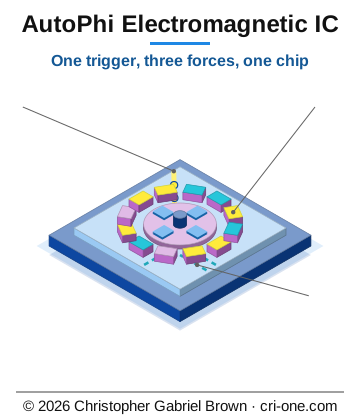
Asset valuation: $4,400,000,000. Design Author: Christopher Gabriel Brown Address: Lawrenceville, Georgia Email: christopher@cri-one.com Email: christopher@cri-one.com Date: March 2026 31-autophi-electromagnetic-ic = the Electromagnetic IC concept: a quantum-electromagn
A chip should not have to choose between thinking and moving. The AutoPhi Electromagnetic IC is a single die where light, magnetism and electron flow are first-class parts of the computation: photons carry the instructions, magnetic fields switch, hold state and make torque, and electrons do the arithmetic. One trigger, three forces, one chip. Add the quantum strand and it becomes the Quantum Electromagnetic IC, QEM-IC: a processor, a motor and a quantum computer on one die.
The instruction set is the Photon Chromosome: wavelength is the opcode, polarization the operand, path the address, intensity the magnitude. A program is a sequence of coloured, polarised, routed laser pulses; the compiler emits a photon schedule, and the light is the instruction. The seed IC is a 20 mm by 20 mm die at 130 nm with 1,290 voxels, 1.29 TFLOPS of FP32 compute, 10.32 INT8 TOPS, 16 qubits and 100 neuromorphic neurons, with 5 nm as the target node. Each voxel carries 192 bits of configuration DNA, so the grid can be reprogrammed and evolved, and Peltier-based electromagnetic cooling runs 32 thermal zones.
Because the same die generates torque, the package lays out ten product families and 10,000 IC arrangements, from ring arrays that turn like a motor to linear strips, precision stages, propulsion and surgical tools, along with the complete Optical Quantum Battery subsystem configured for power export. It is for engineering buyers in motors, robotics, aerospace and precision instruments, at maturity level 4, tape-out and mass-manufacturable, with thirteen-plus USPTO applications filed; the IP stays with the inventor.
Description
Patent Portfolio: 13+ USPTO patent applications filed (17/454,807; 17/454,808; 17/687,656; 18/219,732; 18/370,908; 18/460,559; 18/650,137; 16/948,862; 29/788,287; 29/807,411; 29/839,062; 29/892,202; 63/552,008) plus additional filings 19/031,884; 19/177,547; 19/401,431; 19/403,339; 19/540,453. Grounded in 3,500+ inventions (copyright 2017, Christopher Gabriel Brown).
Maturity Level: 4 — Tape-out / Mass-Manufacturable
The AutoPhi Electromagnetic IC is a quantum-electromagnetic integrated circuit that computes with light, magnetism, and electron flow as one unified electromagnetic system. The chip is not classical silicon alone — it is an electromagnetic machine where photons carry instructions, magnetic fields move and switch, and electrons execute arithmetic. One trigger, three forces, one chip.
The design package delivers an electromagnetic IC architecture where photonic (light), magnetic (field/torque), and electric (electron) phenomena are first-class computational elements. The Photon Chromosome — encoding (wavelength, polarization, path, intensity) as (opcode, operand, address, magnitude) — becomes the instruction set carried by light through the chip. Electromagnetic switching replaces or augments transistor gates. And when all three forces are harnessed together, the chip does what no classical IC can do alone: it computes and generates torque on the same die.
The upgraded designation is the Quantum Electromagnetic IC (QEM-IC) — a single-die system integrating photonic, magnetic, electric, and quantum computation with actuation. A processor, motor, and quantum computer on one chip.
Photonic Photon (light) Instruction delivery, data routing, clock Wavelength = opcode, polarization = operand, path = address, intensity = magnitude
Magnetic Magnetic field Switching, torque, state retention Field direction = state, coil current = control, torque = force
Electric Electron Arithmetic, memory, classical logic Voltage = value, current = flow, charge = storage
Quantum Qubit Quantum compute, entanglement, QEC Gate type, qubit mask, phase/angle, classical control
A program is a sequence of coloured, polarised, routed laser pulses. The compiler outputs a photon schedule. The chip executes it at the speed of light. No separate instruction memory fetch is needed — the light is the instruction.
MEMORY Data storage — classical (charge/magnetic) and quantum (qubit state) Electric + Quantum
Each voxel carries three 64-bit chromosomes (Photon, Electron, Atomic) — 192 bits of configuration DNA per voxel — allowing the grid to be programmed, reprogrammed, and evolved.
1 LED Power Recycling 90% conversion efficiency; 42% net power reduction; on-die GaN micro-LED / micro-PV pairs; photon capture 405–450 nm
2 Vertical Threading 12,000 TSVs/mm²; 125 TB/s aggregate bandwidth; sub-10 μm via pitch
3 Chiplet Stacking Up to 500 layers; 18 chiplets per stack; 3D heterogeneous integration; hybrid Cu-Cu / dielectric bonding
4 Nanophotonic Data Flow 1,400 TB/s aggregate bandwidth; 2,800 photonic channels; zero EMI susceptibility
5 Quantum Error Correction 99.998% gate fidelity; 1,400 logical qubits; surface-code QEC
6 Electromagnetic Cooling (Peltier) 97% cooling efficiency; 32 independently controlled thermal zones; Bi 2 Te 3 thermoelectric; photon-chromosome adaptive control
7 Quantum Battery Layers 20 battery layers; 1,500 Wh total capacity; 75 MW burst discharge; quantum-state energy storage
8 Quantum-Classical Hybrid Interface Seamless qubit-to-electron bridge; measurement + feed-forward; sub-clock-cycle latency; zero protocol overhead
9 Neuromorphic AI Engine 1,000,000+ spiking neurons per system die; 3,200,000,000 neurons at card level; event-driven; near-zero idle power
Total addressable market across all 10 families: $425B+ annually .
Optical Quantum Battery Subsystem
The package includes the complete Optical Quantum Battery system — the power subsystem of the AutoPhi architecture configured for power export. The system generates more power than it consumes, exporting the surplus. LED nano-charging drives quantum dot arrays, EM cooling reclaims waste heat, and the quantum execution unit manages quantum state operations in the energy cycle. The closed loop recycles energy at 84–98% overall efficiency (verified from AutoPhi Generation 43/44 data).
Optical Input Photon charging Grating couplers, silicon waveguides, photonic crystal cavities; integrated LED nano-arrays at 10 6 –10 12 LEDs/cm²
Magnetic Field Control Quantum state manipulation 0.1–10 T fields; Zeeman effect; Landau level quantisation
Electromagnetic Cooling Active thermal management Peltier effect + adiabatic demagnetisation; extends coherence times 10–75×
Quantum Storage Energy storage in quantum states Silicon quantum dot arrays at 10 6 –10 12 dots/cm²; 0.05–0.5 eV per dot
Electrical Extraction Quantum-to-electrical conversion P-N junctions + quantum tunnelling; 85–95% efficiency; gate electrode control
Control & Interface Intelligent management CMOS electronics; temperature control; thermal management
The package also includes the Magnetic Motion Generator — a spherical battery array system with optimised connections and integrated electromagnetic induction. Patent application 19/401,431 (filed November 26, 2025), titled "Magnetic Motion Generator with Optimized Sphere Battery Configuration and Integrated Electromagnetic Induction System."
F = B × I × L × N × k — where F = magnetic force (N), B = field strength (T), I = current (A), L = conductor length (m), N = number of batteries, k = efficiency factor (0.1).
Torque Formula (IC-Level)
Torque = N × I × A × B — where N = coil turns per IC, I = current (proportional to photon intensity), A = coil area, B = field strength.
System η = η base × (1 − R conn × 10) × (1 + R opt × 0.1) System efficiency (η base = 0.85)
RTL Source (Verilog) led_power_recycling_circuit.v 16,137 bytes — top-level power IC; 6 retained AutoPhi technologies; 16-instruction quantum gate set; 32 harvester zones; 32 thermal zones
Testbench led_power_recycling_circuit_tb.v 7,524 bytes — verification test vectors
Synthesised Netlist (Verilog) led_power_recycling_synthesized.v 134,537 bytes — Yosys-synthesised gate-level netlist
Synthesised Netlist (JSON) led_power_recycling_synthesized.json 1,357,276 bytes — machine-readable netlist
GDSII Generator GDSII_GENERATOR_STANDALONE_CD.zip 56,083 bytes — standalone generator for mask-ready output
Foundry handoff package version 1.0 (2025-11-28). Target technology: generic CMOS. Efficiency target: 84–98%.
- LED_POWER_RECYCLING_SYNTHESIS.py — synthesis driver for LED power recycling circuit
- LED_POWER_RECYCLING_VERIFICATION.py — verification and simulation framework
- battery_array_calculator.py — array configuration calculator
- optical_quantum_battery_calculator.py — photon energy, quantum charging time, Zeeman splitting, silicon quantum dot, and electrical extraction calculations
- alternative_outcome_scenarios.py — performance modelling under different scenarios
- add_momentum_cogs.py — cost-of-goods-sold and momentum analysis
- bytedesign.py — byte-level IC design tool
Also included: 260 HDL files (Verilog modules), 305 TCL scripts (EDA flow), 126 SDC constraint files, 108 SDF timing files, and 72 Liberty timing library files from OpenLane place-and-route runs.
- ELECTROMAGNETIC_IC_CONCEPT.md — core concept: what an electromagnetic IC is, how it differs from classical silicon, the three forces unified
- LIGHT_TRIGGER_IC.md — single-photon initiation, coloured laser semiconductor, cold light microchip, digital optics by coloured micro mirrors
- PHOTON_CHROMOSOME_FOR_IC.md — wavelength-opcode, polarisation-operand, path-address, intensity-magnitude encoding and decoding
- DEPOSITION_ELECTROMAGNETIC_IC.md — definitive deposition: what this IC is, what it holds, where it points
- PELTIER_ELECTROMAGNETIC_COOLING.md — on-die Peltier cooling via photon chromosome, plate ballast as heatsink, self-cooling torque arrays
- TORQUE_FROM_IC.md — how the IC generates torque; array shapes (ring, strip, grid, spiral, opposing, stacked); speed and movement control
- ELECTROMAGNETIC_IP_INDEX.md — index of electromagnetic inventions from the 3,500+ IP catalogue across 7 categories
- QUANTUM_ELECTROMAGNETIC_IC_MASTER.md — definitive QEM-IC document unifying Projects 18 and 31; four strands; DNA-style voxel encoding
- NINE_TECHNOLOGIES_INTEGRATED.md — how all 9 AutoPhi Future technologies fold into the EM-IC die across 10 product families
- PERFORMANCE_SPECIFICATIONS.md — all 10 product family performance tables; industry comparison; system and card level specs
- VALUATION.md — per-IC-arrangement valuation; portfolio value by product family; comparable technology values
- 1000_IC_ARRANGEMENTS_PLATE_BALLAST.md — 1,000 plate ballast material and geometry configurations
- QUANTUM_PHOTON_CHROMOSOME_V2.md — upgraded photon chromosome for quantum operations
- Patent specification and filing documents — formal patent specification, patent drawings description, patent filing confirmation, bill of materials, assembly guide, user manual, white paper, commercialisation checklist
OpenLane EDA Runs
Multiple completed OpenLane2 place-and-route runs are included with full output directories, covering synthesis reports, timing analysis across process corners (nom_ff_n40C_1v95, nom_ss_100C_1v60, nom_tt_025C_1v80), latch reports, and SDF timing data. Seed voxel design ( autophi_voxel_blank.v ) with configuration for the SkyWater 130 nm PDK is provided.
Blu-ray Distribution Infrastructure
Build scripts and templates for Blu-ray disc mastering are included ( build_bluray_foundry.py , build_bluray_foundry.bat , build_to_24_bluray_test.bat ), along with disc README templates, manifest generators, and directory structure specifications.
Backed by a broader portfolio of 30+ additional historical filings dating from 2012 to the present. The IP itself (patents, inventions, and copyright) is not for sale — what ships is the design package, documentation, source code, and EDA output.
Related AutoPhi Projects Referenced
- Project 18 (AutoPhi Future) — voxel-as-cell, photon chromosomes, metal tree; 9 breakthrough technologies
- Project 19 (AutoPhi Miracle) — seed voxel flow and Blu-ray foundry packages
- Project 02 (AutoPhi Modern) — product consolidation
- Project 27 (Scale Ultimate) — voxel die building; electromagnetic voxel types for grid
- Project 28 (Complete Unit) — single-chip symmetry; unified electromagnetic compute
- Project 01 (Autocar) , 03 (Electric Jet) , 04 (War Satellite) , 14 (Semiconductor Material) — coinciding technology projects
This package ships on a single Blu-ray disc, posted to the delivery address on your order. The archive on the disc is AES-256 encrypted; the passphrase is sent separately, by email, once the disc is despatched — so the disc alone is of no use to anyone who intercepts it.
Discs are despatched by tracked, signed-for post. Allow 5 business days for mastering and verification before despatch.
© 2026 Christopher Gabriel Brown. All rights reserved.
Photo
Footnotes
- Product number 8479.
- Family: autophi core.
- Purchase: When you buy, you buy the use of that blueprint only.