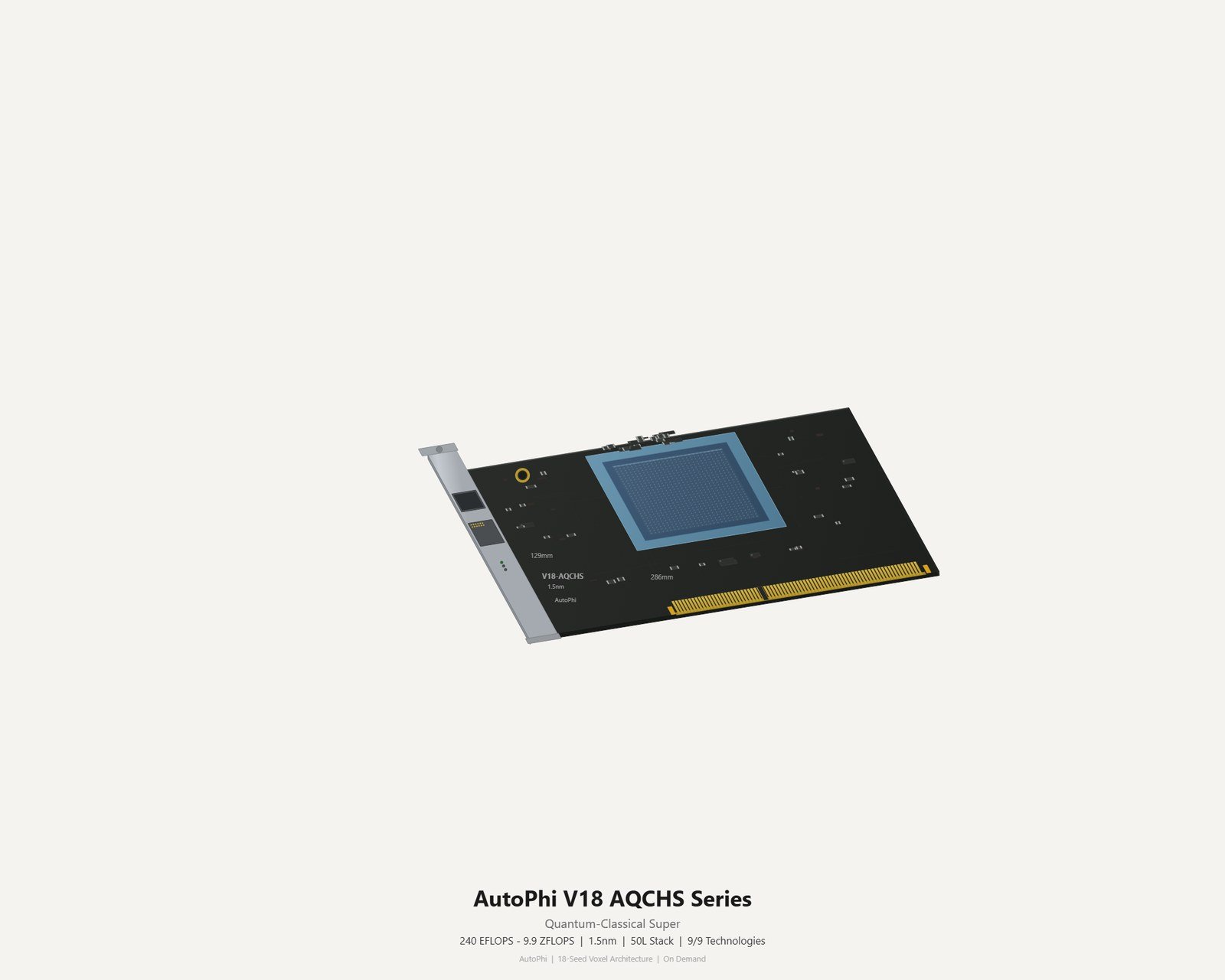
30-autophi-on-demand-three

$99,999,999.00
In stock
SKU
2059
Asset valuation: $12,000,000,000. Master index of all projects: PROJECTSINDEX. Last edited: 2026-05-02 Status: Largest aggregation in the catalog — 68,000+ files of EDA, RTL, reports, and source projects Maturity (per PACKAGEARCHITECTURE.md): L4 (Tape-out / Mass-Manufacturable) — full physical-desig

Valuation

Generous asset valuation: $12,000,000,000. The listed price is the platform maximum; acquisition at valuation is handled by direct enquiry.

AutoPhi On-Demand Three (V20 Epiphany)

AutoPhi On-Demand Three (V20 Epiphany)

Master index of all projects: PROJECTS_INDEX.

Last edited: 2026-05-02

Status: Largest aggregation in the catalog — 68,000+ files of EDA, RTL, reports, and source projects

Maturity (per PACKAGE_ARCHITECTURE.md): L4 (Tape-out / Mass-Manufacturable) — full physical-design flow output across multiple bundled chips

Inventor: Christopher Gabriel Brown

Contact: crioneaka@outlook.com

What This Is

The third-generation AutoPhi On-Demand package, code-named V20 Epiphany. This is the largest aggregation in the catalog: it bundles AutoPhi Future, the Zetta-Flops bundle, the Parts Future 1,000-part catalog, AutoPhi On-Demand Two, the Mathematical Depositions record, and the V20 Epiphany subtree itself.

File-type signal across all subfolders:

  • 14,816 JSON manifests — generated configurations
  • 9,979 Verilog .v files — RTL
  • 7,072 EDA reports (.rpt)
  • 2,219 TCL scripts — synthesis / PnR flow
  • 2,016 log files — flow execution records
  • 1,545 DEF files — physical placement
  • 13,097 Markdown documents

That's a real production-scale ASIC physical-design output, not a documentation set.

What's in this folder

USPTO Patent Status

Coverage flows through the bundled sub-projects. See:

  • 18/370,908 — AutoPhi: Quantum battery integration & electromagnetic propulsion IC
  • 19/540,453 — Integrated Technology Portfolio (umbrella)
  • 19/177,547 — (additional applications referenced in subfolder content)
  • 19/445,644, 19/449,352, 19/555,525 — referenced in deposition subtree

See canonical ../PATENT_PORTFOLIO.md.

Why "On-Demand Three"

The "on-demand" framing: the AutoPhi family produces buildable chip variants on demand from the seed-matrix calculator. This third-generation bundle is the most complete on-demand stack assembled so far, with the V20 Epiphany subtree representing the latest design-iteration output.

Buyer pitch

A buyer who acquires this bundle gets the entire AutoPhi production pipeline as it stands — from the architecture (18) through the parts catalog (24) through the on-demand fabrication flow (this folder). For an acquirer who wants the AutoPhi line as a whole rather than as separate projects, this is the deliverable.

Contact

Christopher Gabriel Brown

1341 Wellington Cove, Lawrenceville, GA 30043-5255, USA

Email:: crioneaka@outlook.com

Email: crioneaka@outlook.com

30 - Autophi On Demand Three

30 - Autophi On Demand Three

> Internal playbook -- not for public eyes.

> Last scaffolded: 2026-05-11

1. Identity

2. One-liner

> The third-generation AutoPhi On-Demand package, code-named V20 Epiphany. This is the largest aggregation in the catalog: it bundles AutoPhi Future, the Zetta-Flops bundle, the Parts Future 1,000-part catalog, AutoPhi On-Demand Two, the Mathematical Depositions record, and the V20 Epiphany subtree itself.

*(Edit this once. It becomes the single sentence you reuse in replies,

on the catalog page, and at the top of any future write-up.)*

3. What's actually in the folder

  • 18-autophi-future/ (24 entries)
  • 23-zetta-flops/ (7 entries)
  • 24-parts-future/ (9 entries)
  • 26-autophi-on-demand-two/ (28 entries)
  • 27-mathmatical-depositions/ (14 entries)
  • 30-v20-epiphany/ (20 entries)
  • sales-pitches/ (3 entries)
  • CHANGELOG.md
  • CONTACT_INFO.txt
  • MANIFEST.json
  • PLAYBOOK.md
  • README.md

4. README at a glance

Top sections found in README.md:

  • What This Is
  • What's in this folder
  • USPTO Patent Status
  • Why "On-Demand Three"
  • Buyer pitch
  • Contact

(Full text: D:\special\30-autophi-on-demand-three\README.md)

5. Hook lines (pick the one that fits the reader)

  • (default) The third-generation AutoPhi On-Demand package, code-named V20 Epiphany. This is the largest aggregation in the catalog: it bundles AutoPhi Future, the Zetta-Flops bundle, the Parts Future 1,000-part catalog, AutoPhi On-Demand Two, the Mathematical Depositions record, and the V20 Epiphany subtree itself.
  • (skeptic / 'what is this really?') TODO -- one honest sentence about

what's solved here that wasn't before.

  • (buyer's-finance angle) TODO -- pricing/risk framing (zero-upfront,

4-step credit-forward, revenue share if applicable).

  • (competitor question) TODO -- the one comparable product or approach

this most often gets confused with, and the one-sentence delta.

6. Reply patterns

When inbound lands, fall back to the cross-portfolio patterns in

D:\special\manager\emails\PLAYBOOK_software_for_data.md (sections 5

and 8 are reusable across every project) and adapt the specifics.

The product-specific bits to fill in here (TODO):

  • One objection unique to this project + the honest answer
  • One pricing anchor unique to this project
  • One reason to walk away that's worth saying out loud

7. Status & gaps

  • Vault: EMPTY -- no archive (must create before 'Send Vault' works)
  • Catalog presence: TODO -- search cri-one.com/store for this product

and paste the live URL here.

  • PoF readiness: TODO -- is there a working demo / sample / proof a

prospect could run in under an hour?

  • NDA-gated technical brief: TODO -- written? not written? where?
  • Critical missing piece before this can close: TODO.

8. Quick links

  • Folder: D:\special\30-autophi-on-demand-three\
  • Catalog (cri-one.com): TODO
  • Related projects in portfolio: TODO (cross-reference here once mapped)

*This scaffold was auto-generated. Replace TODOs as you learn each project

better. Search across all playbooks: grep -ri "<term>" D:\special\\PLAYBOOK.md

Prior Art — LED Power Recycling (this project)

Prior Art — LED Power Recycling (this project)

Status: Research only — third-party patents that overlap with this project's claims. NOT owned by Christopher Gabriel Brown.

Canonical doc: ../PRIOR_ART_LED_RECYCLING_QD_BATTERY.md

Scanned: 2026-05-11

Why this file is here

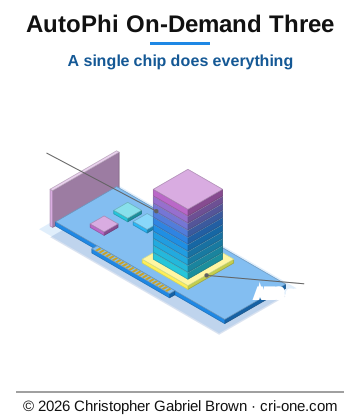
30-autophi-on-demand-three packages the AutoPhi processor with LED Power Recycling explicitly listed in docs/NINE_TECHNOLOGIES.md and credited as "Patent 1026 — LED Recycle" in handoff/legal/PATENT_REFERENCES.md. Public prior art covering the same mechanism is below.
Most relevant prior art for this project

Action item

handoff/legal/PATENT_REFERENCES.md currently lists "Patent 1026 — LED Recycle" as an owned reference. Before that file is sent to a buyer's lawyer, append a "Public prior-art context" section citing the four patents above so the buyer's due-diligence reviewer sees the prior-art landscape upfront. Otherwise their attorney will find these in their own search and use it as a discount lever.

Defensible angle

LED-recycle alone is prior art. AutoPhi's defensible novelty is the nine-element integrated processor. Keep the LED-recycle slice as one of nine bullet points; never as the central claim of an independent claim.

7T Seed — The Rest as a Service

7T Seed — The Rest as a Service

Project 18 — AutoPhi Future

Plan for delivering the 7T seed capability as a service: any size chip, any kind of processing, any zettaflop scale for 7T.

1. What the Service Is

The 7T seed is not a one-time product. It is a service that delivers:

The “rest” — everything beyond the core seed, formulas, and one vessel — is planned as a service: ongoing support, seed versioning, foundry packaging, Blu-ray harvests, and roadmap (quantum/photonic executable seed).

2. Service Tiers

Tier 1 — Seed and Matrix (in the repo today)

  • Seed matrix formula table (CSV/JSON)
  • Template and example; any size; truncated OK
  • One vessel (18) with executable seed path and Blu-ray build

Tier 2 — Build and Harvest as a Service

  • On-demand seeds: customer supplies scenario_id, node_nm, H_mm, W_mm, a_v, f_v, power, AES → we deliver seed + computed C, ρ, P_per_dollar, P_per_watt
  • Foundry packages: TSMC, Samsung, Intel, SkyWater, GlobalFoundries — generated and updated per seed version
  • 25GB Blu-ray harvest: full project folder, standards, COGS, Seeds — distributable per release

Tier 3 — Processing and Scale as a Service

  • Any kind of processing: classical (today), hybrid, photonic, quantum (roadmap) — delivered as seed series and voxel options
  • Zettaflop targeting: ratio-driven; envelope and power/cooling specified; outcome (C, performance per exchange) as contract deliverable
  • Version the seed; version the chips: semantic versioning of seed → reproducible builds and harvests

Tier 4 — Roadmap and Support

  • Path to quantum and photonic executable seed (beyond classical voxel)
  • Clarity docs: how chips are made, quantum vs classical, no scam
  • Support for sell-and-distribute: pitch, COGS, repo structure, build script

3. Deliverables (Rest as a Service)

4. Pricing and 7T

  • The 7T ask is the scale that matches the capability: any size chip, any processing, any zettaflop from the seed.
  • Service revenue can be structured as:
  • One-time 7T (or equivalent) for the vessel + perpetual right to the service stack, or
  • Lower upfront + ongoing service fees for Tier 2–4 (builds, harvests, roadmap, support).

5. Summary

  • 50 WordPress articles seed the message: 7T seed, any size chip, any processing, any zettaflop for 7T.
  • The rest is planned as a service: seed matrix in the open, builds and harvests on demand, foundry packages, Blu-ray, processing tiers, zettaflop targeting, versioning, roadmap, and support.

Project 18 — AutoPhi Future. One vessel. 7T seed. The rest as a service.

7T Seed — 50 Articles for WordPress Import

7T Seed — 50 Articles for WordPress Import

Files

Import steps

1. In WordPress: Tools → Import.

2. Choose WordPress (install “WordPress Importer” if prompted).

3. Upload 7t-seed-50-articles-wordpress-import.xml.

4. Assign author to an existing user (e.g. admin).

5. Run the importer.

Article themes (50)

The 50 posts cover the 7T seed for:

  • Any size chip — seed matrix, envelope (H×W, node_nm), formulas in the open, template CSV/JSON.
  • Any kind of processing — classical, hybrid, photonic, quantum; voxel types; nine technology elements.
  • Any zettaflop for 7T — ratio, miracle we call calculation, performance per dollar/watt, zettaflop scale as a service.
  • Rest as a service — Tier 1–4 (seed/matrix, build/harvest, processing/versioning, roadmap/support); foundry packages; Blu-ray harvest; roadmap.

Base URL in the XML is https://7t-seed.example.com. After import, set your site URL in WordPress; slugs and content are unchanged.

Regenerating the import

Edit scripts/generate_7t_seed_wordpress_import.py (e.g. change ARTICLES or base_url), then:

python scripts/generate_7t_seed_wordpress_import.py

Output: 7t-seed-50-articles-wordpress-import.xml.

Project 19 — AutoPhi Miracle

Project 19 — AutoPhi Miracle

Master index of all projects: PROJECTS_INDEX.

19-autophi-miracle. Re-engineered AutoPhi Future: voxel-as-cell, photon chromosomes, one seed many harvests, Blu-ray foundry packages. Same vision as 18; one project, one path, everything good that 18 could have been. The outcome to be found — that is the miracle we call calculation.

New here? See docs/START_HERE.md for quick links (pitch, what we sell, seed matrix, sell and distribute). No breakage — same files and paths as before.

What 19 Is

  • 19-autophi-miracle = the Future concept and roadmap repo: voxel-as-cell, photon chromosomes, propagation of voxel plans and paths, options to treat the full system as one quantum-classical whole.
  • Mission: Find the right ratio in voxel-to-nm dimensions — how the voxel scales with process, how much function per area at each node. One seed, many harvests; down in scale, up in performance; the ratio is what we are here to discover and choose.
  • What we sell: The ratio of instruction set (from size) to calculation and performance per exchange. See docs/PRODUCT_RATIO.md.
  • It extends 02 (AutoPhi Modern), 27 (Scale Ultimate), and 28 (Complete Unit) with a consistent vocabulary and next-step options for RTL, tooling, and simulation.
  • Why 19: See docs/REENGINEERING_19.md for the re-engineering rationale and what 19 improves over 18.

Contents

Relation to Other Projects

  • 02 (AutoPhi Modern): Product consolidation; 19 is the future vision that informs how the voxel and paths evolve.
  • 27 (Scale Ultimate): Voxel die building, hybrid/light/quantum cores. 19’s cell and chromosome concepts apply to 27’s voxel grid. Seed RTL (e.g. autophi_voxel_blank) comes from 27.
  • 28 (Complete Unit): Single-chip, CPU–accelerator symmetry. 19’s whole-quantum and path options inform 28.
  • 24 (Scale): Foundry packages; 19’s build script sources 24 by default for Blu-ray content.

Status

Concept, documentation, seed voxel flow, and Blu-ray build. Run the seed flow from 19 to populate seeds/; run the build script from 19 to produce a Blu-ray-ready package that includes 19’s Performance/COGS and Seeds.

Sell and distribute: See docs/SELL_AND_DISTRIBUTE.md for readiness checklist (product, pitch, COGS, distribution channels, optional LICENSE/terms).

Project path: (this repository's root directory)

Pitch (HTML)

Open pitch/index.html or pitch/miracle-calculation.html in a browser.

Three Production-Ready Technology Projects from Christopher Gabriel Brown

Three Production-Ready Technology Projects from Christopher Gabriel Brown

Three distinct technology projects—computing, nuclear recycling, and chemical synthesis—are available as complete design packages with documentation, software, and (where applicable) foundry-ready deliverables. Each aligns with products offered at Christopher Gabriel Brown’s full product portfolio.

1. AutoPhi Scale Series — Original Light + Quantum CPU

The AutoPhi Scale Series is an original CPU architecture (not derived from RISC-V, ARM, or x86) built around a “1 Light Trigger” concept and color mathematics (patents 29/839,062 and 3561 2876). It combines a Light CPU (color-coded ops: Red=ADD, Blue=SUB, Green=MUL, Yellow=DIV) with a Quantum CPU (16-instruction creative set) in a unified hybrid design.

Highlights: 877 PFLOPS to 8.594 EFLOPS (standalone), 64+ qubits, 95%+ quantum fidelity, full integration with AutoPhi accelerators (REV-1, REV-4, REV-5, MicroSDXC, Set of Five). The package includes RTL, synthesis (Yosys), OpenLANE P&amp;R configs (14nm/7nm), testbenches, timing/design constraints, manufacturing flow docs, and foundry handoff structure (GDSII/LEF/DEF). Ideal for semiconductor partners and high-performance/quantum computing programs.

Explore the full range of AutoPhi and accelerator offerings: All Products.

2. Small Microwave Nuclear Recycler

A compact nuclear waste recycling system for research, pilot projects, and small-scale operations. It uses microwave-enhanced processing in a single chamber (e.g., 1 m × 1 m × 1.5 m), 5–10 kW microwave power, 10–50 kg batches, and basic energy recovery (1–2 kW electrical) plus gas and water treatment.

Highlights: Lower cost and faster deployment than full-scale facilities; includes system overview, technical specs, operations manual, safety guide, and control/safety monitoring software (controller.py, safety_monitor.py). Suited to R&amp;D, education, and proof-of-concept sites.

See the full nuclear recycling lineup (including full-scale systems): All Products.

3. Chemical Cooker (Serum Build Platform)

The Chemical Cooker is a chemistry/serum build platform with a software-first focus: subscription and serial-key validation, “lite Alchemy” data (elements, methods, probabilities), recipe builder, and G-code generation for automated synthesis. Hardware build (BOM, assembly, wiring, calibration) is fully documented in blueprints for when you’re ready to build.

Highlights: G-code interpreter and controller (dry-run or hardware), drug database integration (e.g., PubChem), aspirin and other recipe generation, simple web UI for G-code run, and a legal foundation doc for patents and compliance. Use it to design and output recipes without hardware; add the physical cooker later.

Browse chemical, medical, and data products: All Products.

Summary

Each project is documented, implementable, and backed by the broader portfolio of technologies—from quantum processors and accelerators to full-scale recycling and medical research—available at Christopher Gabriel Brown — All Products.

Project 19 — AutoPhi Miracle

Project 19 — AutoPhi Miracle

19-autophi-miracle. Re-engineered AutoPhi Future: voxel-as-cell, photon chromosomes, one seed many harvests, Blu-ray foundry packages. Same vision as 18; one project, one path, everything good that 18 could have been. The outcome to be found — that is the miracle we call calculation.

New here? See docs/START_HERE.md for quick links (pitch, what we sell, seed matrix, sell and distribute). No breakage — same files and paths as before.

What 19 Is

  • 19-autophi-miracle = the Future concept and roadmap repo: voxel-as-cell, photon chromosomes, propagation of voxel plans and paths, options to treat the full system as one quantum-classical whole.
  • Mission: Find the right ratio in voxel-to-nm dimensions — how the voxel scales with process, how much function per area at each node. One seed, many harvests; down in scale, up in performance; the ratio is what we are here to discover and choose.
  • What we sell: The ratio of instruction set (from size) to calculation and performance per exchange. See docs/PRODUCT_RATIO.md.
  • It extends 02 (AutoPhi Modern), 27 (Scale Ultimate), and 28 (Complete Unit) with a consistent vocabulary and next-step options for RTL, tooling, and simulation.
  • Why 19: See docs/REENGINEERING_19.md for the re-engineering rationale and what 19 improves over 18.

Contents

Relation to Other Projects

  • 02 (AutoPhi Modern): Product consolidation; 19 is the future vision that informs how the voxel and paths evolve.
  • 27 (Scale Ultimate): Voxel die building, hybrid/light/quantum cores. 19’s cell and chromosome concepts apply to 27’s voxel grid. Seed RTL (e.g. autophi_voxel_blank) comes from 27.
  • 28 (Complete Unit): Single-chip, CPU–accelerator symmetry. 19’s whole-quantum and path options inform 28.
  • 24 (Scale): Foundry packages; 19’s build script sources 24 by default for Blu-ray content.

Status

Concept, documentation, seed voxel flow, and Blu-ray build. Run the seed flow from 19 to populate seeds/; run the build script from 19 to produce a Blu-ray-ready package that includes 19’s Performance/COGS and Seeds.

Sell and distribute: See docs/SELL_AND_DISTRIBUTE.md for readiness checklist (product, pitch, COGS, distribution channels, optional LICENSE/terms).

Project path: C:\work\19-autophi-miracle

Pitch (HTML)

Open pitch/index.html or pitch/miracle-calculation.html in a browser.

Prepared to Sell and Distribute

Prepared to Sell and Distribute

Project 19 — AutoPhi Miracle

Checklist for selling and distributing the product (the ratio of instruction set to calculation and performance per exchange) and the repo.

In short: Yes — we are prepared. Product, pitch, and COGS are in place; repo and Blu-ray build are ready. Add LICENSE or DISTRIBUTION_TERMS when you fix terms. Details below.

What we sell

What we distribute

Checklist before you sell or distribute

One-line answer

Yes — we are prepared to sell and distribute. The repo is standalone, the product (the ratio and the miracle we call calculation) is defined, pitch and COGS are in place, and the Blu-ray build is ready to run. The only optional step is adding LICENSE or DISTRIBUTION_TERMS.txt when you decide the exact terms for redistribution and resale. See docs/DISTRIBUTION_AND_LICENSING.md.

Start Here

Start Here

Project 19 — AutoPhi Miracle

New here? Use these links. Nothing is removed or broken; this page only points you to the right place.

I want to…

Folders

  • docs/ — All written docs (product, seed matrix, pitch, licensing, RAG, etc.).
  • pitch/ — HTML pitch pages and images; open pitch/index.html in a browser.
  • seeds/ — Seed matrix template and example; put OpenLANE2 GDS/LEF here when you have them.
  • rag/ — Standalone RAG data (CSV, portfolio, 18-docs); see rag/README.md.
  • scripts/ — Build and seed flow (Blu-ray, OpenLANE2); see README.md Contents for each.

You can always return to README.md for the full overview.

The Foundation Is Laid: Our First Physical Seed Voxel

The Foundation Is Laid: Our First Physical Seed Voxel

In Project 18 — AutoPhi Future we talk about growing chips from a seed: one canonical blueprint from which every build, every foundry run, every tier is grown. Until now the seed was specs, RTL, and manifests. Now we have the first physical seed: a voxel built with OpenLANE2, real GDS and LEF, sitting in the repo and ready to be copied into every build.

That run is complete. The foundation is made.

What the seed voxel is

The seed voxel is a single block — in this case autophi_voxel_blank from our scale-ultimate RTL: a minimal footprint with the same interface as our hybrid voxels so it can slot into the grid. No logic inside; just the physical and electrical template. We run it through the full OpenLANE2 flow: synthesis, place and route, signoff, on SkyWater 130nm (volare). Out come GDSII and LEF. Those files go into 18-autophi-future/seeds/. Our build script copies that folder into every build as Seeds/ when it exists. So every package now has a real seed to grow from.

How we got there

We run the flow from WSL with a single script: run_seed_openlane_wsl.sh. It copies the voxel RTL and a minimal OpenLANE2 config into a design directory, runs OpenLANE2 (via Nix, Docker, or a local venv), then copies the final GDS and LEF into seeds/. We hit the usual bumps: the OpenLANE2 Nix flake runs Yosys tests in the build and they fail in the sandbox, so we apply a small patch to disable the check phase and the Nix build succeeds. The design has hundreds of IO pins, so we set the die large enough for them. The voxel is meant to be used inside a bigger design, so in a standalone run many pins are intentionally disconnected; we set ERROR_ON_DISCONNECTED_PINS: false so the flow completes and we get the footprint. Once that was in place, the run went through to completion.

What you have when it's done

When the script finishes successfully you have:

  • Seed outputs: 18-autophi-future/seeds/ — GDSII and LEF for the seed voxel.
  • Full run: scripts/openlane_seed_design/runs/RUN_.../final/ — the same GDS/LEF plus all intermediate artifacts.

The build script already knows to include seeds/ in every build. So the package has a real physical seed: one voxel, one process node, one proof that the pipeline from RTL to GDS works.

Why it matters

One definition, many harvests. The seed is the unit. We version the seed; we version the chips. From here we can grow: different foundries, different tiers, different nodes, but all from the same canonical voxel and the same flow. The first run is done. The foundation is laid.

Project 18 — AutoPhi Future. Seed voxel built with OpenLANE2; GDS and LEF in seeds/; the build adds it as Seeds/. One seed, many harvests.

View AutoPhi FUTURE and the full product portfolio at Cri-One.com

Project 19 — AutoPhi Future Two (third version)

Project 19 — AutoPhi Future Two (third version)

This is 19. The third version: 20-autophi-future-three now contains all of 19-autophi-future-two. This repo is the canonical Future — renamed as 19.

Re-engineered AutoPhi Future: voxel-as-cell, photon chromosomes, one seed many harvests, Blu-ray foundry packages. Same vision as 18; one project, one path, everything good that 18 could have been.

What 19 Is

  • 19-autophi-future-two = the Future concept and roadmap repo: voxel-as-cell, photon chromosomes, propagation of voxel plans and paths, options to treat the full system as one quantum-classical whole.
  • Mission: Find the right ratio in voxel-to-nm dimensions — how the voxel scales with process, how much function per area at each node. One seed, many harvests; down in scale, up in performance; the ratio is what we are here to discover and choose.
  • It extends 02 (AutoPhi Modern), 27 (Scale Ultimate), and 28 (Complete Unit) with a consistent vocabulary and next-step options for RTL, tooling, and simulation.
  • Why 19: See docs/REENGINEERING_19.md for the re-engineering rationale and what 19 improves over 18.

Contents

Relation to Other Projects

  • 02 (AutoPhi Modern): Product consolidation; 19 is the future vision that informs how the voxel and paths evolve.
  • 27 (Scale Ultimate): Voxel die building, hybrid/light/quantum cores. 19’s cell and chromosome concepts apply to 27’s voxel grid. Seed RTL (e.g. autophi_voxel_blank) comes from 27.
  • 28 (Complete Unit): Single-chip, CPU–accelerator symmetry. 19’s whole-quantum and path options inform 28.
  • 24 (Scale): Foundry packages; 19’s build script sources 24 by default for Blu-ray content.

Status

Concept, documentation, seed voxel flow, and Blu-ray build. Run the seed flow from 19 to populate seeds/; run the build script from 19 to produce a Blu-ray-ready package that includes 19’s Performance/COGS and Seeds.

Project path: C:\work\20-autophi-future-three (this is 19 — the third version, renamed as 19)

Pitch (HTML)

Open pitch/index.html or pitch/miracle-calculation.html in a browser.

20 — Future Three: Room for Improvement, or at an End?

20 — Future Three: Room for Improvement, or at an End?

Project 19 (third version). This repo is 20-autophi-future-three with all of 19 inside it; we have renamed this third version as 19. The options doc below is preserved from the options phase.

Project 20 — AutoPhi Future Three

This doc captures the options for 20: whether there is room for improvement over 19, or whether the future line is at an end. 20-autophi-future-three did not exist before; the question is what we do from here.

Where things stand

  • 18: Original AutoPhi Future (concept, seed voxel flow, Blu-ray build, pitch).
  • 19: Re-engineered “everything good that 18 could have been” — self-contained paths, creation/growth/strength framing, SEED_GROWTH_3NM_5NM, no “agnostic” language.
  • 20: This project. We are here to consider the options.

So we are not “at an end” because 20 didn’t exist; we are at a choice. Either 19 is the sustained future repo and we stop, or 20 becomes the next iteration with clear improvements.

Room for improvement in 20 (if we continue)

If we add 20 as a real next step, possible improvements over 19 include:

We can pick one, several, or none — and only then decide whether 20 is a full repo or a thin “options” project.

If we do not create 20

Then 19 is the end of the line: the re-engineered future repo, with creation/growth/strength and SEED_GROWTH_3NM_5NM. No 20 unless we later want another deliberate step.

“At an end” = we decide 19 is the final Future repo and stop here.

Next steps (to consider)

1. Decide: Is 19 final, or do we want 20 as a real next iteration?

2. If 20: Which improvements do we want (identity, 3nm/5nm structure, single future home, pitch)?

3. If 20: Do we copy/sync from 19 and then add those improvements, or keep 20 minimal (docs only) until the direction is fixed?

This project (20-autophi-future-three) is the place where we capture that answer and consider the options.

The Miracle We Call Calculation

The Miracle We Call Calculation

Project 19 — AutoPhi Future Two (third version)

ZettaFLOPS in real height and width, inside a normal run of an IC wafer: the right ratio in voxel-to-nm, the envelope, the power and cooling, the AES and COGS. That outcome to be found — the concrete dimensions and the number that put the whole chip, born at once, inside a real run — that is the miracle we call calculation.

We build the whole chip at one birth. We input the result as the instruction. We draw the voxel, plan the pins, grow from root to trunk to branch to leaves. We add light and electrons when needed and transform into quantum. And when we ask: what is the outcome to be found when we need ZettaFLOPS in real height and width? — the finding of that ratio, that envelope, that number, is the miracle we call calculation.

No emojis. Only the naming of the thing: calculation.

RAG for 19 — Retrieval-Augmented Context for Project 19

RAG for 19 — Retrieval-Augmented Context for Project 19

Project 19 — AutoPhi Future Two

This document defines 19's RAG: what to index, in what order, and how to use it when answering questions about 19 (voxel cell, photon chromosomes, seed voxel, Blu-ray foundry packages, one seed many harvests). 19 is the re-engineered Future repo; see docs/REENGINEERING_19.md.

Primary sources (CSV catalog, portfolio) are shared with 18; secondary sources are 19’s docs and README.

1. Primary sources (index first and second)

2. Secondary sources (19 concept and roadmap)

All under C:\work\19-autophi-future-two\:

3. Optional / extended

4. How to use this RAG

1. Index order:

(1) 96-333-fixed.csv.

(2) Yesterday.txt (19 or 18).

(3) All 19-autophi-future-two docs listed in section 2.

(4) Optionally 1 light trigger.txt and 18 docs.

2. When answering about 19:

  • Depositions / catalog / patents: Pull from 96-333-fixed.csv.
  • Portfolio / AQCHS / 142 IC designs: Pull from Yesterday.txt.
  • What 19 is and why it exists: Pull from REENGINEERING_19.md, README.md.
  • Voxel cell, photon chromosomes, seed, whole-quantum: Pull from VOXEL_, SEED_, DEPOSITION_AUTOPHI_FUTURE.md.
  • Seed voxel flow and Blu-ray build: Pull from SEED_VOXEL_OPENLANE2.md, SEED_FOR_GROWING_CHIPS.md.

3. Path note:

Primary #1 is under C:\work\parts\quantum-battery\. Primary #2 and 19’s docs are under C:\work\19-autophi-future-two\.

5. One-line summary

**RAG for 19 = 96-333-fixed.csv (1st) + Yesterday.txt (2nd) + 19-autophi-future-two docs (REENGINEERING_19, VOXEL_, SEED_, DEPOSITION, README); use for depositions, portfolio, 19 identity, seed voxel, and Blu-ray foundry packages.**

Why 19 — Re-engineering AutoPhi Future

Why 19 — Re-engineering AutoPhi Future

Project 19 — AutoPhi Future Two

19 is everything good that 18 could have been: the same vision (voxel-as-cell, photon chromosomes, one seed many harvests, Blu-ray foundry packages) re-engineered into a single, self-contained project with clear identity and paths.

What 19 Is

  • 19-autophi-future-two = the re-engineered AutoPhi Future repo. Same concepts as 18; improved structure and ownership.
  • Self-contained: Scripts, seeds, docs, and pitch live in 19. Paths point to 19. No confusion between “18” and “future.”
  • Can run alongside 18: 18 remains the original; 19 is the iteration. You can keep both or migrate fully to 19.

What We Carried Over (from 18)

What We Improved

  • One project, one path: All references are to 19 (or generic “this repo”). README says Project 19 and C:\work\19-autophi-future-two.
  • Scripts use 19: run_seed_openlane_wsl.sh sets DESIGN_DIR and SEEDS_DIR to 19. Build script uses the repo that contains it (19) for Performance/COGS and seeds.
  • Build script bug fix: Uses copy_seeds and SEEDS_FOLDER consistently (no copy_seed/SEED_FOLDER typo).
  • RAG for 19: docs/RAG_FOR_19.md defines retrieval sources for 19; can still reference 18’s primary sources (96-333-fixed.csv, Yesterday.txt) if desired.
  • Clear narrative: This doc (REENGINEERING_19.md) explains why 19 exists and what it is.

When to Use 19 vs 18

  • Use 19 when you want the re-engineered, self-contained Future repo: one place for seed flow, Blu-ray build, docs, and pitch, with paths that don’t depend on 18.
  • Use 18 when you need the original project path or legacy references (e.g. RAG, external links that point to 18).

Project 19 — AutoPhi Future Two. Everything good that 18 could have been.

Seed for Growing Chips

Seed for Growing Chips

Project 19 — AutoPhi Future Two

Do we need a seed to grow our chips? Yes. The seed is the minimal, canonical spec from which every build (foundry, tier, process node) is grown — one definition, many harvests.

1. What the seed is

In the metal-tree metaphor, a seed = the genetic blueprint. For our chips it is:

So the seed is not one file — it’s the canonical set: chip series (tiers + axes), voxel/tree roles, photon chromosome, nine tech, and performance/COGS summary. From that we grow: foundry packages (TSMC, Samsung, Intel, …), 14nm/7nm builds, 24-full, Blu-ray discs.

2. Why we need it

  • One definition — So every build (this foundry, that tier, that node) comes from the same spec; no drift.
  • Reproducibility — Same seed + same inputs ⇒ same “plant”; version the seed, version the chips.
  • Scaling — Seed defines the unit (one tier, one voxel plan); we grow by repeating or tiling it (segment, stack, volume).

So: we need a seed so we can grow chips consistently from one blueprint.

3. Where the seed lives (today)

  • 19-autophi-future-two (this repo): docs/chip_series_cpu_gpu_dpu.yaml, docs/PERFORMANCE_AND_COGS_SUMMARY.md, VOXEL_PLANT_CHIP_LIGHT_FORM.md, VOXEL_CELL_DNA_AND_PHOTON_CHROMOSOMES.md, PERFORMANCE_POINTS.md (9 elements).
  • 24-autophi-scale: RTL tops, voxel grid, synthesis; 27/28: voxel types, nine technologies. The RTL and voxel plan are the executable part of the seed; the YAML and docs are the declarative part.

Manifest: seeds/SEED.yaml (or seeds/README.md) in this repo that points to these files and lists version/date so “the seed” is one manifest.

4. Seed voxel with OpenLANE2 — add to the package

Should we make a voxel with OpenLANE2 and add that to the package? Yes. The executable seeds = one or more voxels (e.g. autophi_voxel_blank from 27) run through OpenLANE2 to get GDSII/LEF. Put the result in 19-autophi-future-two/seeds/; the Blu-ray build script copies seeds/ into every build as Seeds/ when present. See docs/SEED_VOXEL_OPENLANE2.md for how to build the seed voxel with OpenLANE2 (run from 19).

5. One-line summary

Yes — we need a seed to grow our chips. The seed = chip series (tiers, COGS) + voxel/tree roles + photon chromosome + nine elements + performance/COGS summary. Add executable seeds = one or more voxels built with OpenLANE2 (GDSII/LEF in seeds/); the build script includes them in the package as Seeds/ when present.

19 — Seed Grows into 3nm and 5nm

19 — Seed Grows into 3nm and 5nm

Project 19 — AutoPhi Future Two

19 is different and harder: growth and strength. The seed is one creation — one voxel, one flow, one definition — that grows into every node. 130nm is where we start; 3nm and 5nm are where that same creation grows when we have the foundry PDK and run the same flow. This doc is the path for that growth.

Where we start: 130nm (open)

  • PDK: SkyWater 130nm (sky130), installed via volare at PDK_ROOT (e.g. ~/.volare).
  • Script: scripts/run_seed_openlane_wsl.sh uses that PDK by default. No NDA.
  • Output: GDSII, LEF in 19-autophi-future-two/seeds/.

The seed is created here first. Then it grows.

Growth into 3nm and 5nm: what is required

The creation (RTL, flow, definition) is the same. Growth into 3nm/5nm means: obtain the PDK, set PDK_ROOT, adjust config for that node, run the same flow. Harder — and that is the strength of 19.

When you have a 3nm or 5nm PDK

1. Install the PDK in a directory (e.g. /path/to/tsmc_n5_pdk or per foundry instructions).

2. Point the flow at it:

PDK_ROOT=/path/to/your/3nm_or_5nm_pdk ./run_seed_openlane_wsl.sh

(and ensure OpenLANE2/OpenROAD support that PDK).

3. Adjust config for the node:

The script today writes a config tuned for 130nm (e.g. CLOCK_PERIOD: 10 ns). For 5nm/3nm use a smaller period (e.g. 0.5–1 ns range) and any PDK-specific keys the flow expects. Either:

  • Edit scripts/openlane_seed_design/config.json after the script runs and re-run openlane, or
  • Extend the script to accept a node or PDK name and write a node-specific config when a concrete PDK is in use.

4. Run OpenLANE2 as usual; GDS/LEF go to 19/seeds/ (you may name or copy by node, e.g. seeds/5nm/, for multi-node harvests).

Why 19: creation, growth, strength

  • PERFORMANCE_AND_COGS_SUMMARY.md and DEPOSITION_AUTOPHI_FUTURE.md call out 3nm and $20K AES COGS (e.g. 1B volume, 3nm, 240 dies, 5–10 year path) and $5K paths at advanced nodes.
  • The seed is one creation. It does not sit on a single decision or a “neither.” It grows into 130nm, then into 5nm, then into 3nm — same RTL, same flow concept; only the PDK and node-specific parameters change. 19-autophi-future-two is the place where that growth is different and harder: the future that targets strength at every node.

One-line summary

19 is the future that grows the seed into every node. We start at 130nm (SkyWater, volare). For 3nm or 5nm we obtain the foundry PDK, set PDK_ROOT, adjust CLOCK_PERIOD and node-specific config, and run the same flow. Creation, growth, strength — not a single decision on nothing or neither.


This archive contains 4833 documents; 4815 more beyond this preview. The complete folder ships as the product.

Write Your Own Review
You're reviewing:30-autophi-on-demand-three
Copyright © 2009 Christopher Gabriel Brown